Logic, Sets, and Proofs - Amherst
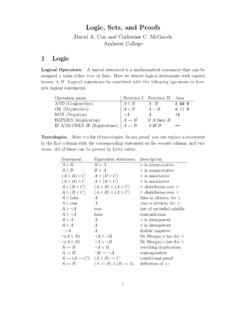
Logic, Sets, and Proofs David A. Cox and Catherine C. McGeoch Amherst College 1 Logic Logical Operators. A logical statement is a mathematical statement that can be ... A set is a collection of objects, which are called elements or members of the set. Two sets are equal when they have the same elements.
Download Logic, Sets, and Proofs - Amherst

Information
Domain:
Source:
Link to this page:
Documents from same domain
Math 17: Intro Stats Final Exam - amherst.edu
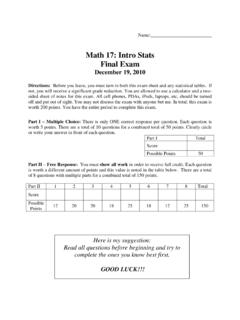
www.amherst.eduFinal Exam December 19, 2010 ... When describing center and spread, which set of summary statistics should we use? Mean and standard deviation, or median and IQR?
Economic, social, and environmental sustainability …
www.amherst.eduEconomic, social, and environmental sustainability in development theory and urban planning practice A. D. BASIAGO* ... impact on the environment can be embodied in

Special Section: Global Environmental History - …
www.amherst.eduSpecial Section: Global Environmental History Beginning in the Belly, ... An Environmental History of Africa, 1800-1990 (Portsmouth, NH: Heinemann, 1999).
2008 Vertebrate Organ Systems - Amherst College
www.amherst.eduLab 9 - Vertebrate Organ Systems Objectives: ... An overview of how to approach your dissection of the fetal pig is on the next two pages.
creation of the “queer” Butler‟s Gender Trouble ...
www.amherst.eduof race, class, the environment and the nation. Texts include feminist philosopher Judith Butler‟s Gender Trouble , anthropologist Kamala Visweswaran‟s Fictions of Feminist
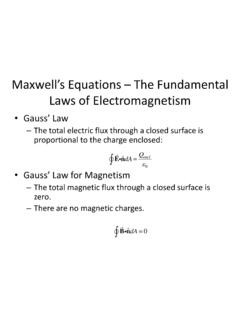
The Fundamental Laws of Electromagnetism - amherst.edu
www.amherst.eduMaxwell’s Equations –The Fundamental Laws of Electromagnetism •Faraday’s Law –When the magnetic flux through some loop (C) changes, it induces an emf around the loop proportional to the rate at which the flux changes. –If loop has N turns, the emf is N times larger.
Localization in Epilepsy - amherst.edu
www.amherst.eduLocalization in Epilepsy DimitrisG.Placantonakis,MD, PhD, TheodoreH.Schwartz,MD* Pharmacologic therapy represents the first line of treatment of epilepsy and is effec-tive in most patients.
![[Fill-in-the-blank] tests measure and multiple choice ...](/cache/preview/5/e/e/9/b/f/1/7/thumb-5ee9bf17e1539b3a63fea89d05cad259.jpg)
[Fill-in-the-blank] tests measure and multiple choice ...
www.amherst.eduThe self-reference effect refers to improved memory for information when: A) someone told the person directly B) the person saw the event first-hand C) that information holds personal meaning D) the person has been directly accused of something
Making Sense of Olive Oil: Simple Experiments To Connect ...
www.amherst.eduexperience oils: color, aroma, bitterness, and pungency. We also describe experiments to explore some of the characteristics of olive oil related to its status as a new health food.
Peanuts - Amherst College
www.amherst.edu• Peanuts were spread to Africa, Europe, and Asia primarily by Portuguese traders • Peanuts were very likely spread to the United States through slave trade Origination
Related documents
Proof Techniques - Stanford University Computer Science
cs.stanford.edumonly seen in proofs. 1.1.1 Proof by contrapositive Consider the statement \If it is raining today, then I do not go to class." This is logically equivalent to the statement \If I go to class, then it is not raining today." So if we want to prove the rst statement, it su ces to prove the second statement (which is called the contrapositive).
Introduction to mathematical arguments
math.berkeley.eduprove any type of statement. This chart does not include uniqueness proofs and proof by induction, which are explained in §3.3 and §4. Apendix A reviews some terminology from set theory which we will use and gives some more (not terribly interesting) examples of proofs. 1

Logic, Sets, and Proofs - Amherst College
www.amherst.eduA set is a collection of objects, which are called elements or members of the set. Two sets are equal when they have the same elements. ... strategies for di erent types of proofs. Direct Proof. The simplest way to prove A )B is to assume A (the \hypothe-sis") and prove B (the \conclusion"). See Proof 2 in Section 5 for a direct proof of

A GUIDE TO PROOFS IN LINEAR ALGEBRA
www.vcccd.eduLogical deduction was the fourth element in our list of ingredients for writing proofs. Much of our logical structure is buried in the development of axiomatic structure and set theory. From this we get the theorems we’ve previously developed in mathematics such as Euclidean geometry, algebra, trigonometry, and calculus.
THE GAUSSIAN INTEGRAL - University of Connecticut
kconrad.math.uconn.eduWe will give multiple proofs of this result. (Other lists of proofs are in [4] and [9].) The theorem is subtle because there is no simple antiderivative for e 21 2 x (or e 2x2 or e ˇx). For comparison, Z 1 0 xe 1 2 x2 dxcan be computed using the antiderivative e 1 2 x2: this integral is 1. 1. First Proof: Polar coordinates

Direct Proofs - Stanford University
web.stanford.eduDirect Proofs A direct proof is the simplest type of proof. Starting with an initial set of assumptions, apply simple logical steps to derive the result. Directly prove that the result is true. Contrasts with indirect proofs, which we'll see on Friday.

Identity 2. - gatech.edu
www2.isye.gatech.eduFurther, x ∈ A and x 6∈B also by definition of set difference. Thus x ∈ A and x 6∈B and x 6∈C, which implies x 6∈(BorC). Hence, x 6∈(B∪C) by definition of union. Thus, given x ∈ A we have x ∈ A−(B∪C) by definition of set difference. 1. Identity 4. Let A, B and C be sets. Show that

Basic Proofs - Loyola University Maryland
math.loyola.eduThere are four basic proof techniques to prove p =)q, where p is the hypothesis (or set of hypotheses) and q is the result. 1.Direct proof 2.Contrapositive 3.Contradiction 4.Mathematical Induction What follows are some simple examples of proofs. You very likely saw these in MA395: Discrete Methods. 1 Direct Proof

Chapter 1. Metric spaces - Proofs covered in class
www.maths.tcd.ie5 A set is open if and only if it is a union of open balls. Proof. Suppose first that U is a union of open balls. Then U is a union of open sets by part 4, so it is open itself by part 2. Conversely, suppose that U is an open set. Given any x ∈ U, we can then find some ε x > 0such that B(x,ε x)⊂ U. This gives {x} ⊂ B(x,ε x)⊂ U