
MEASURING COURSE LEARNING OUTCOMES
means of assessing the knowledge and skills obtained from learning opportunities. Learning outcomes have applications at three distinct levels: (i) the . ... the cognitive domain. The affective domain refers to attitudes and the psychomotor domain covers manual and physical skills. The group further divided the cognitive domain into six levels that
Download MEASURING COURSE LEARNING OUTCOMES

Information
Domain:
Source:
Link to this page:
Documents from same domain

AIR CONDITIONING, REFRIGERATING AND HEATING
files.eric.ed.govAN ANALYSIS OF THE AIR CONDITIONING, REFRIGERATING AND HEATING OCCUPATIONS. Developed By. Melvin R. Frass Instrur`lr, Electrical Appliances Refrigeration & Air-Conditioning

A National Principal Survey on How Social and …
files.eric.ed.govA National Principal Survey on How Social and Emotional Learning Can Prepare Children and Transform Schools Civic Enterprises with Hart Research Associates

ED 360 865 FL 021 457 AUTHOR Malave, Lillian M., …
files.eric.ed.govDifferent approaches to bilingual education have been contrasted with almost exclusive regard for educational or peda-gogical issues. In so doing, the effects of …
Reproductions supplied by EDRS are the best …
files.eric.ed.govDOCUMENT RESUME. ED 473 557 FL 027 565. TITLE Revista de Investigacion Educativa, 2001 (Journal of. Educational Research, 2001). …

Addressing Barriers to Learning - files.eric.ed.gov
files.eric.ed.govAddressing Barriers New ways to think . . . to Learning Better ways to link Volume 13, Number 1 Winter, 2008 Challenges and Opportunities in the Classroom
Addressing Barriers to Learning - ERIC
files.eric.ed.govAddressing Barriers New ways to think . . . to Learning Better ways to link Volume 12, Number 4 Fall, 2007 Mental Health in Schools: Much More than Services for a Few
Use of Case Study Methods in Human Resource …
files.eric.ed.govUse of Case Study Methods in Human Resource Management, Development, and Training Courses: Strategies and Techniques

CANADIAN MATHEMATICS EDUCATION GROUPE …
files.eric.ed.govcanadian mathematics education study group groupe canadien d¶Étude en didactique des mathÉmatiques proceedings / actes 2015 annual meeting /

education policy analysis archives - ERIC
files.eric.ed.govEducation Policy Analysis Archives Vol. 24 No. 110 4 All’s support for and participation in corporate, market-based approaches to education reform globally can be seen in its “... reliance on the private sector to move teacher and educational policies,

Cheating In Examinations in Two Polish Higher …
files.eric.ed.govThe Lamar University Electronic Journal of Student Research Spring 2007 Cheating In Examinations in Two Polish Higher Education Schools Teresa Ann Hughes, PhD
Related documents
MATHEMATICS GRADES 10–12 - Alberta
education.alberta.caAFFECTIVE DOMAIN A positive attitude is an important aspect of the affective domain and has a profound effect on learning. Environments that create a sense of belonging, support risk taking and provide opportunities for success help students to develop and maintain positive attitudes and self-confidence. Students with positive attitudes

Assessing Children with Autism Spectrum Disorders
uwreadilab.comaffective components evaluate the child’s abilities to understand basic and complex emotions. Four sources of information are incorporated into the assessment: (1) parent report, (2) teacher report, (3) observation, and (4) direct child interaction. The parent information

CONTINUOUS ASSESSMENT IN PRIMARY AND SECONDARY …
globalacademicgroup.comworks especially in cognitive domain leaving the affective and psychomotor domains. embed the assessment in their instructions, Benefits of Continuous Assessment The fundamental objective of the introduction of continuous assessment was to correct the defects of the past system of assessment which concentrated on one final examination.

1 Test Blueprint Guide - Clemson University
www.clemson.eduthe levels of learning in three possible domains: cognitive, affective, and psychomotor. The Cognitive Domain reflects the categories of Bloom’s Taxonomy as discussed above. This model also includes examination of affective and psychomotor skills. The Affective Domain reflects feelings and emotions. Learning in this domain is reflected by
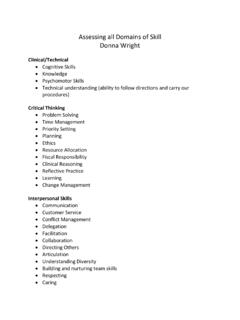
Assessing all Domains of Skill Donna Wright
www.uclahealth.orgthe Affective Domain of Learning Valuable in measuring competencies that relate to values, beliefs, myths, and assumptions that help/hinder us in achieving our desired outcomes. Example Pain Management Self-Assessment. Reflective exercise that allows exploration of the thoughts that influence day-to-day judgements (conscious and previously
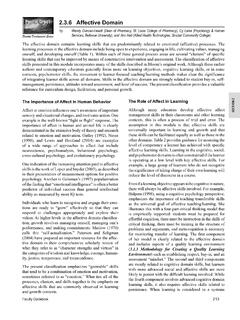
2.3.6 Affective Domain
www.pcrest.comThe affective domain contains learning skills that are predominantly related to emotional (affective) processes. The ... Table 2 provides guidance for assessing the level of competency a learner has achieved with specific affective learning skills. Learning in the cognitive, social,

Family Assessment Device (FAD)
movingahead.psy.unsw.edu.au(4) Affective Responsiveness, assesses the extent to which individual family members are able to experience appropriate affect over a range of stimuli. (5) Affective Involvement, is concerned with the extent to which family members are interested in and place value on each other’s activities and concerns.

Assessment of learning domains to improve student’s ...
www.jyoungpharm.orgJan 05, 2014 · expect the educators to include level of the affective domain in COs. Table 2 outlines the fi ve levels in the affective domain and keywords that can be used to write learning objectives. Psychomotor domain Psychomotor domain focuses on performing sequences of motor activities to a specified level of accuracy, smoothness, rapidity, or force.

Assessment Benefits and Barriers - ed
files.eric.ed.govwhen teaching, assessing, and grading students. Teachers should revisit unit objectives and identify goals that comple-ment the psychomotor domain. Because psychomotor skill is only one of four areas on which a grade is usually deter-mined, lower-skilled students can emphasize other areas such as knowledge, homework, teamwork, and affective