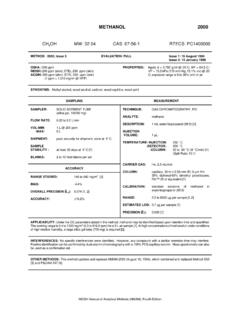
METHANOL 2000
Positive identification can be confirmed by dual column chromatography with a 100% PEG capillary column. Mass spectrometry can also be used as a confirmation aid. OTHER METHODS: This method updates and replaces NMAM 2000 (August 15, 1994), which combined and replaced Method S59 [3] and P&CAM 247 [4].
Download METHANOL 2000

Information
Domain:
Source:
Link to this page:
Documents from same domain
School Chemistry Laboratory Safety Guide
www.cdc.govSchool Chemistry Laboratory Safety Guide. October 2006. U.S. Consumer Safety Product Commission DEPARTMENT OF HEALTH AND HUMAN SERVICES. Centers for Disease Control and Prevention

Biosafety in Microbiological and Biomedical …
www.cdc.goviii. Foreword. Biosafety in Microbiological and Biomedical Laboratories (BMBL) quickly became the cornerstone of biosafety practice and policy in the United States upon first
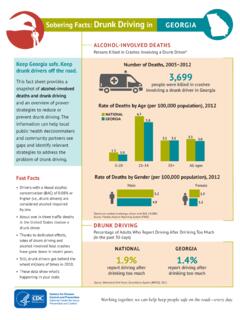
Sobering Facts: Drunk Driving in Georgia
www.cdc.govSobering Facts: Drunk Driving in GEORGIA Keep Georgia safe. Keep drunk drivers off the road. This fact sheet provides a snapshot of alcohol-involved deaths and drunk driving
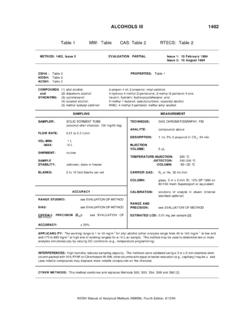
ALCOHOLS III 1402
www.cdc.govALCOHOLS III: METHOD 1402, Issue 2, dated 15 August 1994 - Page 3 of 4 a. Remove and discard back sorbent section of a media blank sampler. b. Inject a known amount of analyte or DE stock solution directly onto front sorbent section
Fast Facts
www.cdc.govAny person working outdoors is at risk of exposure to poisonous plants, such as poison ivy, poison oak, and poison sumac. When in contact with skin, the sap oil (urushiol) of
Trans Fat: The Facts
www.cdc.gov• Read the Nutrition Facts label and ingredient list to compare foods. » Choose products with 0 grams trans fat. » Check the Ingredient List to see if there is any partially hydrogenated oil in the product.

ANTIBIOTIC RESISTANCE THREATS
www.cdc.govApr 23, 2013 · 6. ANTIBIOTIC RESISTANCE THREATS IN THE UNITED STATES, 2013. Executive Summary. Antibiotic Resistance Threats in the United States, 2013. is a snapshot of the complex problem
Chlorine Residual Testing
www.cdc.govChlorine Residual Testing Fact Sheet, CDC SWS Project 4 Methods to Test Free Chlorine in the Field in Developing Countries There are three main methods to test free chlorine residual in drinking water in the field
2018 Combined Recommended Immunization …
www.cdc.govRecommended Immunization Schedule for Children and Adolescents Aged 18 Years or Younger, UNITED STATES, 2018 Approved by the Advisory Committee on …

Traveling? Make Sure You Protect Yourself from …
www.cdc.govCS26201 Malaria transmission occurs throughout Malaria transmission occurs in some parts Malaria transmission is not known to occur Center for Global Health
Related documents
METHOD 8081 ORGANOCHLORINE PESTICIDES AND PCBs …
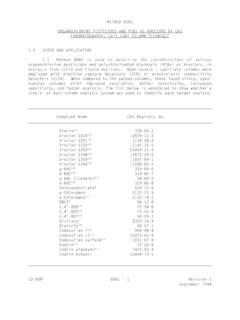
legismex.mty.itesm.mxORGANOCHLORINE PESTICIDES AND PCBs AS AROCLORS BY GAS CHROMATOGRAPHY: CAPILLARY COLUMN TECHNIQUE 1.0 SCOPE AND APPLICATION 1.1 Method 8081 is used to determine the concentrations of various organochlorine pesticides and polychlorinated biphenyls (PCBs) as Aroclors, in extracts from solid and liquid matrices. Open-tubular, capillary columns were
Thin Layer Chromatography (TLC) - Delhi University
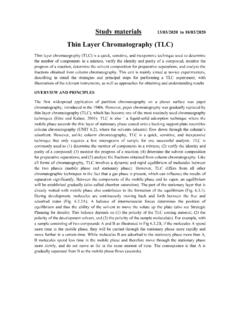
chemistry.du.ac.inThin layer chromatography (TLC) is a quick, sensitive, and inexpensive technique used to determine the number of components in a mixture, verify the identity and purity of a compound, monitor the progress of a reaction, determine the solvent composition for preparative separations, and analyze the fractions obtained from column chromatography.

Fundamental LC-MS Introduction - UMass Amherst
www.ecs.umass.eduLC/MS is a hyphenated technique, which combines the separating power of High ... Performance Liquid Chromatography (HPLC), with the detection power of mass spectrometry. Mass Spectrometry is a wide-ranging analytical technique, which involves the production ... • Production of charged droplets at the capillary tip

Ion Exchange Chromatography - An Overview
cdn.intechopen.comstationary phases. These are: liquid chromatography including high performance, ion, micellar, electrokinetic, thin-layer, gel-permeation, and countercurrent versions; gas chromatography and supercritical fluid chromatography. Various forms of chromatogra‐ phy can be used to separate a wide variety of compounds, from single elements to large
An Introduction to Gel Permeation Chromatography and Size ...
www.agilent.comcapillary tube. A gas such as helium is used as the mobile phase. Volatile samples, or samples volatilized by heating, are introduced into the gas phase and flow through the column, during which the components of the sample have time to interact with the stationary phase, mainly through physical interactions and adsorption.
ALCOHOLS I 1400
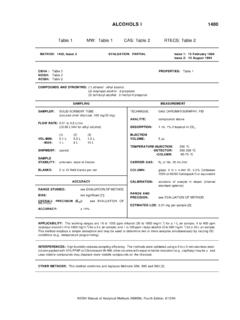
www.cdc.govTECHNIQUE: GAS CHROMATOGRAPHY, FID ANALYTE: compounds above DESORPTION: 1 mL 1% 2-butanol in CS 2 INJECTION VOLUME: 5 µL TEMPERATURE-INJECTION: 200 °C-DETECTOR: 250-300 °C-COLUMN: 65-70 °C CARRIER GAS: N 2 or He, 30 mL/min COLUMN: glass, 2 m x 4-mm ID, 0.2% Carbowax 1500 on 60/80 Carbopack C or equivalent …

Guide to achieving reliable quantitative LC-MS measurements
www.rsc.orgtechnique. For example, more than 1,500 compounds may have the same molecular mass at around 250 Da. Hence, an additional separation technique is needed before presenting the sample to the mass spectrometer. Liquid chromatography-mass spectrometry (LC-MS) is the combination of two selective

Basics & Fundamentals - Gas Chromatography
www.shimadzu.eu.comBasics & Fundamentals: Gas Chromatography. Introduction . Gas chromatography (GC) is an analytical methodology, which was devised by Nobel Laureate, Martin, et al. in 1952. More than 60 years after the award, GC systems are widely commercialized and used in various industries, capable of both of quantitation and qualifcation.