NCERT
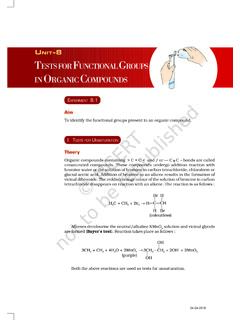
Both aldehydes and ketones contain carbonyl group (>C = O) and are commonly known as carbonyl compounds. Identification of aldehydes and ketones is done by two important reactions of carbonyl group i.e. (i) addition reaction on double bond of >C = O group and (ii) oxidation of carbonyl group. Addition reactions of derivatives of ammonia are ...
Download NCERT

Information
Domain:
Source:
Link to this page:
Documents from same domain

ntse exam notification - National Council Of …
ncert.nic.inExamination: The tentative pattern of written examination will be as follows: Stage-I & Il : examination at the State/UT level will comprise of three papers i.e.
14 Effects Electric Current and Its - National …
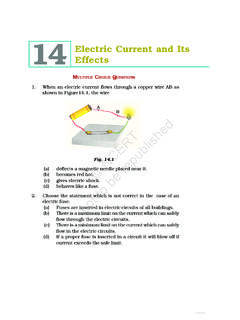
ncert.nic.in76 EXEMPLAR PROBLEMS 3. Three bulbs A, B, C are connected in a circuit as shown in Figure 14.2. When the switch is ‘ON’ (a) bulb C will glow first. (b) bulb B and C will glow simulaneously and bulb A will

SEMICONDUCTOR AND SIMPLE CIRCUITSnot to be …
ncert.nic.in469 Semiconductor Electronics: Materials, Devices and Simple Circuits semiconductors. However , after 1990, a few semiconductor devices using organic semiconductors and semiconducting polymers have been
ENVIRONMENTAL CHEMISTRY - National Council …
ncert.nic.in400 CHEMISTRY (c) Hydrocarbons: Hydrocarbons are composed of hydrogen and carbon only and are formed by incomplete combustion of fuel …
LAWS OF MOTION
ncert.nic.inLAWS OF MOTION 91 In practice, the ball does come to a stop after moving a finite distance on the horizontal plane, because of the opposing force of friction which
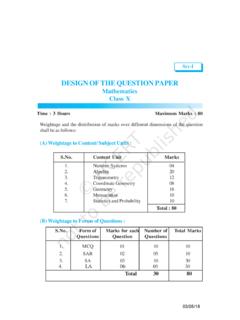
DESIGN OF THE QUESTION PAPER Mathematics …
ncert.nic.inDESIGN OF THE QUESTION PAPER, SET-I 207 (A) 18 5 (B) 17 5 (C) 17 8 (D) 1 7. In the adjoining figure, PA and PB are tangents from a point P to a circle with centre O.
CHAPTER 10
ncert.nic.in(A) Main Concepts and Results Circle, radius, diameter , chord, segment, cyclic quadrilateral. • Equal chords of a circle (or of congruent circles) subtend equal angles at the
INDIA : CLIMATE, VEGETATION AND WILDLIFE
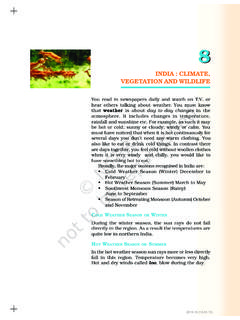
ncert.nic.inINDIA : CLIMATE, VEGETATION AND WILDLIFE 59 year. Therefore, they always appear gr een and are called evergreen forest as you may notice in Figure
Objectives Polymers - National Council of …
ncert.nic.in427 Polymers C:\Chemistry-12\Unit-15.pmd 28.02.07 Polymers can also be classified on the basis of mode of polymerisation into two sub groups.
TEXTBOOK IN GEOGRAPHY FOR CLASS IX
ncert.nic.inFOREWORD The National Curriculum Framework, (NCF) 2005, recommends that children’s life at school must be linked to their life outside the school. This principle
Related documents
Reactions of Amines
web.mnstate.eduFrom Aldehydes or Ketones: Reductive Amination (Section 19-19) R R 1 O Ketone or aldehyde + H N R 3 R 2 NaBH 3C cat.H+ R R H 1 N 2R via N • Access: 1º, 2º, or 3º Amines • Mechanism: Not required. (Basic workup) • The carbonyl reactant can be an aldehyde or a ketone • The amine reactant must have at least one hydrogen, as shown above ...

Organometallic Chemistry - uni-regensburg.de
www-oc.chemie.uni-regensburg.deketones, alkyl halides, and esters. – Relative reactivity: RCOCl > RCHO > tosylates, iodides > epoxides > bromides >> ketones > esters > nitriles. • In reactions with α,β-unsaturated carbonyl compounds, the organocopper reagents prefer 1,4-addition …

Chapter 17: Alcohols and Phenols
as.vanderbilt.edu17.5: Alcohols from reduction of carbonyl compounds add the equivalent of H 2 across the π-bond of the carbonyl to give an alcohol RR' C O[H] R' RH H aldehyde (R or R´= H) → 1° alcohol ketone (R and R´≠ H) → 2° alcohol [H]: sodium borohydride: NaBH 4, ethanol reduces aldehydes to 1° alcohols and ketones to 2° alcohols

Transition Metal Carbonyls
alpha.chem.umb.educarbonyl product, which is greater for a low-valentmetal. Note that the first step in the case of an aldehydeis oxidative addition of the aldehydeC−H bond. It is much more difficult for the metal to break into a C−C bond so ketones, R 2CO, are usually resistant to this reaction.

Chapter 23. Carbonyl Condensation Reactions
as.vanderbilt.edu23.1 Mechanism of Carbonyl Condensation Reactions An enolate of one carbonyl (nucleophile) reacts with the carbonyl carbon (electrophile) of a second carbonyl compound (1,2-addition reaction) resulting in the formation of a new C-C bond General mechanism (Fig. 23.1, page 855): Nucleophilic carbonyl: aldehydes, ketones, esters, amides and nitrile
12.112.112.1 Nomenclature and Structure of Carbonyl Group
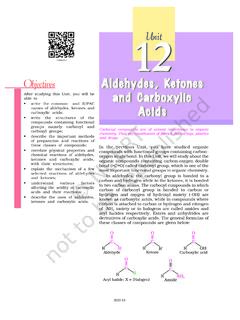
ncert.nic.in361 Aldehydes, Ketones and Carboxylic Acids The carbonyl carbon atom is sp2-hybridised and forms three sigma (σ) bonds. The fourth valence electron of carbon remains in its p-orbital and forms a π-bond with oxygen by overlap with p-orbital of an oxygen. In addition, the oxygen atom also has two non bonding electron pairs.
Carbonyl Chemistry (12 Lectures)
www.ch.ic.ac.ukCarbonyl Group Reactions ¥Addition Reactions ÐCarbonyl groups in aldehydes and ketones undergo addition reactions. ÐThis is one of the most important reactions of the carbonyl group. O C + O C E E Y Y ¥Addition reactions occur by two different mechanisms: ÐBase-catalyzed addition (under basic or neutral conditions)

CARBANIONS - SIUE
www.siue.eduaddition at the carbonyl group of another molecule. This process is a very important synthetic procedure and is known as the Aldol Condensation. The final product from aliphatic aldehydes or ketones contains both a carbonyl and an alcohol group. The product is called an aldol. CH 3CH=O CH 2CH=O CH 2=CH-O OH CH 3CH=O CH 2CH=O CH 3CH-O CH 2CH=O H ...