
Non-Destructive Testing Reading
Leak Testing (LT) Several techniques are used to detect and locate leaks in pressure containment parts, pressure vessels, and structures. Leaks can be detected by using electronic listening devices, pressure gauge measurements, liquid and gas penetrant techniques, or simple soapbubble tests.
Download Non-Destructive Testing Reading

Information
Domain:
Source:
Link to this page:
Documents from same domain

Classification - ccmr.cornell.edu
www.ccmr.cornell.eduwhole organizational system for living things is called “classification.” It works like this: Suppose you wanted to classify a car. See Figure 3. The first group, or kingdom, would all be cars. That would exclude trucks, school buses, and RVs. The kingdom of cars would be further divided into all sedans.

Buoyancy - Cornell Center for Materials Research
www.ccmr.cornell.eduThe Archimedes Principle The mathematician Archimedes, who lived in the third century B.C., is credited with discovering much of how buoyancy works.

Trace Evidence – How Fibers and Hair are used to aid in ...
www.ccmr.cornell.eduTrace Evidence – How Fibers and Hair are used to aid in Crime Solving. Locard’s Exchange Principal – when a criminal comes in contact with a person or object a cross ... Medullas have three general appearances, as well as many different shapes. Deer Medulla (notice it is as thick as the hair) Rabbit Medulla (again the medulla is very large)

WHAT IS THE SCIENTIFIC METHOD?
www.ccmr.cornell.eduterms of combinations of air, earth, fire and water. One French scientist, Antoine Lavoisier, (1743-1794) worked to change the way chemistry was done. Lavoisier had a habit of making very careful measurements in his experiments. One of the things he discovered from these experiments was that combustion is the result of a reaction with oxygen.
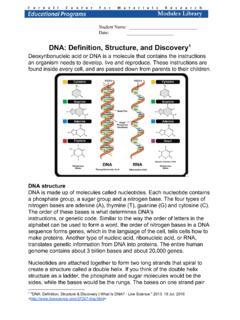
DNA: Definition, Structure, and Discovery
www.ccmr.cornell.edustructure of nucleic acids and i t s signi f i cance f or i nf ormat i on t ransf er i n living material." DNA sequencing DNA sequencing is t echnol ogy t hat al l ows researchers t o det ermi ne t he order of bases in a D NA sequence. T he t echnol ogy can be used t o determine the order of bases i n genes, chromosomes, or an ent i re ...
Scanning Electron Microscope
www.ccmr.cornell.eduelectron source, optical aberrations of the final lens (objective) and the diffraction aberration on the final aperture. The spot size is smaller at shorter working distances. The incident electron beam is cone-shaped. The vertex angle of the cone is determined by the aperture angle. The wider the cone, the lower the depth of focus.
Related documents
May 2002 NORME EUROPÉENNE + A1 ÄISCHE NORM March …
www.entech.rsEN 10246-14, Non-Destructive Testing of steel tubes - Part 14:Automatic ultrasonic testing of seamless and welded (except submerged arc welded) steel tubes for the detection of laminar imperfections. EN 10256, Non-Destructive Testing of steel tubes - Qualification and competence of level 1 and level 2 NDT personnel.

Double Block and Bleed Valves - Bonney Forge Corporation
bonneyforge.comdifferent non-destructive testing, like dye pen-etrant test on butt weld ends and on all hard faced and cladding areas. Non-destructive test are also carried out on the critical areas as defined by ASME B16.34. Optional examinations like: Radiographic Magnetic particicles Ultrasonic Helium leak test Personal performing NDT are trained and qual-
Leak Detection Methods - Thomasnet
cdn.thomasnet.comone-time non-destructive test, without impact on the environment and operators. Several leak-testing techniques are available, spanning from very simple approaches to systems that are more complex. The most commonly used leak test methods are underwater bubble test, bubble soap paint, pressure and vacuum decay, and tracer gas detectors (halogen ...
Introduction to Non-destructive Testing
ncr.indianrailways.gov.inIntroduction to Non-destructive Testing . The use of noninvasive techniques to determine the integrity of a material, component or structure or quantitatively measure some characteristic of an object. ... testing is a higher energy (shorter wavelength) version of the

Liquid Penetrant and Magnetic Particle Testing at Level 2
www-pub.iaea.orgmethods, i.e. liquid penetrant testing, magnetic particle testing, eddy current testing, radiographic testing and ultrasonic testing, and the second and revised is IAEA-TECDOC-628 which includes additional methods of visual testing and leak testing.

Guidebook on non-destructive testing of concrete structures
www-pub.iaea.orgtesting, magnetic particle testing, eddy current testing, radiographic testing, ultrasonic testing, visual inspection and leak testing. Based on these syllabi, training course notes have been produced to cover Industrial Radiography (IAEA Training Course Series No. 3) and Ultrasonic Testing of Materials at

Non Destructive Testing Certification Requirements and ...
www.dot.state.pa.usNon Destructive Testing Certification Requirements and Challenges James A. Kretzler, ASNT Level III. ... • Leak Testing ... techniques, and procedures to be used. Written Practice The employer shall establish a written practice for the control and
Generator In-Situ Inspections - General Electric
www.ge.com• Retaining Ring Non-Destructive Evaluation (NDE) Scanner • Othertests andinspections,includingelectricaltesting hydraulic testing The in-situ inspection consists of the basic MAGIC visual inspection as well as one or more additional tests or inspections based on the circumstances and customer needs . Table 2 lists critical generator
Study of Porosity Defect in Aluminum Die Castings and its ...
www.irjet.netIn the last decades, industrial interest in the development of advanced non-destructive testing (NDT) techniques for qualification of materials and products has been increased noticeably. 4 Radiographic Testing (RT) is a non-destructive testing (NDT) method which uses either x-rays or gamma rays to examine the