Example: tourism industry
Classification - ccmr.cornell.edu
whole organizational system for living things is called “classification.” It works like this: Suppose you wanted to classify a car. See Figure 3. The first group, or kingdom, would all be cars. That would exclude trucks, school buses, and RVs. The kingdom of cars would be further divided into all sedans.
Tags:
Information
Domain:
Source:
Link to this page:
Documents from same domain

WHAT IS THE SCIENTIFIC METHOD?
www.ccmr.cornell.eduterms of combinations of air, earth, fire and water. One French scientist, Antoine Lavoisier, (1743-1794) worked to change the way chemistry was done. Lavoisier had a habit of making very careful measurements in his experiments. One of the things he discovered from these experiments was that combustion is the result of a reaction with oxygen.
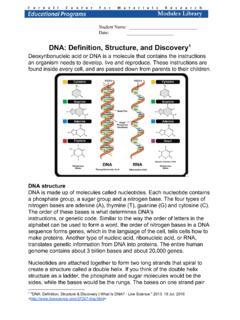
DNA: Definition, Structure, and Discovery
www.ccmr.cornell.edustructure of nucleic acids and i t s signi f i cance f or i nf ormat i on t ransf er i n living material." DNA sequencing DNA sequencing is t echnol ogy t hat al l ows researchers t o det ermi ne t he order of bases in a D NA sequence. T he t echnol ogy can be used t o determine the order of bases i n genes, chromosomes, or an ent i re ...

Buoyancy - Cornell Center for Materials Research
www.ccmr.cornell.eduThe Archimedes Principle The mathematician Archimedes, who lived in the third century B.C., is credited with discovering much of how buoyancy works.

Non-Destructive Testing Reading
www.ccmr.cornell.eduLeak Testing (LT) Several techniques are used to detect and locate leaks in pressure containment parts, pressure vessels, and structures. Leaks can be detected by using electronic listening devices, pressure gauge measurements, liquid and gas penetrant techniques, or simple soapbubble tests.

Trace Evidence – How Fibers and Hair are used to aid in ...
www.ccmr.cornell.eduTrace Evidence – How Fibers and Hair are used to aid in Crime Solving. Locard’s Exchange Principal – when a criminal comes in contact with a person or object a cross ... Medullas have three general appearances, as well as many different shapes. Deer Medulla (notice it is as thick as the hair) Rabbit Medulla (again the medulla is very large)

Scanning Electron Microscope
www.ccmr.cornell.eduelectron source, optical aberrations of the final lens (objective) and the diffraction aberration on the final aperture. The spot size is smaller at shorter working distances. The incident electron beam is cone-shaped. The vertex angle of the cone is determined by the aperture angle. The wider the cone, the lower the depth of focus.
Related documents
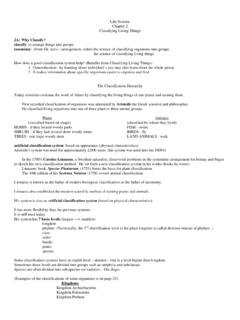
Chapter 2 Classifying Living Things - pjteaches.com
pjteaches.comLife Science Chapter 2 Classifying Living Things 2A: Why Classify? classify: to arrange things into groups taxonomy: (from Gk. taxis - arrangement, order) the science of classifying organisms into groups the science of classifying living things How does a good classification system help?
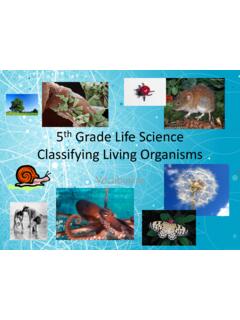
Classifying Living Organisms - PC\|MAC
images.pcmac.orgClassifying Living Organisms Vocabulary . Classification Grouping things by a set of rules . kingdom The largest group into which living things can be classified . species The smallest name grouping used in classification . vertebrates Animals with a backbone . invertebrates

UNIT 2 – LIVING THINGS - UAB Barcelona
grupsderecerca.uab.catganisms, scientists developed a classification system. This system divides the or. ganisms into large groups called . kingdoms. Or: ganisms in each kin. gdom share basic traits or ... UNIT 2 – LIVING THINGS 55 The following chart can help you organize information about the …

Teacher Notes/ Activity/Worksheets - Hamilton Zoo
hamiltonzoo.co.nz• To recognise that living things can be grouped into science- ... Teacher Notes/ Activity/Worksheets . Classification Page 2 of 13 Learning Intentions - Respect self, others and the environment ... Classification Page 3 of 13 Pre-visit Learning - Think about the different ways things …

How do we classify living things? Learning how to make and ...
kbsgk12project.kbs.msu.eduClassification Activity pg.1 How do we classify living things? Learning how to make and use dichotomous keys and trees Overview One of the many challenges faced by scientists is how to classify all of the Earthʼs biodiversity. With so many plants, animals, insects and other forms of life we need a way to identify new ...
Name Score - mrscienceut.net
mrscienceut.netIn the past scientists used to classify living things into either the plant or animal kingdoms. Today it is customary to use a classification system that uses five kingdoms,

KEY CONCEPT Scientists develop systems for classifying ...
www.classzone.comClassification and Taxonomy Tw o scientific processes deal with classifying and naming living things. is the process of arranging organisms into groups based

Classification of Living Things - BiologySc
biologysc.weebly.comClassification of Living Things Biology is defined as the study of living things and their interactions with the environment. There are 7 characteristics that distinguish living things from non- living

Classification of Living Things - Biology Building Blocks
bioblocks.weebly.com• _____ - total of all the living things in an ecosystem. • _____ population of organisms that share similar characteristics and can breed with each other

Unit 1 Characteristics and classification of living organisms
assets.cambridge.orgWelcome to the exciting and amazing world of living things. Go outside and look around you. Look at the sky, the soil, trees, plants, people, animals.
Related search queries
Chapter 2 Classifying Living Things, Things, Living things, Classification, Classifying Living Organisms, UNIT 2 – LIVING THINGS, Teacher Notes/ Activity/Worksheets, We classify living things? Learning how, Name Score, Classification of Living Things, Of living things, Living, Unit 1 Characteristics and classification of living