
NP-complete problems - People
nential algorithms make polynomially slow progress, while polynomial algorithms advance exponentially fast! For Moore’s law to be reected in the world we need efcient algorithms. As Sissa and Malthus knew very well, exponential expansion cannot be sustained in-denitely in our nite world. Bacterial colonies run out of food; chips hit the ...
Download NP-complete problems - People

Information
Domain:
Source:
Link to this page:
Documents from same domain
Fundamentals of HVAC Controls Course Content …
people.eecs.berkeley.eduFundamentals of HVAC Controls The application of Heating, Ventilating, and Air-Conditioning (HVAC) controls starts with an understanding of the building and the use of the spaces to be conditioned and controlled.
SIA: Secure Information Aggregation in Sensor Networks
people.eecs.berkeley.eduSIA: Secure Information Aggregation in Sensor Networks Bartosz Przydatek Carnegie Mellon University Pittsburgh, PA 15213, USA bartosz@cmu.edu Dawn Song
Lecture Notes on Probability Theory and Random Processes
people.eecs.berkeley.educourse on probability and random processes in the Department of Electrical Engineering and Computer Sciences at the University of California, Berkeley. The notes do not replace a textbook.
Introduction to Database Systems What Is a DBMS? CS186
people.eecs.berkeley.edu1 Introduction to Database Systems CS186 “Knowledge is of two kinds: we know a subject ourselves, or we know where we can find information upon it.”
ABC: An Academic Industrial-Strength Verification Tool
people.eecs.berkeley.eduABC: An Academic Industrial-Strength Verification Tool Robert Brayton Alan Mishchenko EECS Department, University of California, Berkeley, CA 94720, USA {brayton, alanmi}@eecs.berkeley.edu Abstract. ABC is a public-domain system for logic synthesis and formal verification
1 Simultaneous Localisation and Mapping (SLAM): Part II ...
people.eecs.berkeley.edu1 Simultaneous Localisation and Mapping (SLAM): Part II State of the Art Tim Bailey and Hugh Durrant-Whyte Abstract —This tutorial provides an introduction to the Si-multaneous Localisation and Mapping (SLAM) method and the extensive research on SLAM that has been undertaken.
1 Simultaneous Localisation and Mapping (SLAM): Part I The ...
people.eecs.berkeley.edu1 Simultaneous Localisation and Mapping (SLAM): Part I The Essential Algorithms Hugh Durrant-Whyte, Fellow, IEEE, and Tim Bailey Abstract|This tutorial provides an introduction to Simul- taneous Localisation and Mapping (SLAM) and the exten-
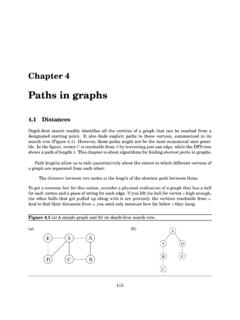
Paths in graphs - People
people.eecs.berkeley.edushows a path of length 3. This chapter is about algorithms for nding shortest paths in graphs. Path lengths allow us to talk quantitatively about the extent to which different vertices of a graph are separated from each other: The distance between two nodes is the length of the shortest path between them.
Chapter 13 The Multivariate Gaussian - People
people.eecs.berkeley.edu2 CHAPTER 13. THE MULTIVARIATE GAUSSIAN The factor in front of the exponential in Eq. 13.1 is the normalization factor that ensures that the density integrates to one.
Lab 2: Basic Concepts in Control System Design
people.eecs.berkeley.eduLab 2: Basic Concepts in Control System Design \There is nothing worse than a sharp image of a fuzzy concept." { Ansel Adams 1Objectives The goal of this lab is to understand some of the basic concepts behind control theory: equilibrium points, stability, feedback, steady-state response, and linearization.
Related documents

An Introduction to Software Architecture
sunnyday.mit.eduGarlan & Shaw: An Introduction to Software Architecture 2 1. Introduction As the size and complexity of software systems increases, the design problem goes beyond the algorithms and data structures of the computation: designing and specifying the overall system structure emerges as a new kind of problem.
Software Development
home.pearsonvue.com1.2 Construct and analyze algorithms and flowcharts to solve programming problems • Decision structures used in all computer programming languages; if ... Software Develpoment Principles 2.1 Describe software development lifecycle (SDLC) management • Requirement analysis, planning and design, implementation, testing,
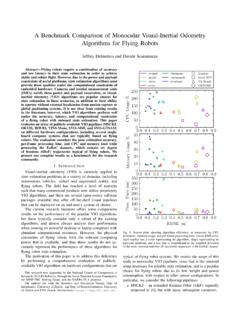
A Benchmark Comparison of Monocular Visual-Inertial …
rpg.ifi.uzh.chVIO algorithms, and there are several open-source software packages available that offer off-the-shelf visual pipelines that can be deployed on an end-user's system of choice. The current research literature offers some comparative results on the performance of the popular VIO algorithms, but these typically consider only a subset of the existing
Algorithms for Reinforcement Learning - University of Alberta
sites.ualberta.capseudocode of almost twenty algorithms was included, hoping that this will make it easier for the practically inclined reader to implement the algorithms described. The target audience is advanced undergaduate and graduate students, as well as researchers and practitioners who want to get a good overview of the state of the art in RL quickly.

DESIGN AND ANALYSIS OF ALGORITHMS
www.iare.ac.in1. Levitin A, “Introduction to the Design And Analysis of Algorithms”, Pearson Education, 2008. 2. Goodrich M.T.,R Tomassia, “Algorithm Design foundations Analysis and Internet Examples”, John Wileyn and Sons, 2006. 3. Base Sara, Allen Van Gelder ,“ Computer Algorithms Introduction to Design and Analysis”, Pearson, 3rd Edition, 1999.

Analysis of Algorithms
www.ics.uci.eduApplication: Job Interviews q High technology companies tend to ask questions about algorithms and data structures during job interviews. q Algorithms questions can be short but often require critical thinking, creative insights, and subject knowledge. n All the “Applications” exercises in Chapter 1 of the Goodrich- Tamassia textbook are taken from reports of actual job interview

Data_Structures_Algorithms_Tutorial.pdf - Tutorialspoint
www.tutorialspoint.comData Structures & Algorithms Compile&ExecuteOnline For most of the examples given in this tutorial you will find Try it option, so just make use of this option to execute your programs on the spot and enjoy your learning. Try the following example using the Try it option available at the top right corner of the following sample code box −