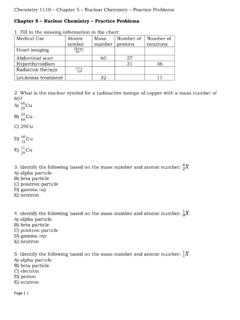
Nuclear Chemistry Practice Problems
Chemistry 1110 – Chapter 5 – Nuclear Chemistry – Practice Problems Page | 10 47. The half-life of a radioisotope is A) one-half of the time it takes for the radioisotope to completely decay to a nonradioactive isotope. B) the time it takes for the radioisotope to become an isotope with one-half of the atomic
Download Nuclear Chemistry Practice Problems

Information
Domain:
Source:
Link to this page:
Documents from same domain
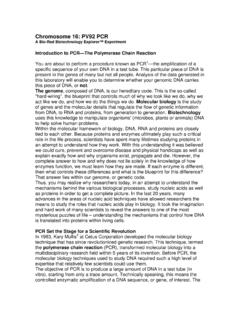
Chromosome 16: PV92 PCR - Utah State University
ion.chem.usu.eduChromosome 16: PV92 PCR A Bio-Rad Biotechnology Explorer™ Experiment Introduction to PCR—The Polymerase Chain Reaction You are about to perform a procedure known as PCR1—the amplification of a
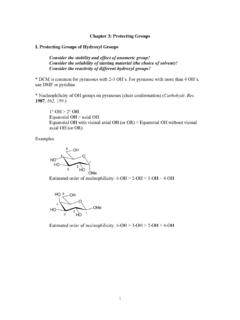
Chapter 3 Protecting Groups - chem.usu.edu
ion.chem.usu.eduChapter 3: Protecting Groups ... relatively strong acid (TFA) to remove * Stable in basic conditions * The reagent, MOMCl, is considered carcinogenic Reagent/Condition Reference MOMCl, NaH in THF or ... Protecting Groups of Amino Groups (i) Masking NH2 (amino) as N3 (azido)
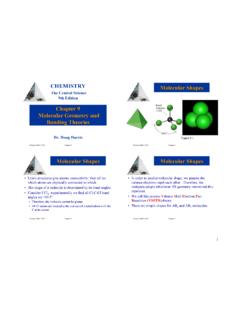
The Central Science 9th Edition - Chemistry Department
ion.chem.usu.edu• count the total number of electron pairs around the central atom, • arrange the electron pairs in one of the above geometries to minimize e − -e − repulsion, and count multiple bonds as one
Introduction to Organic Chemistry: Hydrocarbons
ion.chem.usu.eduOrganic Compounds Organic chemistry is the study of carbon compounds. An organic compound • Always contains carbon and hydrogen atoms • May also contain other nonmetals such as oxygen, nitrogen, phosphorus, or a halogen. • Organic compounds are found in: •Gasoline, medicines, shampoos, plastics, and perfumes •Carbohydrates, fats, and proteins
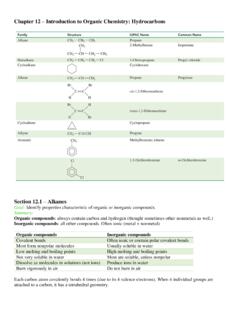
Chapter 12 Introduction to Organic Chemistry: Hydrocarbons
ion.chem.usu.eduChapter 12 – Introduction to Organic Chemistry: Hydrocarbons Section 12.1 – Alkanes Goal: Identify properties characteristic of organic or inorganic compounds. Summary: Organic compounds: always contain carbon and hydrogen (thought sometimes other nonmetals as well.) Inorganic compounds: all other compounds.Often ionic (metal + nonmetal) Organic …
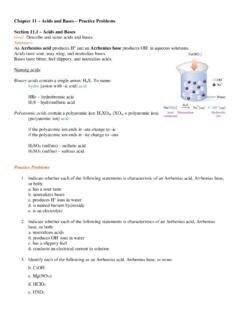
Chapter 11 Acids and Bases Practice Problems Section 11.1 ...
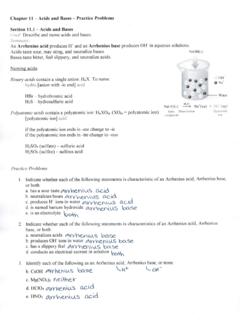
ion.chem.usu.eduSection 11.1 – Acids and Bases Goal: Describe and name acids and bases. Summary: An Arrhenius acid produces H+ and an Arrhenius base produces OH-in aqueous solutions. Acids taste sour, may sting, and neutralize bases. Bases taste bitter, feel slippery, and neutralize acids. Naming acids: Binary acids contain a single anion: H n X. To name:
Utah State University Chemistry and Biochemistry | USU
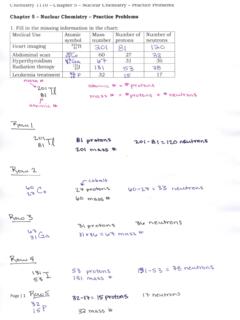
ion.chem.usu.educnermstry 1 1 IU — unapter — Nuclear cnermstry — practice yrot)lerns 32. When a gamma ray is emitted from the nucleus of an atom, the nuclear mass A) increases by two units. B) decreases by one unit. C) increases by one unit. D decreases by two units. emains the same. 33. Radium-226 decays by alpha decay to A) barium-131. B) cobalt-60. C ...
Utah State University Chemistry and Biochemistry | USU
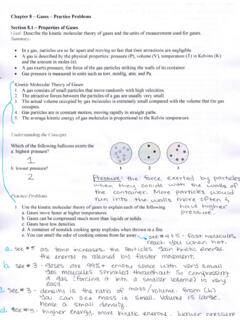
ion.chem.usu.eduExample: A sample of helium gas (He) has a volume 6.8 L and a pressure of 2.5 atm. What is the final volume, ... The volume is compressed to 2.0 L. b. The volume expands to 12 L. 9. A gas at a pressure of 2.0 atm is in a closed container. Indicate the changes (increases, decreases, or does
Utah State University Chemistry and Biochemistry | USU
ion.chem.usu.eduth1S IS a basic solution. !nderstanding the Concepts: Why are the concentrations ofH30 and OH- equal in pure water? One is + What is the meaning and value of Kw at 250C? In an acidic solution how does the concentration of 1-130 compare to the concentration of …
CH3 Practice Key Updates - Utah State University
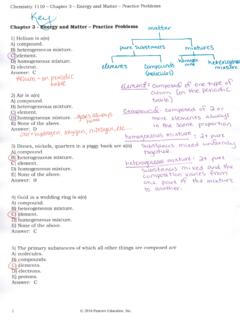
ion.chem.usu.eduChemistry 1 110 — Chapter 3 — Enerw and Matter — 26) 3.25 kcal is the same amount of enerw as Practice Problems A) 3.25 J. B) 0.777 J. C 777 J.
Related documents
Material Safety Data Sheet Page 1 of 2 Vinegar
dept.harpercollege.eduDisclaimer: Scholar Chemistry and Columbus Chemical Industries, Inc., (“S&C”) believes that the inform ation herein is factual but is not intended to be all inclusive. The information relates only to the specific material designated and does not relate to its use in combination with other materials or its use as to any
Gas Laws Save Lives: The Chemistry Behind Airbags
www.chemistry.wustl.edupotentially life-saving decisions about using airbags. Overview of How Airbags Work Timing is crucial in the airbag's ability to save lives in a head-on collision. An airbag must be able to deploy in a matter of milliseconds from the initial collision impact. It must also be prevented from deploying when there is no collision.
AP Chemistry 2019 Free-Response Questions
apcentral.collegeboard.orgCHEMISTRY FREE-RESPONSE QUESTIONS . GO ON TO THE NEXT PAGE. -6-(c) Calculate the concentration of urea, in mol/L, in the saturated solution at 20.°C. (d) The student also determines that the concentration of urea in a saturated solution at 25°C is 19.8 . M. Based on this information, is the dissolution of urea endothermic or exothermic?
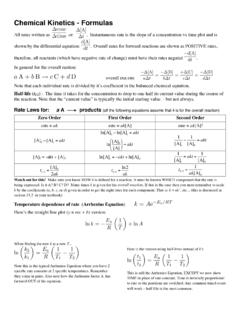
Kinetics formulas copy - Chemistry 301
ch301.cm.utexas.eduHalf-life (t 1/2): The time it takes for the concentration to drop to one half its current value during the course of the reaction. Note that the “current value” is typically the initial starting value - but not always. Rate Laws for: a A products (all the following equations assume that k is for the overall reaction)
Syllabus Cambridge IGCSE Chemistry 0620
www.cambridgeinternational.orgChemistry 0620. Why choose Cambridge? Cambridge Assessment International Education prepares school students for life, helping them develop an informed curiosity and a lasting passion for learning. We are part of the University of Cambridge.
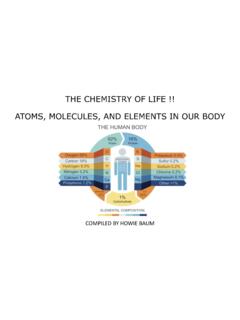
THE CHEMISTRY OF LIFE !! ATOMS, MOLECULES, AND …
www.uc.eduCarbon-Based life form !! Carbon is a key component of all known life on Earth, representing approximately 45-50% of all living things, such as animals and plants. Complex molecules are made up of carbon bonded with other elements, especially oxygen and hydrogen and frequently also with nitrogen, phosphorus and sulfur.