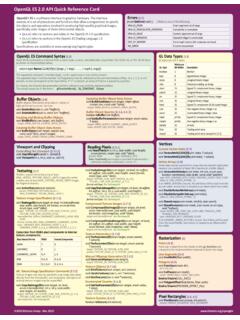
OpenGL ES 2.0 API Quick Reference Card - Khronos Group
OpenGL ES 2.0 API Quick Reference Card OpenGL® ES is a software interface to graphics hardware. The interface consists of a set of procedures and functions that allow a programmer to specify the objects and operations involved in producing high-quality graphical images, specifically color images of three-dimensional objects.
Download OpenGL ES 2.0 API Quick Reference Card - Khronos Group

Information
Domain:
Source:
Link to this page:
Documents from same domain
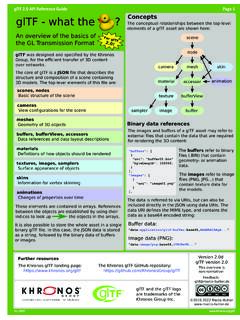
glTF 2.0 Quick Reference Guide Page 1 glTF a e TM T ...
www.khronos.orgto access 2D texture coordinates: The data of the bufferView may be bound as an OpenGL buffer, using glBindBuffer. Then, the properties of the accessor may be used to define this buffer as vertex attribute data, by passing them to ... glTF 2.0 Quick Reference Guide Page 4
The OpenGL ES Shading Language - Khronos Group
www.khronos.orgThis document restates the relevant parts of the GLSL specification and so is self-contained in this respect. However GLSL ES is also based on C++ (see section 12: Normative References) and this reference must be used in conjunction with this document. 1.1 Change History Changes from Revision 16 of the OpenGL ES Shading Language specification:

The OpenGL Shading Language - Khronos Group
www.khronos.orgChanges from revision 5 of version 1.20 • Removed notation showing additions and deletions to the specification, added table of contents, and cleaned up some cross-references and some resulting text-flow issues. No functional changes. Changes from revision 4 of version 1.20 • Updated the grammar. (It still has to be validated.)
The OpenGL Shading Language 4 - Khronos Group
www.khronos.orgThe OpenGL® Shading Language Language Version: 4.50 Document Revision: 7 09-May-2017 Editor: John Kessenich, Google Version 1.1 Authors: John Kessenich, Dave Baldwin, Randi Rost

The OpenGL® Shading Language, Version 4.60
www.khronos.orgwith a smaller number, the language accepted is a previous version of the shading language, which will be supported depending on the version and type of context in the API. See the normative references for details on what language versions are supported. Previous versions of the OpenGL Shading Language, as well as the OpenGL ES Shading Language,

The OpenGL Shading Language - Khronos Group
www.khronos.orgAll OpenGL Graphics System Specification references in this specification are to version 3.3. 1.1 Acknowledgments This specification is based on the work of those who contributed to past versions of the OpenGL Language Specification, the OpenGL ES 2.0 Language Specification, and the following contributors to this version: Pat Brown, Nvidia
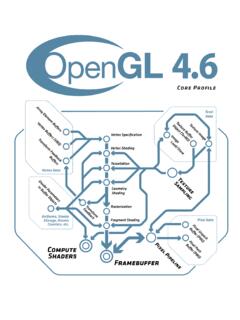
OpenGL 4.6 (Core Profile) - October 22, 2019
www.khronos.orgThe OpenGL R Graphics System: A Specification (Version 4.6 (Core Profile) - October 22, 2019) Mark Segal Kurt Akeley Editor (version 1.1): Chris …

Camera System API Working Group Proposed Scope of Work
www.khronos.orgJan 19, 2022 · The specification will be defined as an object-oriented API enabling bindings to C, C++ and other languages. ... The API shall provide flexible control over Sensor Captures, including the ability to mix persistent and optional ... Working Group an industry-wide call for participation shall be issued.

OpenGL 3.3 (Core Profile) - March 11, 2010
www.khronos.orgThe OpenGL R Graphics System: A Specification (Version 3.3 (Core Profile) - March 11, 2010) Mark Segal Kurt Akeley Editor (version 1.1): Chris Frazier Editor (versions 1.2-3.3): Jon Leech

The OpenCL Specification
www.khronos.orgLast Revision Date: 11/14/12 Page 9 Acknowledgements The OpenCL specification is the result of the contributions of many people, representing a cross
Related documents
Map Accuracy Standards - USGS
pubs.usgs.govpoint would be the intersection of two roads. Positions are established on the test points by field teams using sophis-ticated surveying techniques to determine positions from aerial photographs. Field survey methods are the only tests accepted for official accuracy testing. Positions must be obtained by surveys of a higher accuracy. Vertical ...

Metals Melting Temperatures Reference Chart
appliedmc.comThis document is for reference only and should not be construed as an express or implied warranty by Vize ... Information is subject to change without notice. Metal. Melting Point (°C) (°F) Admiralty Brass: 900-940 1650-1720: Aluminum 660: 1220 Aluminum Bronze: 600-655 1190-1215: Antimony 630: 1170 Beryllium: 1285 2345: Beryllium Copper 865 ...
Basic Elements of Style – Diction, Syntax, Point of View ...
www.mcpshs.netOct 16, 2014 · Basic Elements of Style – Diction, Syntax, Point of View, Tone, Theme . Diction = word choice – A study of diction is the analysis of how a writer uses language for a distinct purpose and effect, including word choice and figures of speech. “The difference between the right word and almost the right word is like the difference
Empathy and emotional intelligence: What is it really about?
internationaljournalofcaringsciences.orgunderstand the problem through the patient’s point of view • Respect: recognition and full acceptance of the patient as a person • Authenticity: honesty, real expression of views without hypocrisy • Warmth and unconditional positive recognition • Self exposure: health care professional reports personal experiences from his perspective