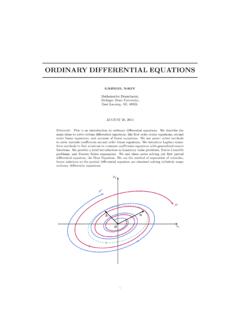
ORDINARY DIFFERENTIAL EQUATIONS
We introduce Laplace trans-form methods to nd solutions to constant coe cients equations with generalized source functions. We provide a brief introduction to boundary value problems, Sturm-Liouville problems, and Fourier Series expansions. We end these notes solving our rst partial di erential equation, the Heat Equation. We use the method of ...
Download ORDINARY DIFFERENTIAL EQUATIONS

Information
Domain:
Source:
Link to this page:
Documents from same domain
Thomas Calculus; 12th Edition: The Power Rule
users.math.msu.eduThomas Calculus; 12th Edition: The Power Rule Cli ord E. Weil September 15, 2010 The following paragraph appears at the bottom of page 116 of Thomas Calculus, 12th Edition. The Power Rule is actually valid for all real numbers n.
Convolution solutions (Sect. 6.6). - users.math.msu.edu
users.math.msu.eduConvolution solutions (Sect. 6.6). I Convolution of two functions. I Properties of convolutions. I Laplace Transform of a convolution. I Impulse response solution. I Solution decomposition theorem.
Special Second Order Equations (Sect. 2.2). Special Second ...
users.math.msu.eduSpecial Second Order Equations (Sect. 2.2). I Special Second order nonlinear equations. I Function y missing. (Simpler) I Variable t missing. (Harder) I Reduction order method. Special Second order nonlinear equations Definition Given a functions f : R3 → R, a second order differential equation in the unknown function y : R → R is given by
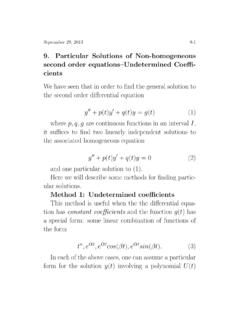
second order equations{Undetermined Coe - cients
users.math.msu.eduSeptember 29, 2013 9-1 9. Particular Solutions of Non-homogeneous second order equations{Undetermined Coe -cients We have seen that in order to nd the general solution to
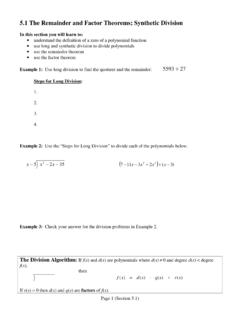
5.1 The Remainder and Factor Theorems.doc; Synthetic Division
users.math.msu.eduPage 2 (Section 5.1) Example 4: Perform the operation below. Write the remainder as a rational expression (remainder/divisor). 2 1 2 8 2 3 5 4 3 2 + − + + x x x x x Synthetic Division – Generally used for “short” division of polynomials when the divisor is in the form x – c. (Refer to page 506 in your textbook for more examples.)
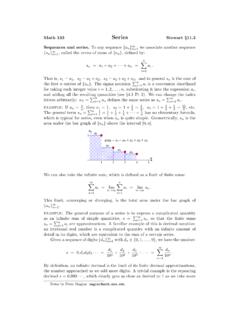
Math 133 Series Sequences and series. fa g
users.math.msu.eduGeometric sequences and series. A general geometric sequence starts with an initial value a 1 = c, and subsequent terms are multiplied by the ratio r, so that a n = ra n 1; explicitly, a n = crn 1. The same trick as above gives a formula for the corresponding geometric series. We have s …
The Laplace Transform (Sect. 6.1). - users.math.msu.edu
users.math.msu.eduThe Laplace Transform (Sect. 6.1). I The definition of the Laplace Transform. I Review: Improper integrals. I Examples of Laplace Transforms. I A table of Laplace Transforms. I Properties of the Laplace Transform. I Laplace Transform and differential equations.
Sequences and Series - Michigan State University
users.math.msu.edu2 2. Sequences and Series A topological way to say lima n = ais the following: Given any -neighborhood V (a) of a, there exists a place in the sequence after which all of the terms are in V (a): Easy Fact: lim(c) = cfor all constant sequences (c): Quanti ers. The de nition of lima n = aquanti es the closeness of a n to aby an arbi-
Convergence of Taylor Series (Sect. 10.9) Review: Taylor ...
users.math.msu.eduConvergence of Taylor Series (Sect. 10.9) I Review: Taylor series and polynomials. I The Taylor Theorem. I Using the Taylor series. I Estimating the remainder. The Taylor Theorem Remark: The Taylor polynomial and Taylor series are obtained from a generalization of the Mean Value Theorem: If f : [a,b] → R is differentiable, then there exits c ∈ (a,b) such that
Power series (Sect. 10.7) Power series definition and examples
users.math.msu.eduPower series (Sect. 10.7) I Power series definition and examples. I The radius of convergence. I The ratio test for power series. I Term by term derivation and integration. Power series definition and examples Definition A power series centered at x 0 is the function y : D ⊂ R → R y(x) = X∞ n=0 c n (x − x 0)n, c n ∈ R. Remarks: I An equivalent expression for the power series is
Related documents

Complex Signals - DTU
bme.elektro.dtu.dkwhere x∗(t) is the complex conjugate of x(t), and (↔) denotes a Fourier trans-form pair. Let the complex signal x(t) be expressed in the form: x(t) = x 1(t)+jx 2(t), (2.8) where x 1(t) and x 2(t) are real signals. Let their spectra be X 1(f) and X 2(f), respectively, i.e. x 1(t) ↔ X 1(f) and x 2(t) ↔ X 2(f). The real part of x(t) can be ...
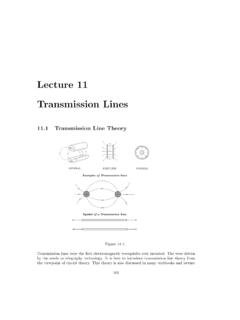
Lecture 11 Transmission Lines - Purdue University
engineering.purdue.edudomain data by performing a Fourier inverse transform. For a time-harmonic signal on a transmission line, one can analyze the problem in the frequency domain using phasor technique. A phasor variable is linearly proportional to a Fourier transform variable. The telegrapher’s equations (11.1.6) and (11.1.7) then become d dz V(z;!) = j!LI(z ...
Solutions to Exercises
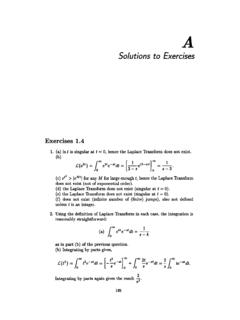
link.springer.comAn Introduction to Laplace Transforms and Fourier Series 1 1 1 9s 9(s + 3) 3(s + 3)2 ~ -~(3t + 1)e-3t 99· (d) This last part is longer than the others. The partial fraction decom position is best done by computer algebra, although hand computation is possible. The result is 1 1 3 1 2
Digital Signal Processing - University of Cambridge
www.cl.cam.ac.ukFourier transform. Harmonic phasors as orthogonal base functions. Forms of the Fourier transform, convolution theorem, Dirac’s delta function, impulse combs in the time and frequency domain. Discrete sequences and spectra. Periodic sampling of continuous signals, pe-riodic signals, aliasing, sampling and reconstruction of low-pass and band-pass
Lecture 7 -The Discrete Fourier Transform
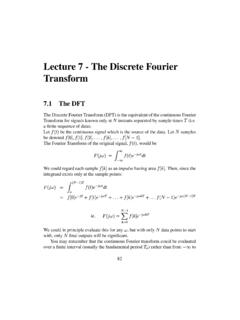
www.robots.ox.ac.ukThe Discrete Fourier Transform (DFT) is the equivalent of the continuous Fourier Transform for signals known only at instants separated by sample times (i.e. a finite sequence of data). Let be the continuous signal which is the source of the data. Let samples be denoted . The Fourier Transform of the original signal,, would be ...
Inverse Discrete Fourier transform (DFT)
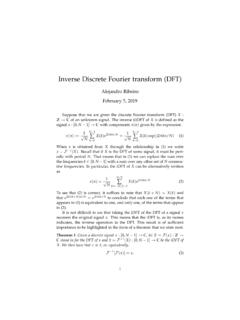
www.seas.upenn.edueasier to interpret, say the DFT X, we can compute the respective trans-form and proceed with the analysis. This analysis will neither introduce spurious effect, nor miss important features. Since both representations are equivalent, it is just a matter of which of the representations makes the identification of patterns easier.