
Oxidation Numbers: Rules
Covalent and ionic bonding represent two extremes: In pure nonpolar covalent bonds electrons are equally shared by the atoms In pure electrostatic ionic bonds electrons are completely transferred from one atom to the other Most compounds fall somewhere between these two …
Download Oxidation Numbers: Rules

Information
Domain:
Source:
Link to this page:
Documents from same domain

Ziegler-Natta polymerization of olefins - …
www.chem.tamu.eduZiegler-Natta polymerization of olefins - stereoselectivity CHEM 462: Inorganic/Organometallic Chemistry Haomiao Xie & Xu Ye . …
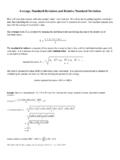
Average, Standard Deviation and Relative Standard …
www.chem.tamu.eduAverage, Standard Deviation and Relative Standard Deviation How will your data compare with other people’s data? Let’s find out. We will do this by pulling together everybody’s

Selected Bond Energies and Bond Lengths
www.chem.tamu.eduSelected Bond Energies and Bond Lengths Arranged according to families. Energy (D) in kJ/mol. Bond length (r) in picometers. Hydrogen Compounds

Paramagnetism and Diamagnetism - Department of Chemistry
www.chem.tamu.edu1 Paramagnetism and Diamagnetism zAtoms with unpaired ↑electrons are called paramagnetic. • Paramagnetic atoms are attracted to a magnet. zAtoms with paired ↑↓electrons are called diamagnetic. • Diamagnetic atoms are repelled by a magnet.

NMR spectroscopy of paramagnetic complexes. Part 39 ...
www.chem.tamu.eduMAGNETIC RESONANCE IN CHEMlSTRY, VOL. 31, 2-6 (1993) NMR Spectroscopy of Paramagnetic Complexes Part 39*-Natural Abundance *H NMR of Paramagnetic Sandwich Compounds Janet Blumel, Peter Hofmann and Frank H. Kohlert Anorganisch-chemisches Institut, Technische Universitat Miinchen, D-8046 Garching, Germany
Chemistry 689 A Brief Introduction to Symmetry and Group ...
www.chem.tamu.eduA Brief Introduction to Symmetry and Group Theory in Chemistry Instructor: Dr. Timothy Hughbanks Time: TTh 12:45 - 2:00 PM; Room 2121 ... After a brief introduction to the abstract theory of groups is ... Franzen Physical Chemistry of Solids, Basic Principles …

Electron Paramagnetic Resonance: Hyperfine Interactions
www.chem.tamu.edu§ Abragam & Bleaney Electron Paramagnetic Resonance of Transition Ions; § Carrington & McLachlan, Introduction to Magnetic Resonance; § Wertz & Bolton, Electron Spin Resonance. 2. ... • Basic ideas from MO theory and ligand field theory must be familiar. 6. Experimental Aspects • EPR performed at fixed frequency (i.e., field is
Oxidation Numbers: Rules
www.chem.tamu.edu1 Oxidation Numbers: Rules 1) The oxidation number of the atoms in any free, uncombined element, is zero 2) The sum of the oxidation numbers of all atoms

CO2 Reduction Catalysts and Catalysis
www.chem.tamu.eduCO2 Reduction Catalysts and Catalysis CHEM 462 Kristina Goldstein . Soomin Park . 1

Coordination Chemistry Transition Metal Complexes
www.chem.tamu.eduCoordination Chemistry Transition Metal Complexes Direct Application of Lewis AB and Hard/Soft AB “Theories” A TEP (Thermal Ellipsoid Plot) of ... Metals may exhibit multiple oxidation states 3. Metals may exhibit paramagnetism dependent on …
Related documents
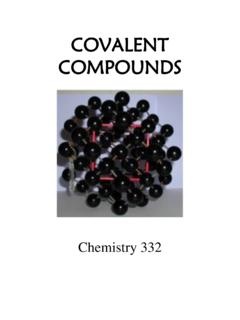
COVALENT - chemunlimited.com
chemunlimited.comCOVALENT COMPOUNDS Covalent compounds are made from two non-metals and so don’t follow the normal ionic rules. You can tell if a compound is covalent because it has prefixes modifying the species names. These species tell you exactly how many atoms are in the covalent compound. The prefixes are 1 = mono 2 = di 3 = tri
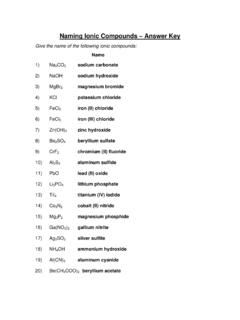
Naming Ionic Compounds – Answer Key
siemianowski.weebly.comNaming Mixed Ionic and Covalent - Answers Name the following compounds. Remember, they may be either ionic or covalent compounds, so make sure you use the right naming method! 1) NaF sodium fluoride 2) NF 3 nitrogen trifluoride 3) Li 2O lithium oxide 4) Al 2S 3 aluminum sulfide 5) MgSO 4 magnesium sulfate 6) SiH 4 silicon tetrahydride 7) KNO 3 ...
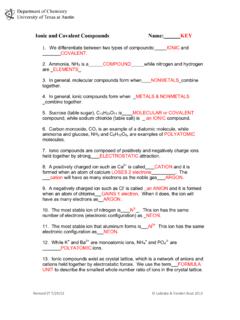
Ionic and Covalent Compounds Name: KEY
ch301.cm.utexas.eduIonic and Covalent Compounds Name: KEY!! 1. We differentiate between two types of compounds: IONIC and COVALENT. ! 2. Ammonia, NH3 is a COMPOUND while nitrogen and hydrogen are _ELEMENTS_. ! 3. In general, molecular compounds form when NONMETALS_combine together. ! 4. In general, ionic compounds form when _METALS & …
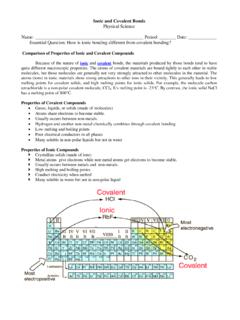
Ionic and Covalent Bonds
www.wsfcs.k12.nc.usInstructions: Classify the following properties as either Ionic or Covalent compounds. Write ionic or covalent on the space before each property. _____ 4. Atoms share electrons to become stable. _____ 5. High melting and boiling points _____ 6. Conduct electricity when melted _____ 7. Usually occurs between non-metals. ...
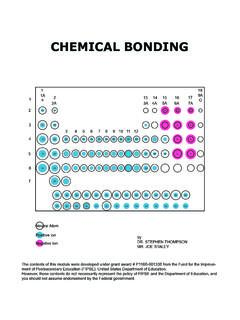
Chemical Bonding
www.smallscalechemistry.colostate.eduIonic bonds occur between metals and nonmetals when there is a large difference in electronegativity. Ionic Bonding In COVALENT BONDING the valence electrons are shared as pairs between the bonded atoms. Pure covalent bonding only occurs when two nonmetal atoms of the same kind bind to each other. When two