Part IV Generative Learning algorithms
5 1.2 The Gaussian Discriminant Analysis model When we have a classification problem in which the input features x are continuous-valued random variables, we can then use the Gaussian Discrim-
Download Part IV Generative Learning algorithms

Information
Domain:
Source:
Link to this page:
Documents from same domain
Data Fusion for Predicting Breast Cancer Survival
cs229.stanford.eduData Fusion for Predicting Breast Cancer Survival Linbailu Jiang, Yufei Zhang, Siyi Peng Mentor: Irene Kaplow December 11, 2015 1 Introduction 1.1 Background
Automated Bitcoin Trading via Machine Learning …
cs229.stanford.eduAutomated Bitcoin Trading via Machine Learning Algorithms Isaac Madan Department of Computer Science Stanford University Stanford, CA 94305 imadan@stanford.edu
Prediction of consumer credit risk - Machine learning
cs229.stanford.eduCS229 Prediction of consumer credit risk Marie-Laure Charpignon mcharpig@stanford.edu Enguerrand Horel ehorel@stanford.edu Flora Tixier ftixier@stanford.edu
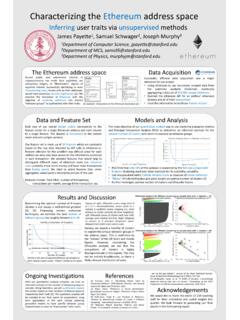
Inferring user traits via unsupervised methods
cs229.stanford.edufeature vector for a single Ethereum address and each column to a single feature. The dataset is normalized to the sample ... "Ethereum: A secure decentralised generalised transaction ledger." Ethereum Project Yellow Paper 151 (2014). [3] Kodinariya, Trupti M., and Prashant R. Makwana. "Review on determining number of Cluster in K-Means
X-Ray Photoelectron Spectroscopy Enhanced by …
cs229.stanford.eduX-Ray photoelectron spectroscopy (XPS) is a technique for identifying individual elements in a mixture/compound. Samples are irradiated by X …
More on Multivariate Gaussians - CS229: Machine …
cs229.stanford.eduMore on Multivariate Gaussians Chuong B. Do November 21, 2008 Up to this point in class, you have seen multivariate Gaussians arise in a number of appli-

Stock Trading with Recurrent Reinforcement …
cs229.stanford.eduStock Trading with Recurrent Reinforcement Learning (RRL) CS229 Application Project Gabriel Molina, SUID 5055783
James Payette,1 Samuel Schwager, and Joseph …
cs229.stanford.eduJames Payette,1 Samuel Schwager,2 and Joseph Murphy3 1Department of Computer Science, Stanford University, Stanford, CA 94305, USA 2Department of Mathematical and Computational Science, Stanford University 3Department of …

Sales Prediction with Time Series Modeling - …
cs229.stanford.eduSales Prediction with Time Series Modeling Gautam Shine, Sanjib Basak I. Introduction Predicting sales-related time series quantities like number of transactions, page views, and revenues is ... P.A. Fishwick, Time series forecasting using neural networks vs Box-Jenkins methodology, Simulation, Vol. 57 (1991) pp. 303-310.
Modeling approaches for time series forecasting …
cs229.stanford.edutime series regression and anomaly detection as well [17]. Some previous application of KNN regression have been forecasting traffic flow [20] and predict rice prices [18].
Related documents
Soft Skills are Smart Skills - Prasad Kaipa, PhD
kaipagroup.comSoft skills v7 ©2005 Kaipa Group Page 1 Soft Skills are Smart Skills Prasad Kaipa & Thomas Milus, SelfCorp, Inc. Subhash Chowdary, Ankhen, Inc.

MATHEMATICAL FORMULAE Algebra
orion.math.iastate.edu2 29. if a+ ib=0 wherei= p −1, then a= b=0 30. if a+ ib= x+ iy,wherei= p −1, then a= xand b= y 31. The roots of the quadratic equationax2+bx+c=0;a6= 0 are −b p b2 −4ac 2a The solution set of the equation is
DISCRIMINANT FUNCTION ANALYSIS (DA)
userwww.sfsu.educorrelations between the variables and the discriminant functions. Finally, the means for the significant discriminant functions are examined in order to
AS PURE MATHS REVISION NOTES
www.mathsbox.org.ukwww.mathsbox.org.uk AS PURE MATHS REVISION NOTES 1 SURDS • √A root such as 3 that cannot be written exactly as a fraction is IRRATIONAL
IBM SPSS Statistics 19 Statistical Procedures …
www.norusis.com377 Cluster Analysis IBM SPSS Statistics has three different procedures that can be used to cluster data: hierarchical cluster analysis, k-means cluster, and two-step cluster.
The World Health Organization’s WHOQOL-BREF …
www.pain-initiative-un.orgThe World Health Organization’s WHOQOL-BREF quality of life assessment: Psychometric properties and results of the international field trial

123-29: Creating and Exploiting SAS Indexes
www2.sas.com1 Paper 123-29 Creating and Exploiting SAS® Indexes Michael A. Raithel, Westat, Rockville, MD Abstract SAS indexes can drastically improve the performance of programs that access small subsets of observations from
Related search queries
Soft Skills are Smart Skills, MATHEMATICAL FORMULAE Algebra, DISCRIMINANT FUNCTION ANALYSIS, Discriminant, AS PURE MATHS REVISION NOTES, SPSS Statistics 19 Statistical Procedures, Assessment: Psychometric properties and results, Creating and Exploiting SAS Indexes, Creating and Exploiting SAS® Indexes