
Phase shift due to reflection - Physics Courses
Conditions for constructive and destructive interference (film in air) Constructive interference 1 2( ) 2 dm n l = + l /n is the speed of light in the media with refractive index n. The condition involves the half integer wavelength because of the phase shift due to reflection Destructive interference 2dm n l =
Download Phase shift due to reflection - Physics Courses

Information
Domain:
Source:
Link to this page:
Documents from same domain
3.1 Reflection and Refraction - University of California ...
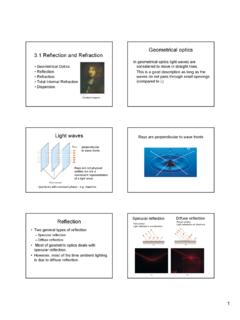
courses.physics.ucsd.edu3.1 Reflection and Refraction • Geometrical Optics • Reflection • Refraction • Total Internal Refraction • Dispersion Christian Huygens Geometrical optics In geometrical optics light waves are ... Refraction and Reflection The light beam (3) is refracted at the interface. 4
Reflection and Refraction of Light
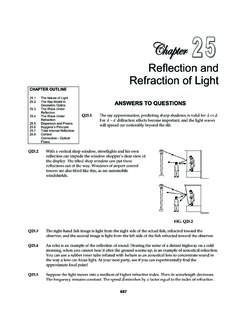
courses.physics.ucsd.edu688 Reflection and Refraction of Light Q25.6 If a laser beam enters a sugar solution with a concentration gradient (density and index of refraction increasing with depth) then the laser beam will be progressively bent downward (toward the normal) as it passes into regions of greater index of refraction.
Lecture Notes on Classical Mechanics (A Work in Progress)
courses.physics.ucsd.eduLecture Notes on Classical Mechanics (A Work in Progress) Daniel Arovas Department of Physics University of California, San Diego May 8, 2013
The Zeeman Effect - Physics Courses
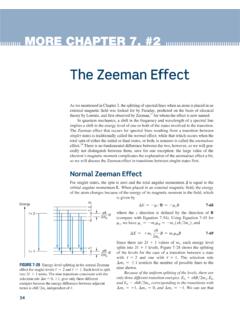
courses.physics.ucsd.eduMore Chapter 7 37 spin-orbit effect and decouples L and S so that they precess about B nearly indepen- dently; thus, the projections of L behave as if S 0, and the effect reduces to three lines, each of which is a closely spaced doublet. EXAMPLE 7-5 Magnetic Field of the Sun The magnetic field of the Sun and stars can be determined by measuring the Zeeman-effect splitting of …
Lecture Notes on Condensed Matter Physics (A Work in …
courses.physics.ucsd.eduLecture Notes on Condensed Matter Physics (A Work in Progress) Daniel Arovas Department of Physics University of California, San Diego March 14, 2010
Lecture Notes on Classical Mechanics (A Work in Progress)
courses.physics.ucsd.eduLecture Notes on Classical Mechanics (A Work in Progress) Daniel Arovas Department of Physics University of California, San Diego May 8, 2013
Lagrangian Mechanics - Physics Courses
courses.physics.ucsd.edu2 CHAPTER 6. LAGRANGIAN MECHANICS 6.2 Hamilton’s Principle The equations of motion of classical mechanics are embodied in a variational principle, called Hamilton’s principle. Hamilton’s principle states that the motion of a system is such that the action functional S q(t) = Zt2 t1 dtL(q,q,t˙ ) (6.2) is an extremum, i.e. δS = 0.
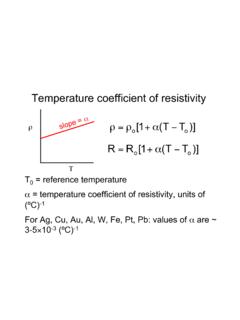
Temperature coefficient of resistivity
courses.physics.ucsd.eduPower Transmission Transmitting electrical power is done much more efficiently at higher voltages due to the desire to minimize (I2R) losses. Consider power transmission to a small community which is 100 mi from the power plant and which consumes power at a rate of 10 MW. In other words, the generating station needs to supply whatever power it ...
Lecture Notes on Superconductivity (A Work in Progress)
courses.physics.ucsd.eduLecture Notes on Superconductivity (A Work in Progress) Daniel Arovas Congjun Wu Department of Physics University of California, San Diego June 23, 2019
Physics 1B: Electricity & Magnetism
courses.physics.ucsd.eduMedical Devices (Defibrillators) EM Radiation (visible light, radio, TV, cell phones) Ch. 19: Electric Forces & Electric Fields Properties of electric charges & how they interact with each other --on both macroscopic and microscopic scales. Electric Charges & Conservation of Charge
Related documents
Double slit interference and single slit diffraction ...
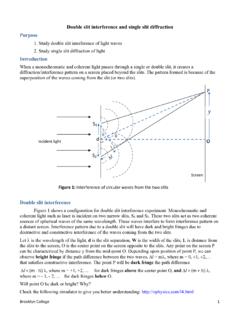
depthome.brooklyn.cuny.eduInterference pattern due to a double slit will have dark and bright fringes due to destructive and constructive interference of the waves coming from the two slits. Let l is the wavelength of the light, d is the slit separation, W is the width of the slits, L is distance from

Experiment 5: Polarization and Interference
www.columbia.eduWe want a bright spot, i.e. constructive interference In order for two maxima to overlap the difference in travel distance must be a multiple of the wavelength where m is an integer number and λ is the wavelength of incoming light Since D>>d we can use the small angle approximation: The distance of the m-th bright spot from the center is then:

Reflection and Interference from Thin Films
www.phys.ufl.eduPHY 2049: Chapter 36 14 Reflection and Interference from Thin Films ÎNormal-incidence light strikes surface covered by a thin film Some rays reflect from film surface Some rays reflect from substrate surface (distance d further) ÎPath length difference = 2d causes interference From full constructive to full destructive, depending on λ d n 1 n 2 n 0 = 1
Combination of Waves
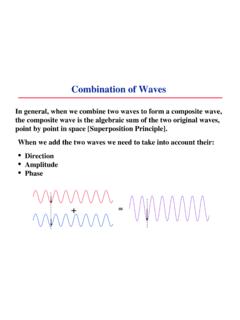
physics.ucf.eduInterference of Waves When light waves travel different paths, and are then recombined, they interfere. Each wave has an electric field whose amplitude goes like: E(s,t) = E 0 sin(ks-ωt) î Here s measures the distance traveled along each wave’s path. Mirror 1 2 * + = Constructive interference results when light paths differ

Interference and difiraction - Harvard University
scholar.harvard.edudestructive interference at places where the two waves are 180– out of phase (where the pathlengths from the two slits difier by an odd multiple of half of the wavelength). For example, there is constructive interference at point A in Fig.3 and …
Chapter 14 Interference and Diffraction
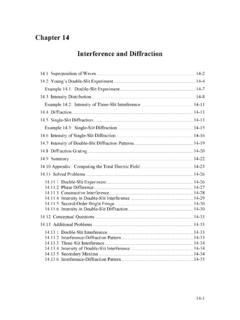
web.mit.eduThe interference is constructive if the amplitude of ψ(,x t)is greater than the individual ones (Figure 14.1.1b), and destructive if smaller (Figure 14.1.1c). As an example, consider the superposition of the following two waves at t =0:

Chapter 3 7 Inter ference of Light W aves
www3.nd.edu3 7.1 Conditions for Interference In Chapter 18, we found that the superposition of two mechanical waves can be constructive or destructive. In constructive inter ference, the amplitude of the resultant wave at a given position or time …