
Probabilistic Algorithms in Robotics
Autonomous robots must act in the face of uncertainty—a direct consequence of their inability to know what is the case. When making decisions, probabilistic approaches take the robot’s uncertainty into account. Some consider only the robot’s current uncertainty, others anticipate
Download Probabilistic Algorithms in Robotics

Information
Domain:
Source:
Link to this page:
Documents from same domain

Robotic Mapping: A Survey - Sebastian Thrun
robots.stanford.eduThe problem of robotic mapping is that of acquiring a spatial model of a robot’s environment. Maps are commonly used for robot navigation (e.g., localization) [7, 51].

Particle Filters in Robotics - Sebastian Thrun
robots.stanford.eduamples include the simultaneous localization and mapping problem [8, 27, 36, 45], which phrased as a state estima-tion problem involves a variable number of dimensions. A recent particle-filter algorithm known as FastSLAM [34] has been demonstrated to solve problems with more than
Simultaneous Localization and Mapping - Sebastian Thrun
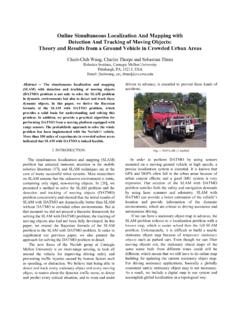
robots.stanford.eduThe simultaneous localization and mapping (SLAM) problem has attracted immense attention in the mobile robotics literature [17], and SLAM techniques are at the core of many successful robot systems. Most researchers on SLAM assume that the unknown environment is static,
FastSLAM: A Factored Solution to the Simultaneous ...
robots.stanford.eduFastSLAM: A Factored Solution to the Simultaneous Localization and Mapping Problem Michael Montemerlo and Sebastian Thrun School of Computer Science Carnegie Mellon University Pittsburgh, PA 15213 mmde@cs.cmu.edu, thrun@cs.cmu.edu Daphne Koller and Ben Wegbreit Computer Science Department Stanford University Stanford, CA 94305-9010
Stanley: The robot that won the DARPA Grand Challenge
robots.stanford.eduroof rack also holds two 24 GHz RADAR sensors, supplied by Smart Microwave Sensors. Both RADAR sensors cover the frontal area up to 200 m, with a cov-erage angle in azimuth of about 20°. Two antennae of this system are mounted on both sides of the laser sensor array. The lasers, camera, and radar system Figure 4.
Pyramidal Implementation of the Lucas Kanade Feature ...
robots.stanford.edu2 Description of the tracking algorithm The two key components to any feature tracker are accuracy and robustness. The accuracy component relates to ... is propagated to the next level L 1 by passing the new initial guess gL 1 of expression: gL 1 = 2(gL + dL): (7) The next level optical ow residual vector dL 1 is then computed through the same ...
Related documents

Wicked Problems and Clumsy Solutions: the Role of …
leadershipforchange.org.ukWicked Problems and Clumsy Solutions: the Role of Leadership Keith Grint BA (Hons) Sociology BA (Hons) Politics DPhil Professor of Public Leadership and Management

You Only Look Once: Unified, Real-Time Object Detection
pjreddie.com448 448 3 7 7 Conv. Layer 7x7x64-s-2 Maxpool Layer 2x2-s-2 3 3 112 112 192 3 3 56 56 256 Conn. Layer 4096 Conv. Layer Conn. Layer 3x3x192 …

3 Robots Free Sample - EnglishForEveryone.org
englishforeveryone.orgRobots are all around us. Some robots are used to make things. For example, robots can help make cars. Some robots are used to explore dangerous places. For example, robots can help explore volcanoes. Some robots are used to clean things. These robots can help vacuum your house. Some robots can even recognize words.
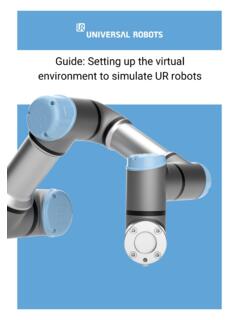
Guide: Setting up the virtual ... - Universal Robots
academy.universal-robots.comUniversal Robots makes available for users a virtual disk image of a Linux operating system containing the software that simulates Polyscope and the physical robots, called URSim. To run the simulator in another operating system, a virtual machine is needed.
Stanley: The robot that won the DARPA Grand Challenge
robots.stanford.eduThe robots all competed on the same course; starting one after another at 5 min intervals. When a faster robot overtook a slower one, the slower robot was paused by DARPA officials, allowing the second robot to pass the first as if it were a static obstacle. This eliminated the need for robots to handle the case of dynamic passing. 1.2. Team ...
ROS: an open-source Robot Operating System
www.robotics.stanford.eduFor example, on the large service robots for which ROS was designed, there are typically several onboard computers connected via ethernet. This network segment is bridged via wireless LAN to high-power offboard machines that are running computation-intensive tasks such as computer vision or speech recognition (Figure 1). Running the central

ROBOTS AND JOBS: NATIONAL BUREAU OF ECONOMIC …
www.nber.orgrobots—that are capable of replacing human labor in a range of tasks. Industrial robots are argued to have already deeply impacted the labor market and are expected to transform it in the decades to come (e.g., Brynjolfsson and McAfee, 2012; Ford, 2016). Indeed, between 1993 and 2007 the stock of robots in the United States and Western