Radiofrequency Plasma Sources for Semiconductor Processing
plasma, and the low frequency controls the ion distribution in the sheath. These devices are quite different from the original RIEs because they operate at high
Download Radiofrequency Plasma Sources for Semiconductor Processing

Information
Domain:
Source:
Link to this page:
Documents from same domain
Fundamentals of Chemical Reactor Theory1 - …
www.seas.ucla.edu1 UNIVERSITY OF CALIFORNIA, LOS ANGELES Civil & Environmental Engineering Department Fundamentals of Chemical Reactor Theory Michael K. Stenstrom

Introduction to Switched-Capacitor Circuits
www.seas.ucla.eduChapter 12. Introduction to Switched-Capacitor Circuits 398 Vout Vin C1 Vout V C C1 2 AB AB in0 (a) (b) Vin VA Vin0 t0 t Vin0 C1 C2 (c) Vout Figure 12.5. Circuit of Fig. 12.4 in (a) sampling mode, (b) amplification mode.

Noise in RF Design - Engineering
www.seas.ucla.eduEE215C B. Razavi Win. 13 HO #2 17 Example Noise Figure At high frequencies, it becomes difficult to measure the input-referred noise …
CMOS technology characterization for analog and …
www.seas.ucla.eduCMOS Technology Characterization for Analog and RF Design Behzad Razavi, Member, IEEE Abstract— The design of analog and radio-frequency (RF) circuits in CMOS technology becomes increasingly more difficult as device modeling faces new challenges in deep submicrometer processes and emerging circuit applications. The …

Analog Integrated Circuit Design - Engineering
www.seas.ucla.eduEE 215A HO#1 Fall 2014 Analog Integrated Circuit Design Instructor: Behzad Razavi 56-147D, Eng. IV
International Journal of Heat and Mass Transfer - …
www.seas.ucla.eduS;T refers to heat of mixing due to temperature gradient 638 A. d’Entremont, L. Pilon/International Journal of Heat and Mass Transfer 75 (2014) 637–649 depends on the ion concentration distribution and vice versa.

Seismic Code Requirements - Engineering
www.seas.ucla.eduBuilding Response Analysis zIn general, three types of analyses are done to design buildings subjected to earthquakes – Response History Analysis zLinear or nonlinear approach to calculate time varying responses (P, M, V, δ) – Response Spectrum Analysis zLinear approach to calculate modal responses (peak values) and combine modal responses
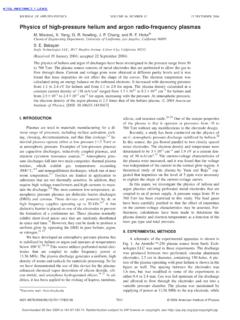
Physics of high-pressure helium and argon radio-frequency ...
www.seas.ucla.eduThe physics of helium and argon rf discharges have been investigated in the pressure range from 50 to 760 Torr. The plasma source consists of metal electrodes that are perforated to allow the gas to
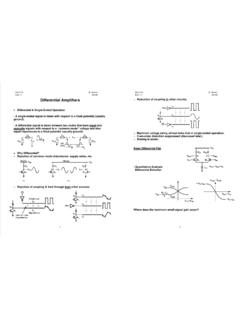
Fall 14 HO #8 - School of Engineering and Applied Science
www.seas.ucla.eduEE215A B. Razavi Fall 14 HO #8 1 Differential Amplifiers Differential & Single-Ended Operation - A single-ended signal is taken with

The Bandgap Reference - Engineering
www.seas.ucla.eduIEEE SOLID-STATE CIRCUITS MAGAZINE Summer 2016 11 First, a CMOS op amp directly driv-ing the feedback resistors must deal with gain-power-stabil-ity trade-offs.
Related documents

New York Mid and Low Back Injury Medical Treatment ...
www.wcb.ny.govNew York State Workers’ Compensation Board New York Mid and Low Back Injury Medical Treatment Guidelines Second Edition, January 14, 2013 iii

Analytical method Validation: ICP-OES
www.rsc.orgInstrument description: The instrument Inductively Coupled Plasma-Optical Emission Spectroscopy (ICP-OES) is used in atomic spectroscopy, and during analysis the sample is decomposed by intense heat into a cloud of hot gases containing free atoms and ions of the element(s) of interest. high temperatures cause significant amounts
Inductively Coupled Plasma/Optical Emission Spectrometry
www.unil.chemission source are so impressive that virtually all other emission sources [such as the flame, microwave-induced plasma (MIP), direct current plasma (DCP), laser-induced plasma (LIP), and electrical discharge] have been relegated to specific, narrowly defined appli-cation niches. Indeed, even much of the application field
Inductively Coupled Plasma Mass Spectrometry (ICP-MS)
www.iitk.ac.in(flame or plasma) Light and heat energy from high intensity source (plasma) High energy (light and heat) promotes an electron to a higher energy level (excitation). Electron falls back and emits light at characteristic wavelength Light emission is proportional to elemental concentration - -- -High energy (light and heat) ejects electron

Basic Principles of Atomic Absorption and Atomic Emission ...
www.philadelphia.edu.joFlame and Plasma Emission Spectroscopy are based upon those particles that are electronically excited in the medium. The Functions of Flame and Plasma 1. To convert the constituents of liquid sample into the vapor state. 2. To decompose the constituents into atoms or simple molecules: M+ + e-(from flame) -> M + hn 3.
CHAPTER 4 Inductively Coupled Plasma—Atomic Emission ...
www.whitman.edu4.3 Components of an Inductively Coupled Plasma—Atomic Emission Spectrometry System (ICP-AES) 4.3.1 Overview: An ICP-AES system can be divided up into two basic parts; the inductively coupled plasma source and the atomic emission spectrometry detector. Figure 4.1 shows the common components of an ICP-AES system from the late 1980s to the 1990s.

METHOD 200.7 DETERMINATION OF METALS AND TRACE …
www.epa.govBY INDUCTIVELY COUPLED PLASMA-ATOMIC EMISSION SPECTROMETRY 1.0 SCOPE AND APPLICATION 1.1 Inductively coupled plasma-atomic emission spectrometry (ICP-AES) is used to determine metals and some nonmetals in solution. This method is a consolidation of existing methods for water, wastewater, and solid wastes. 1-4

METHOD 6010D INDUCTIVELY COUPLED PLASMA OPTICAL …
www.epa.govnebulized and the resulting aerosol is transported to the plasma torch. Element-specific emission spectra are produced by a radio-frequency, inductively coupled plasma. The spectra are dispersed by a grating spectrometer, and the intensities of the emission lines are monitored by photosensitive devices.

Chapter 3 Flame Atomic Absorption and Emission …
www.whitman.eduAn emission spectrometer can be identical to an absorption system except that no external light source is used to excite the atoms. In flame emission spectroscopy, the electrons in the analyte atoms are excited by the thermal energy in the flame. Thus the sample is the source of photon emissions through
Inductively Coupled Plasma-Atomic Emission Spectroscopy
www.ocf.berkeley.eduICP-AES, or Inductively Coupled Plasma-Atomic Emission Spectroscopy (also known as ICP-OES, Optical Emission Spectroscopy), is a type of emission spectroscopy that is often used to detect the presence of trace metals in a sample. Through the use of the eponymous Inductively Couple Plasma, an ICP-AES produces excited ions and atoms