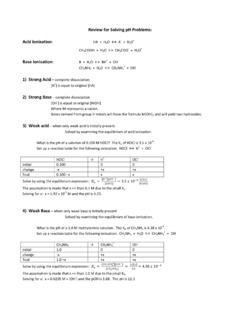
Review for Solving pH Problems: Base Ionization 1)
c) strong base to a buffer solution A problem of this type would have a reaction followed by an equilibrium. The reaction would be solved as described in 6 above.
Download Review for Solving pH Problems: Base Ionization 1)

Information
Domain:
Source:
Link to this page:
Documents from same domain

Chem 1721 Brief Notes: Chapter 14 Chapter 14: …
www2.onu.eduChem 1721 Brief Notes: Chapter 14 Chapter 14: Chemical Equilibrium In this chapter we will discuss What is the state of dynamic equilibrium?

Chapter 13 Rates of Reaction - Ohio Northern …
www2.onu.eduChapter 13 Rates of Reaction Chemical Kinetics: Rates of Chemical Reactions & Factors that Affect Rates of Reactions How fast does a chemical reaction occur? rates of reactants consumed

Chapter 12 Solutions - Ohio Northern University
www2.onu.eduChapter 12 Solutions solute + solvent ! solution speciation? stoichiometry? empirical solubility rules: Which ionic compounds are soluble in water? electrolyte definitions:

Chapter 16: Acid-Base Equilibria
www2.onu.eduChapter 16: Acid-Base Equilibria In the 1st half of this chapter we will focus on the equilibria that exist in aqueous solutions containing: weak acids polyprotic …

Chapter 17: Overview of the Chapter Solubility & …
www2.onu.eduChapter 17: Solubility & Complex Ion Equilibria The goal of this chapter is to understand the equilibria that exist between ionic solids and their ions in solution, and

Overview of the Chapter Chapter 18 …
www2.onu.eduChapter 18 Thermodynamics and Equilibrium Overview of the Chapter Look at equilibrium from the perspective of thermodynamics energy considerations in …

bond dissociation enthalpy HBDE Ionic and Covalent Bonding
www2.onu.eduChapter 9 Ionic and Covalent Bonding the chemical bond: the force that holds atoms or ions together as an aggregate unit bond energy (or bond dissociation enthalpy, ∆HBDE): energy required to break a chemical bond Cl–Cl (g) ! 2 Cl (g); ∆H = bond

SI: INTERNATIONAL SYSTEM of UNITS (a.k.a. METRIC)
www2.onu.eduSI: INTERNATIONAL SYSTEM of UNITS (a.k.a. METRIC) • used universally in science • convenient decimal structure quantity : a number and units ; may be measured, calculated, or derived from other quantities e.g. JAG height = 18.8 base units : fundamental units from which all others in the system …

Chapter 14: Acids and Bases - Ohio Northern University
www2.onu.eduThe reaction of interest is: OH-(aq) + H 2 O(l) H 2 O(l) + OH-(aq).Since there is no net change in the molecules present after the reaction, it is sufficient to know that the base dissociates in water.
Related documents

Market Failure and Government Failure - Michael Munger
michaelmunger.com2 For some, market failures serve as a rationale for public intervention. However, the fact that self-interested market behavior does not always produce felicitous social consequences is not

Fugacity - The Pillars Curriculum for Chemical Engineering
pillars.che.pitt.eduPhase Equilibrium: Fugacity and Equilibrium Calculations (FEC) Phase Equilibrium: Fugacity and Equilibrium Calculations • Relate the fugacity and the chemical potential (or …
Acid-base Equilibria and Calculations
www.chem1.com• Acid and base strengths. 1.2 Acid and base strengths. The equilibrium constants that define the strengths of an acid and of a base are K. a = [H. 3. O +][OH ]

Type 1 - Calculating Keq Given Equilibrium Concentrations
www.colgurchemistry.comChemistry 12 Unit 2 Notes - Equilibrium Unit 2 Notes – Equilibrium Page 64 A variation of Type 1 problems is when you are given the Keq and all the equilibrium concentrations except one and you are asked to calculate that one.

Alberto Bisin Dept. of Economics NYU January 12, 2011
www.nyu.eduPreface Introduction to Economic Analysis is the introductory class I taught for several years at NYU. It is the –rst class of the theory concentration major in
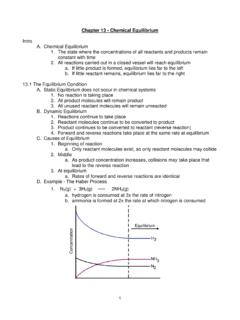
Chapter 13 - Chemical Equilibrium - ScienceGeek.net
www.sciencegeek.netA. Procedure for Solving Equilibrium Problems 1. Write the balanced equation for the reaction 2. Write the equilibrium expression using the law of mass action