![[SEM] Structural Equation Modeling](/cache/preview/7/0/f/3/a/1/3/0/thumb-70f3a130b29203a686082ca257f48745.jpg)
[SEM] Structural Equation Modeling
intro 1 — Introduction DescriptionRemarks and examplesAlso see Description SEM stands for structural equation model. Structural equation modeling is 1. A notation for specifying SEMs. 2. A way of thinking about SEMs. 3. Methods for estimating the parameters of SEMs. Stata’s sem and gsem commands fit these models: sem fits standard linear ...
Download [SEM] Structural Equation Modeling

Information
Domain:
Source:
Link to this page:
Documents from same domain
Syntax - Stata
www.stata.com2cluster kmeans and kmedians— Kmeans and kmedians cluster analysis Options Main k(#) is required and indicates that # groups are to be formed by the cluster analysis.
Syntax Description - Stata
www.stata.com2substr()— Extract substring Diagnostics In substr(s, b, l) and substr(s, b), if b describes a position before the beginning of the string or after the end, "" is returned.
Title stata.com generate — Create or change …
www.stata.comTitle stata.com generate — Create or change contents of variable SyntaxMenuDescriptionOptions Remarks and examplesMethods and formulasReferencesAlso see Syntax Create new variable generate type newvar
SyntaxDescriptionRemarks and examplesAlso see
www.stata.commacro— Macro definition and manipulation 3 Macro extended functions related to matrices rownamesjcolnamesjrowfullnamesjcolfullnames matname roweqjcoleq
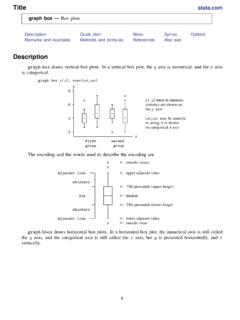
Title stata.com graph box — Box plots
www.stata.comgraph box— Box plots 3 Menu Graphics > Box plot Syntax graph box yvars if in weight, options graph hbox yvars if in weight, options where yvars is a varlist options Description
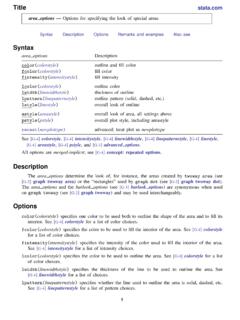
Title stata
www.stata.comarea options — Options for specifying the look of special areas 3 Also see [G-2] graph dot — Dot charts (summary statistics)
www.stata.com
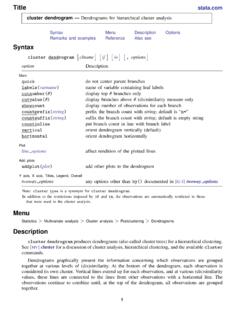
www.stata.com2cluster dendrogram— Dendrograms for hierarchical cluster analysis The height of the vertical lines and the range of the (dis)similarity axis give visual clues about the
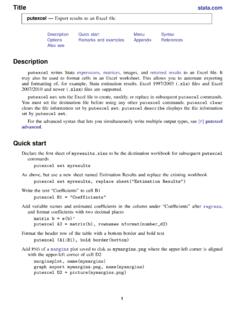
Title stata.com putexcel — Export results to an Excel …
www.stata.computexcel— Export results to an Excel file 3 export options Description Main overwritefmt overwrite existing cell formatting when exporting new content
destring — Convert string variables to numeric ... - …
www.stata.comTitle stata.com destring — Convert string variables to numeric variables and vice versa SyntaxMenuDescription Options for destringOptions for tostringRemarks and …
Title stata.com gettoken — Low-level parsing
www.stata.comTitle stata.com gettoken — Low-level parsing SyntaxDescriptionOptionsRemarks and examplesAlso see Syntax gettoken emname1 emname2: emname3, parse("pchars") quotes qed(lmacname) match(lmacname) bind
Related documents
An Introduction in Structural Equation Modeling
www.joophox.netIntroduction Structural Equation Modeling 1 Family Science Review, 11, 354-373. An Introduction to Structural Equation Modeling1 J.J. Hox University of Amsterdam/Utrecht University T.M. Bechger CITO, Arnhem Abstract This article presents a short and non-technical introduction to Structural Equation Modeling or SEM.
Chapter 12 Introduction to Organic Chemistry: Hydrocarbons
ion.chem.usu.eduChapter 12 – Introduction to Organic Chemistry: ... Write the IUPAC names and draw the condensed or line-angle structural formulas for alkanes and cycloalkanes. ... Write the balanced chemical equation for the complete combustion of cyclopropane. a. C 3 H 8 + O 2 CO 2 + H 2 O b. C 3 H 8 + 5O 2 3CO 2 + 4H 2 O

Partial Least Squares Structural Equation Modeling (PLS ...
marketing-bulletin.massey.ac.nzIntroduction . Structural Equation Modeling (SEM) is a second-generation multivariate data analysis method that is often used in marketing research because it can test theoretically supported linear and additive causal models (Chin, 1996; & KaplanHaenlein , …

Chapter 16 – Structural Dynamics - Memphis
www.ce.memphis.eduStructural Dynamics Dynamics of a Spring-Mass System The standard form of the equation is: The above equation is a second-order linear differential equation whose solution for the displacement consists of a homogeneous solution and a particular solution. The homogeneous solution is the solution obtained when the right-hand-side is set equal to ...

Hierarchical Linear Modeling (HLM): An Introduction to Key ...
files.eric.ed.govChapter 1: Introduction Hierarchical linear modeling (HLM) is a powerful and flexible statistical framework for analyzing complex nested relationships. In education, for example, we may be interested in ... sections of the structural equation modeling manuscript from this series (Anderson, Patarapichayatham, & Nese, 2013). Because the intended ...
Structural Equation Modeling Using AMOS
stat.utexas.eduStructural equation modeling (SEM) encompasses such diverse statistical techniques as path analysis, confirmatory factor analysis, causal modeling with latent variables, and even analysis of variance and multiple linear regression. The course features an introduction to the logic of SEM, the assumptions and

The Basics of Structural Equation Modeling
www.lexjansen.comStructural equation modeling (SEM) is a methodology for representing, estimating, and testing a network of relationships between variables (measured variables and latent constructs). This tutorial provides an introduction to SEM including comparisons between “traditional statistical” and SEM analyses.