
SOLUBILITY, IONIC STRENGTH AND ACTIVITY COEFFICIENTS ...
of interest and also on the diameters of ions of opposite sign that may be present in the solution. For aqueous solutions at 25oC, the value of A is 0.509; for Ca(IO 3) 2 with KCl ions, a value of B = 1.09 at 25oC seems to give the best value of the slope. Combining Eq. (8) for the (+) and (-) ions gives Eq. (10) for γ ±. Correspondingly Eq ...
Download SOLUBILITY, IONIC STRENGTH AND ACTIVITY COEFFICIENTS ...

Information
Domain:
Source:
Link to this page:
Documents from same domain

Guidelines for Literature/Review Proposal
homepages.wmich.eduEMR 6400 Fundamentals of EMR Guidelines for Literature/Review Proposal DUE APRIL 9, 2008 Introduction The introduction to the literature review/proposal orients the reader to the problem under study

Writing a Thought Paper: The Ten-Step Process
homepages.wmich.edu1 Writing a Thought Paper: The Ten-Step Process There are many things that go into writing a good thought paper. One might compare it to building a house.
PROPERTY TABLES AND CHARTS (SI UNITS) - …
homepages.wmich.eduTABLE A –1 Molar mass, gas constant, and critical-point properties Gas Critical-point properties Molar mass, constant, Temperature, Pressure, Volume,
5.1 Shell-and-Tube Heat Exchangers - Homepages at WMU
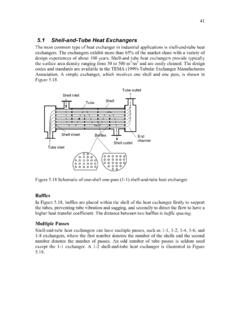
homepages.wmich.eduShell-and-tube heat exchangers can have multiple passes, such as 1-1, 1-2, 1-4, 1-6, and 1-8 exchangers, where the first number denotes the number of the shells and the second number denotes the number of passes.

The Man-eater of Malgudi R. K. Narayan SYNOPSIS
homepages.wmich.eduThe Man-eater of Malgudi | R. K. Narayan SYNOPSIS ANALYSIS Originally published in 1961, The Man-eater of Malgudi tells the tale, through the first-person voice, of a printer ... A Tiger for Malgudi and The Man-Eater of Malgudi. New York: Penguin Books, 2009. Print Theme: Nature •While perhaps an obvious element,

Balance of Payments - Homepages at WMU
homepages.wmich.edu• The Balance of Payments should balance; thus CA+ KA = 0 Thus, if we are running a CA surplus, we will have a KA deficit; a CA deficit implies a KA surplus A KA deficit indicates that the country is a net lender; A KA surplus indicates that the country is a net debtor

Attachment styles, shame, guilt, and collaborative problem ...
homepages.wmich.eduAttachment styles, shame, guilt, and collaborative problem-solving orientations FREDERICK G. LOPEZ, MARK R. GOVER, JENNIE LESKELA, ERIC M. SAUER, ... tionships of attachment styles, shame and guilt, and problem-solving orientations is clearly warranted. I90 EG. Lopez et al.
Chapter 5 Compact Heat Exchangers (Part III)
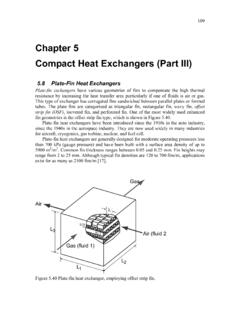
homepages.wmich.edu109 Chapter 5 Compact Heat Exchangers (Part III) 5.8 Plate-Fin Heat Exchangers Plate-fin exchangers have various geometries of fins to compensate the high thermal resistance by increasing the heat transfer area particularly if one of fluids is air or gas.

Chapter 11 Density of States, Fermi Energy and Energy Bands
homepages.wmich.edu11-3 ! p k (11.6) Knowing the momentum p = mv, the possible energy states of a free electron is obtained m k m p E mv 2 2 2 1 2 2 ! (11.7) which is called the dispersion relation (energy or frequency-wavevector relation). Effective Mass In reality, an electron in a crystal …

Alan Turing: “Computing Machinery and Intelligence”
homepages.wmich.eduWhat is a “computer?” •“A person who makes calculations or computations; a calculator, a reckoner; spec.a person employed to make calculations in an observatory, in surveying,
Related documents
Eye on Ions: Electrical Conductivity of Aqueous Solutions
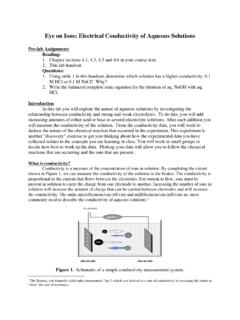
web.colby.eduEye on Ions: Electrical Conductivity of Aqueous Solutions Pre-lab Assignment: Reading: 1. Chapter sections 4.1, 4.3, 4.5 and 4.6 in your course text. 2. This lab handout. Questions: 1. Using table 1 in this handout, determine which solution has a higher conductivity, 0.1 M HCl or 0.1 M NaCl? Why? 2.
Chemical Bonding - Colorado State University
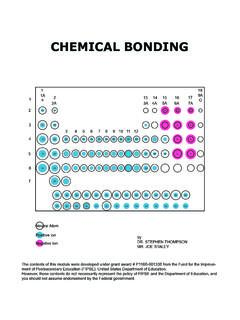
www.smallscalechemistry.colostate.eduIONS: COUNTING ELECTRONS AND PROTONS Li 3+ In the pictures below, draw in the number of elec-trons required to make the atom neutral and write the element symbol in the box to the left of the atom. 11+ 17+ 8+ 9+ NEUTRAL ATOMS POSITIVE IONS Positive ions have more protons than electrons. Since the number of protons an atom has is fi xed in
Conductance Measurements Part 1:Theory
www.currentseparations.comConductivity and Concentration The experimentally determined conductivity reflects contributions from all ions present in solution that are mobile and can support the cur-rent. Conductivity can be written in terms of the mobilities of all of the ions present (3): where F is the Faraday constant (96,485 C/mol), and Ci is the con-
LITHIUM-ION BATTERIES - Nobel Prize
www.nobelprize.orgsame time, Y. Yao and J.T. Kummer studied ionic conductivity in solids, and showed that sodium ions can move at the same rate in solids as in salt melts.16 Kummer also proposed the use of this configuration for batteries in a patent from 1969.17 At the same time, John Newman developed a theory for ion transfer in electrochemical cells.18 Figure ...
Questions on Instrumental Methods of Analysis
www.philadelphia.edu.joAqueous KMnO 4 solutions are purple. A plot of absorbance against concentration is: a. non-linear. b. linear with a negative gradient. c. linear with a positive gradient. d. an exponential curve. Answer = c 37.A shift to lower wavenumber for an absorption in a spectrum corresponds to: a. a loss of intensity. b. a shift to lower wavelength.
I. Acidic and Basic water solutions: Dissociation of water O
www.sas.upenn.edugenerally true for all polyprotic acids; essentially all of the H+ ions come from the first dissociation. C. Determining Experimentally Measure electrical conductivities of solutions. 0.10M HF will have low conductivity since small amount of ions to conduct a current. 0.10M HCl has a high conductivity, 10 times that of HF. IV. Strong and Weak Bases
Electroanalytical 6.2.4 Conductometric Titrations Methods-II
www.tau.ac.ilhydrogen ions by the added cation as H + ions react with OH − ions to form undissociated water. This decrease in the conductance continues till the equivalence point. At the equivalence point, the solution contains only NaCl. After the equivalence point, the conductance increases due to the large conductivity of OH-ions (Fig. 6.2).

pH in Drinking-water - WHO
www.who.intimparted by bicarbonate, carbonate, and hydroxyl ions, this temperature effect is modified (1). The pH of most raw water lies within the range 6.5–8.5 (1). ANALYTICAL METHODS The pH of an aqueous sample is usually measured electrometrically with a glass electrode. Temperature has a significant effect on pH measurement (1,2).
pH in Drinking-water - WHO
www.who.inthydroxyl ions, this temperature effect is modified (APHA, 1989). The pH of most drinking-water lies within the range 6.5–8.5. Natural waters can be of lower pH, as a result of, for example, acid rain or higher pH in limestone areas. 2. ANALYTICAL METHODS The pH of an aqueous sample is usually measured electrometrically with a glass electrode.