Transcription of Alan Turing: “Computing Machinery and Intelligence”
1 Can (non-human) machines think?Alan Turing: computing Machinery and intelligence What is a computer? A person who makes calculations or computations; a calculator, a reckoner; person employed to make calculations in an observatory, in surveying, etc. Now chiefly hist. [OED] ENIAC: Electronic Numerical Integrator and Computer (1946) was the world s first electronic Turing complete computer. [Wiki]Logic Gate: A Simple Computer More Gates, Smaller Package30 years: 250,000 times more RAM1985:Kaypro: 64 KB RAM2015:Mac: 16 GB RAMC ould Computers Think? What is thinking? Turing means more than mere calculating. What kindsof things can think? Human beings? Non-human animals? Computers? How can we tellif something can think? How do I know if you are a thinking thing? How do I knowthat youare conscious?Turing: The realquestion concerns how it is that we can tellif something is thinking.
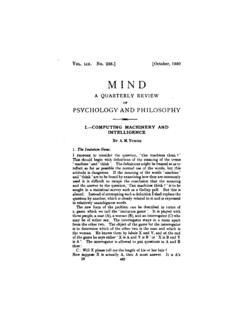
2 He offers a functional definition of thinking: A thing thinks if it meets the same observable criteria as do the obvious cases of thinking things, , if it acts (in the relevant ways) the same way that human beings Imitation Game: Played with 3 people a man (A), a woman (B), and an interrogator (C). The interrogator stays in a room apart from the other two. The interrogator asks questions and tries to determine, from the answers, which answerer is the man and which is the s Strategy Instead of asking whether or not a computer can think, How could we measurethat? Ask instead whether or not a computer could successfully play the imitation game, and fool a questioner trying to figure out which answers come from a human. This is at least something we can s Imitation Game Can digital computers be made to play satisfactorily the part of A in the imitation game?
3 The new problem has the advantage of drawing a fairly sharp line between the physical and the intellectual capacities of a man. , by looking at the answers provided (rather than what the answerer looks like, etc.), it focuses on what is essential to : I believe that .. it will be possible to program computers, with a storage capacity of 109[ , 10 gigabytes], to make them play the imitation game so well that an average interrogator will not have more than 70% chance of making the right identification after five minutes of questioning. Turing s Claim Any computer (hardware plus software plus data) that can successfully play the imitation game .. , one that can provide answers to our questions to it that we can t distinguish from the answers provided by a human being ..thinks! I have no more reason to deny that it is conscious or has inner states than I have to deny that s Reasoning The Imitation Game gives us a functional definition(a behavioral criterion) for whether or not something can think.
4 Since we can t look inside other people s minds this is the best criterion we can get. If computers can successfully play the imitation game, then they meet the behavioral criterion, and so (we would have no reason to deny that) they think. So, if it quacks like a duck, it s a duck!Objection: The Argument from Consciousness 1) Only things which are conscious ( , that have conscious mental states) can think. 2) Computers are not conscious ( , do not have conscious mental states). 3) Therefore, computers cannot s Response: But how do we knowthat computers aren t conscious? Isn t this essentially the same question we are discussing .. , whether or not computers can think? The objection begs the question: The real question is whether or not computers can be conscious. The objection just assumesthat they cannot. Question: How can we tell if other human beings are conscious what makes us believe that other human beings can think?
5 Who/what thinks? I am pretty sure that Ithink! I am directly aware of my own thoughts. How can I tell if someone (something) else thinks? that it has a conscious inner life? If I need to be directly aware of their thoughts, then I can t know anyone thinks except me. If I don t need to be directly aware of their thoughts, I must rely on observablecriteria. The Turing Test appeals to such Think: Do You?The upshot : I can t directly experience anyone s conscious mental states but my own. All I can observe is their behavior (how they answer questions, etc.). If I conclude that other people think, solely on the basis of observing their behavior, without directly seeing their conscious mental states, then I must reach the same conclusion about computers. Alternately put: If I deny that computers can think because I can t see their inner states, then I will have to deny that other humans can think, for the same reason.
6 This is : The criteria we in factuse to attribute thinking (consciousness) to other human beings are behavioral. Since we can t directly experience their inner states, we must be basing our judgement solely on their observable linguistic behavior how they verbally interact with us. If these are the criteria I use with other human beings, it would be inconsistent to demand some higher standard of computers. So, if a computer could meet the same standards of linguistic behavior we apply in judging that other human beings think ( , if it could successfully play the imitation game), we must, on pain of inconsistency, claim that it thinks, , that it is conscious.