TCP/IP Tutorial and Technical Overview
TCP/IP Tutorial and Technical Overview December 2006 International Technical Support Organization GG24-3376-07
Download TCP/IP Tutorial and Technical Overview

Information
Domain:
Source:
Link to this page:
Documents from same domain
Performance Optimization and Tuning Techniques …
www.redbooks.ibm.comRedbooks Front cover Performance Optimization and Tuning Techniques for IBM Power Systems Processors Including IBM POWER8 Peter Bergner Brian Hall
IBM Spectrum Scale (formerly GPFS)
www.redbooks.ibm.comRedbooks Front cover IBM Spectrum Scale (formerly GPFS) Dino Quintero Luis Bolinches Puneet Chaudhary Willard Davis Steve Duersch Carlos Henrique Fachim
IBM Spectrum Archive Single Drive Edition and …
www.redbooks.ibm.comInternational Technical Support Organization IBM Spectrum Archive SDE and LE: Installation and Configuration Guide March 2018 SG24-8090-01
IBM PowerVM Best Practices
www.redbooks.ibm.comibm.com/redbooks IBM PowerVM Best Practices Adriano de Almeida Rafael Antonioli Urban Biel Sylvain Delabarre Bartłomiej Grabowski Kristian Milos Fray L Rodríguez
ABCs of IBM z/OS System Programming Volume 3
www.redbooks.ibm.comInternational Technical Support Organization ABCs of IBM z/OS System Programming Volume 3 January 2018 SG24-6983-04
Implementing the IBM Storwize V7000 Gen2 - IBM …
www.redbooks.ibm.comInternational Technical Support Organization Implementing the IBM Storwize V7000 Gen2 January 2015 SG24-8244-00
PowerHA SystemMirror for IBM i Cookbook - IBM …
www.redbooks.ibm.comibm.com/redbooks Front cover PowerHA SystemMirror for IBM i Cookbook Hernando Bedoya Abdell Ali-Darwish Ingo Dimmer Sabine Jordan KyoSeok Kim Akinori Mogi Nandoo Neerukonda
Technical Overview of WebSphere Process Server …
www.redbooks.ibm.com2 Technical Overview of WebSphere Process Server and WebSphere Integration Developer Integration Business and
IBM PowerVM Virtualization Introduction and …
www.redbooks.ibm.comIBM PowerVM Virtualization Introduction and Configuration June 2013 International Technical Support Organization SG24-7940-05
System Programmer's Guide to: z/OS System Logger
www.redbooks.ibm.comInternational Technical Support Organization System Programmer’s Guide to: z/OS System Logger July 2007 SG24-6898-01
Related documents

FINANCIAL MANAGEMENT MANUAL - OSI
www.orgwise.cafinancial data. The manual is generally used by finance staff, but it can also act as a reference for board members, managers and other staff. There is no one model of a financial procedures manual that suits all and yours will depend on the needs and structure of your organization. …

System Management Bus
www.smbus.orgthe SMBus as they would appear in the first three layers of the OSI reference network model, the physical layer the data link layer and the network layer. The section on the physical layer sets out SMBus electrical characteristics. The section on the data link layer specifies bit transfers, byte data transfers, arbitration and clock signals.

CHAPTER FOUR OSI Model and Network Protocols
access.itxlearning.commodel. Even though the OSI model is conceptual, an appreciation of its purpose and function can help you better understand how protocol suites and network architectures work in practical applications. The OSI Seven-Layer Model As shown in Figure 4.1, the OSI reference model is built, bottom to top, in the

OSI Reference Model - Router Alley
www.routeralley.comOSI Reference Model The Open Systems Interconnection (OSI) model was developed by the International Organization for Standardization (ISO), and formalized in 1984. It provided the first framework governing how information should be sent across a network. The OSI model consists of seven layers, each corresponding to a specific network function:

Asynchronous Transfer Mode (ATM)
www.cse.wustl.eduThe ATM protocol reference model is based on standards developed by the ITU. Communi-cation from higher layers is adapted to the lower ATM defined layers, which in turn pass the information onto the physical layer for transmission over a selected physical medium. The protocol reference model is divided into three layers: the ATM adaptation ...
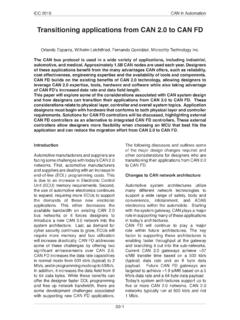
Transitioning applications from CAN 2.0 to CAN FD
www.can-cia.orgOSI reference model – ISO 11898-1/2 Figure 1: OSI reference model [1] The Layered Architecture according to the OSI Reference Model specified in the ISO 11898-1 is the same for both CAN 2.0 and CAN FD (shown in Figure 1). The differences within the OSI Reference Model between CAN 2.0 and CAN FD are in the Logical Link Control (LLC) and the Medium
TJA1021 - NXP
www.nxp.comThe LIN physical layer is independent of higher OSI model layers (e.g., the LIN protocol). Consequently, nodes containing an ISO 17987-compliant physical layer can be combined, without restriction, with LIN physical layer nodes that comply with earlier revisions (LIN1.0, LIN 1.1, LIN 1.2, LIN 1.3, LIN 2.0, LIN 2.1, LIN 2.2 and LIN 2.2A).

INTRODUCTION TO PROFIBUS DP - Unict
www.diit.unict.itthe OSI (Open System Interconnection) reference model per international standard ISO 7498. In this model, every layer handles precisely defined tasks. Layer 1 of this model is the physical layer and defines the physical transmission characteristics. Layer 2 is the data link layer and defines the bus access protocol.
Understanding Layer 2, 3, and 4 Protocols - pearsoncmg.com
ptgmedia.pearsoncmg.comOSI Seven Layer Model. When we talk about Layer 2 and Layer 3 networking, it is these layers that we’re referring to, and logically the further up the OSI model we move, the greater intelligence we can use in networking decisions. Each layer plays its part in moving data from one device to another across a net-

TJA1028 LIN transceiver with integrated voltage regulator
www.nxp.comphysical layer is independent of higher OSI model layers (e.g. the LIN protocol), nodes containing a LIN 2.2-compliant physical layer can be combined, without restriction, with LIN physical layer nodes that comply with earlier revisions (i.e. LIN 1.0, LIN 1.1, LIN 1.2, LIN 1.3, LIN 2.0 and LIN 2.1). 7.2 Operating modes