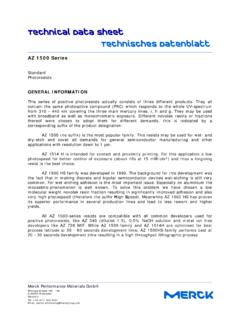
Technical Data Sheet Technisches Datenblatt
Technical Data Sheet Technisches Datenblatt. PHYSICAL and CHEMICAL PROPERTIES. AZ 1505 1518 1529 1514H 1512HS 1518HS Solids content [%] 17.7 29.9 34.0 27.8 26.5 30.4
Download Technical Data Sheet Technisches Datenblatt

Information
Domain:
Source:
Link to this page:
Documents from same domain
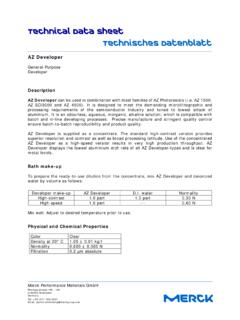
Technical Data Sheet Technisches Datenblatt
www.microchemicals.comTechnical Data Sheet Technisches Datenblatt. Development . Immersion Immerse for approximately 60 seconds in either high-contrast or high-speed AZ Developer

AZ nLOF 20xx Negative Resist - MicroChemicals
www.microchemicals.comMicroChemicals GmbH Ulm – www.microchemicals.com - tech@microchemicals.com AZ ®® nLOF 20xx Negative Resist ... complement Information for Processing revised 2005-11 …

General Purpose Developer - MicroChemicals
www.microchemicals.comDescription AZ 351B Developer is a general purpose developer for use with almost any positive AZ Photoresist. It was designed to achieve utmost contrast and best wall profile.

Post Exposure Bake (PEB) - microchemicals.com
www.microchemicals.comAZ® 726 MIF is 2.38 % TMAH- (TetraMethylAmmoniumHydroxide) in water, with additional surfactants for rapid and uniform wetting of the substrate (e. g. for puddle development) AZ® 826 MIF is 2.38 % TMAH- (TetraMethylAmmoniumHydroxide) in water, with additional surfactants for rapid and uniform wetting of the substrate (e. g. for puddle development) and other additives for the removal of ...

ELECTRO-PLATING: BASICS - MicroChemicals
www.microchemicals.comELECTRO-PLATING: BASICS The following section would like to explain the physical and chemical basis for electroplating to the extent as it is useful for understanding the following chapters. The Metal Potential A Metal in Aqueous Solution If a metal is dipped in an aqueous solution (a salt solution, a diluted acid, or only water), some of the

Silicon Ingot Production - MicroChemicals
www.microchemicals.comFirst, poly-crystalline silicon (e.g. from the Siemens-pro-cess) optionally together with dopants are melted in a quartz crucible at a temperature > 1400°C in an inert Fig. 3: The deposition of poly-crystalline silicon from the gas-eous phase of highly purifi ed trichlorosilane and hydrogen in the so-called Siemens process Cha m b e r (cool ...

technical datasheet - MicroChemicals
www.microchemicals.comSoft bake times and temperatures may be application specific. Process optimization is recommended to ensure stable lithographic and adhesion performance. Soft bake temperatures for AZ P4000 should be in the 95-115C range. Temperatures towards the high end of this range will improve adhesion to most metals.

Silicon Wafer Production and Specifications - MicroChemicals
www.microchemicals.comost any application. How ever, the special properties of each resist fami y makes them specially suited for AZ certain fields of application. 2 Resi s t f i lm thi c kness achievable and TI processable with stan d ard equ i pm e nt u n der standa r d conditions. So m e resist s can be dilut e d for lower fi lm thickne s ses; with additional ...
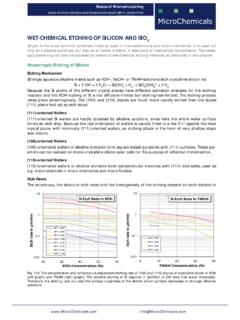
Wet-chemical etching of silicon and SiO2
www.microchemicals.comchromium are used, which in turn can be structured using photoresist masks. Fig. 120: The concentration and temperature-dependent selectivity of the etching rate of (100) - Si and SiO 2

WET-CHEMICAL ETCHING OF METALS
www.microchemicals.comThe chromium nitrate, which during the etching process forms a dark, constantly new formation on the chromium layer, is very soluble in water and thus in the chromate etchants. Compatibility and Selectivity All of our photoresists are suffi ciently stable in ceric ammonium nitrate and perchloric acid-based etching