
thermodynamics 2: applications - USTC
590 17 STATISTICAL THERMODYNAMICS 2: APPLICATIONS (a) The Helmholtz energy The Helmholtz energy, A, is defined as A =U −TS.This relation implies that A(0) = U(0), so substitution for U and S by using eqn 17.1 leads to the very simple expression A −A(0) =−kT ln Q (17.2) (b) The pressure By an argument like that leading to eqn 3.31, it follows from A = U − TS …
Download thermodynamics 2: applications - USTC

Information
Domain:
Source:
Link to this page:
Documents from same domain
MINOR REVISION OF TVCG-2014-09-0248 1 Fast …
staff.ustc.edu.cn1077-2626 (c) 2015 IEEE. Personal use is permitted, but republication/redistribution requires IEEE permission. See http://www.ieee.org/publications_standards/publications/rights/index.html for more …
16 Statistical thermodynamics 1 - ustc.edu.cn
staff.ustc.edu.cnStatistical thermodynamics 1: the concepts Statistical thermodynamics provides the link between the microscopic properties of matter and its bulk properties.

Elements of Information Theory (Wiley Series in ...
staff.ustc.edu.cnHistorical Notes 100 5 Data Compression 103 5.1 Examples of Codes 103 5.2 Kraft Inequality 107 5.3 Optimal Codes 110 5.4 Bounds on the Optimal Code Length 112 5.5 Kraft Inequality for Uniquely Decodable Codes 115 5.6 Huffman Codes 118 5.7 Some Comments on Huffman Codes 120 5.8 Optimality of Huffman Codes 123 5.9 Shannon–Fano–Elias Coding 127

Computer Organization and Architecture 9th - USTC
staff.ustc.edu.cn17.6 Nonuniform Memory Access 640 17.7 Vector Computation 644 17.8 Recommended Reading 656 17.9 Key Terms, Review Questions, and Problems 657 Chapter 18 Multicore Computers 664 18.1 Hardware Performance Issues 665 18.2 Software Performance Issues 669 18.3 Multicore Organization 674 18.4 Intel x86 Multicore Organization 676 18.5 ARM11 MPCore 679

电子能谱及其应用 - USTC
staff.ustc.edu.cnVolume 1: Auger and X-ray Photoelectron Spectroscopy”, John Wiley & Sons, 1996 4. Graham C. Smith, “Surface Analysis by Electron Spectroscopy: Measurement & Interpretation”, Plenum Press, New York, 1994 5. 吴正龙译《表面分析(XPS和AES) 引论》华东理工大学出版社,2008 6.
5.4 紧束缚模型 (tight-binding model) - USTC
staff.ustc.edu.cn- Linear combination of atomic orbitals (LCAO) 首先忽略电子之间相互作用,其次采用单电子近似 2 H i m V Ai V Bi] i i i 2 [2 则猜测波函数为两个原子的线性组合: i C i A (r i ) i B (r i) 若两个波函数相等,可以解出 1 C ( A B) 2 2() * * C H aa H ab dr

X射线光电子能谱学》 - USTC
staff.ustc.edu.cnVolume 1: Auger and X-ray Photoelectron Spectroscopy”, John Wiley & Sons, 1992 4. Stefan Hüfner, “Photoelectron Spectroscopy: Principles and Applications”, Springer-Verlag, 2003, ISBN: 3-540-41802-4 5. Graham C. Smith, “Surface Analysis by Electron Spectroscopy: Measurement & Interpretation”, Plenum Press, New York, 1994 6.
Yu-ran Luo
staff.ustc.edu.cnof formation ∆ f Ho of a large number of atoms, free radicals, ions, clusters and compounds is available from the websites of NIST, NASA, CODATA, and IUPAC . Most authors prefer to use the BDE values at 298 .15 K . The following seven tables provide essential information of ex-perimental BDE values of R−X and R+−X bonds .

IEEE Standard for Verilog Hardware Description Language
staff.ustc.edu.cning on standardizing SystemVerilog in 2001, additional issues were identified that could possibly have led to incompatibilities between Verilog 1364 and SystemVerilog. The IEEE P1364 Working Group was estab-lished as a subcomittee of the SystemVerilog P1800 Working Group to help ensure consistent resolution of such issues.

MICROECONOMICS
staff.ustc.edu.cnJehle/Reny Advanced Microeconomic Theory Johnson-Lans A Health Economics Primer Keat/Young Managerial Economics Klein Mathematical Methods for Economics Krugman/Obstfeld/Melitz International Economics: Theory & Policy* Laidler The Demand for Money Leeds/von Allmen The Economics of Sports Leeds/von Allmen/Schiming Economics* …
Related documents
Chapter 20: Entropy and the Second Law of Thermodynamics
astro1.panet.utoledo.edu(statistical thermodynamics) Let’s bring the numbers down to illustrate the relationship between entropy and probability. Consider an insulated box containing six molecules (N=6). The box is divided into the left half and the right half. Let n 1 be the number of molecules in the left half and n 2 be the number of molecules in the right half ...
16 Statistical thermodynamics 1 - USTC
staff.ustc.edu.cnStatistical thermodynamics 1: the concepts Statistical thermodynamics provides the link between the microscopic properties of matter and its bulk properties. Two key ideas are introduced in this chapter. The first is the Boltzmann distribution, which is used to predict the populations of states in systems at thermal equilibrium.
Handout 7. Entropy - Stanford University
micro.stanford.eduIn thermodynamics, the equation of state is obtained from experiments: In statistical mechanics, we can derive S(N;V;E) from fundamental dynamics of the mi-croscopic particles. Other equation of state (e.g. pV = Nk BT) can be derived from this fundamental relation. Statistical Mechanics Microcanonical (N;V;E) ensemble. There are many ...
Thermodynamics - Texas A&M University
www.chem.tamu.eduThe Third Law of Thermodynamics . The entropies of all perfect crystals approach zero as the absolute temperature approaches zero . Statistical entropy . S = k ln(W), where W is the number of different microstates for the macrostate . The statistical definition of entropy is equivalent to that derived from macroscopic observations . Standard ...
Thermodynamics and Statistical Mechanics
farside.ph.utexas.eduClassical and Statistical Thermodynamics: A.S. Carter (Prentice-Hall, Upper Saddle River NJ, 2001). 1.3 Why Study Thermodynamics? In a nutshell, thermodynamics is the study of the internal motions of many-body systems. Virtu-allyall physicalentitiesthatwe encounterin everydaylife are many-bodysystemsof sometypeor
Statistical Physics - University of Cambridge
www.damtp.cam.ac.uk1. The Fundamentals of Statistical Mechanics 1 1.1 Introduction 1 1.2 The Microcanonical Ensemble 2 1.2.1 Entropy and the Second Law of Thermodynamics 5 1.2.2 Temperature 8 1.2.3 An Example: The Two State System 11 1.2.4 Pressure, Volume and the First Law of Thermodynamics 14 1.2.5 Ludwig Boltzmann (1844-1906) 16 1.3 The Canonical Ensemble 17
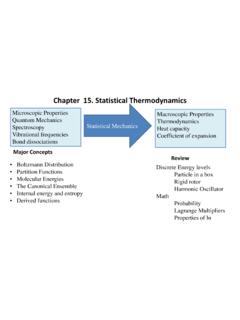
Chapter 15. Statistical Thermodynamics
www.chem.tamu.eduStatistical Thermodynamics Statistical thermodynamics provides the link between the microscopic (i.e., molecular) properties of matter and its macroscopic (i.e., bulk) properties. It provides a means of calculating thermodynamic properties from the statistical relationship between temperature and energy.

Thermodynamics & Statistical Mechanics
farside.ph.utexas.edu1.8 Thermodynamics and statistical thermodynamics In this course, we are going to develop some machinery for interrelating the sta-tistical properties of a system containing a very large number of particles, via a statistical treatment of the laws of …
A Crash Course in Statistical Mechanics - Harvard University
scholar.harvard.eduA Crash Course in Statistical Mechanics Noah Miller December 27, 2018 Abstract A friendly introduction to statistical mechanics, geared towards ... can let the second law of thermodynamics to do all the hard work, transferring energy into our …

Statistical Thermodynamics - lehman.edu
www.lehman.edustatistical thermodynamics as well. The formalism of statistical thermodynamics can be developed for both classical and quantum systems. The resulting energy distribution and calculating observables is simpler in the classical case. However, the very formulation of the