Thin layer chromatography TLC
Thin Layer Chromatography. Thin layer chromatography, or TLC, is a method for analyzing mixtures by separating the compounds in the mixture. TLC can be used to help determine the number of components in a mixture, the identity of compounds, and the purity of a compound. By observing the appearance of
Download Thin layer chromatography TLC

Information
Domain:
Source:
Link to this page:
Documents from same domain

Esters. An Introduction.
people.chem.umass.eduof mixtures, albeit not as complex as their natural counterparts. One example is an artificial pineapple mixture – 7 esters, 3 carboxylic acids, and 7 essential oils (other natural extracts). In some cases even an individual ester smells similar to a natural aroma. Some examples include O O O O O O O O chocolate vanilla honey caramel

Distillation - BMB & Chemistry IT
people.chem.umass.eduFamiliar examples include the distillation of crude fermentation broths into alcoholic spirits such as gin and vodka, and the fractionation of crude oil into useful products such as gasoline and heating oil. ... It shows only the basic pieces that exemplify the process.) If we placed the 1:1 mixture of cyclohexane and toluene into the ...

The Synthesis of Phenacetin from Acetaminophen Introduction
people.chem.umass.eduScheme 2 shows the reaction that will be performed i n this experiment . Acetaminophen is treated ... via syringe followed by the football-shaped magnetic stir bar. 3. Turn the stirrer on to low. The stir bar should be allowed to spin at a rate to sufficiently mix ... Reaction Work Up: 1. Add 4 mL water to the RBF and allow the solid to ...
Thin layer chromatography TLC
people.chem.umass.eduThin Layer Chromatography. Thin layer chromatography, or TLC, is a method for analyzing mixtures by separating the compounds in the mixture. TLC can be used to help determine the number of components in a mixture, the identity of compounds, and the purity of a compound.
Identification of an Unknown – Alcohols, Aldehydes, and ...
people.chem.umass.edu2,4-Dinitrophenylhydrazine : Aldehydes and ketones react with 2,4-dinitrophenylhydrazine reagent to form yellow, orange, or reddish-orange precipitates, whereas alcohols do not react. Formation of a precipitate therefore indicates the presence of an aldehyde or ketone. The precipitate from this test also serves as a solid derivative.

Acid-Base Extraction - University of Massachusetts Amherst
people.chem.umass.edusalt of carboxylic acid - low solubility in ether - high solubility in water In the experiment done in this lab, a mixture of a carboxylic acid (stronger acid), a phenol (weaker acid), and a neutral compound will be separated by acid-base extractions. The separated compounds

Synthesis of Cyclohexene The Dehydration of Cyclohexanol
people.chem.umass.eduSet up a fractional distillation apparatus in the same way as in the distillation experiment (remember the boiling chips). Be sure to use the distillation column (in some rare cases a slightly longer narrower glass tube that looks a lot like the distillation column may have inadvertently gotten mixed in to some of the lockers. Be sure to
Melting Points - University of Massachusetts Amherst
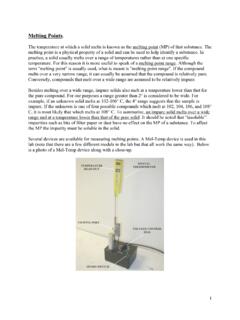
people.chem.umass.eduMelting Points. The temperature at which a solid melts is known as the melting point (MP) of that substance. The melting point is a physical property of a solid and can be used to help identify a substance. In practice, a solid usually melts over a range of temperatures rather than at one specific temperature.

A Brief Discussion of Color - BMB & Chemistry IT
people.chem.umass.eduA Brief Discussion on Color. Because several tests in the Alcohol, Aldehyde, and Ketone experiment involve color changes or produce colored compounds, a modest understanding of color will be helpful in the interpretation of the test results. What causes a compound to appear as being colored? The answer to this
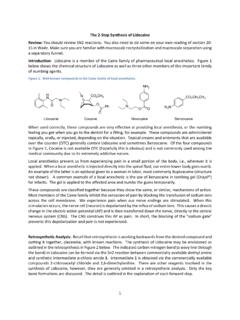
The 2-Step Synthesis of Lidocaine Review: Introduction
people.chem.umass.eduabove for the proper hook-up of a water-cooled condenser). Turn water on very slowly. Your water going to the drain should just trickle out, not flow like white-water rapids! Lower assembly close to the hot plate and reflux for 90 minutes (note any and all observations). Cool to room temperature, unaided. Transfer to a separatory funnel and ...
Related documents
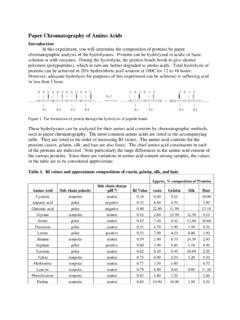
Paper Chromatography of Amino Acids
classes.kvcc.eduCHM250 Paper Chromatography Lab 5 | P a g e 7. After the hydrolysis is complete, cool the hydrolysate, stopper it and save the solution for the analysis by paper chromatography. Separation of Amino Acids by Paper Chromatography 1. Obtain a 24 x 15.5 cm rectangle of Whatman No. 1 filter paper. Handle this paper by the top edge only.

Answer Key for Chromatography Lab - Weebly
davidson-biochs.weebly.comHonors Biology: Chromatography Lab Answer Key Terms and Definitions (1 Point Each): 1. Chromatogram 2. Mobile Phase 3. Stationary Phase 4. Solute 5. Solvent 6. Heterogeneous Mixture 7. Homogenous Mixture 8. Endergonic Reaction 9. Exergonic Reaction 10. Heterotroph 11. Autotroph 12. Photosynthesis 13. Pigment 14. Adenosine Tri-phosphate 15 ...
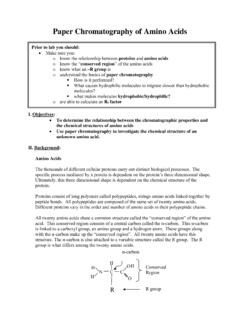
Paper Chromatography of Amino Acids
faculty.buffalostate.eduPaper Chromatography Chromatography is an analytical tool for distinguishing different biomolecule based on their chemical properties. One of the oldest and most reliable forms of chromatograpy is paper chromatography. In this assay, a biomolecule (or mixture of biomolecules) is spotted on a piece of filter paper.
Lab 6: Paper Chromatography - Texas Christian University
geo1.tcu.eduLab 6: Paper Chromatography Pages145-154 Pre-lab page 151 No Post lab – Chromatogram must be turned in attached to lab report. Chromatography • Chromatography is an analytical technique used to separate the components of a mixture. • All forms of …
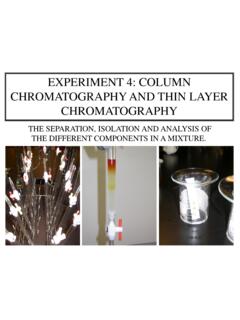
EXPERIMENT 4: COLUMN CHROMATOGRAPHY AND THIN …
academic.macewan.caperform column chromatography in the fume hood, tlc on the bench. to save time, run the tlc experiment while the column chromatography is underway. keep an eye on solvent labels and dispose of all waste in the appropriate containers. no lab report is required for experiment 4. there will be a quiz on experiments 3 & 4 next week.
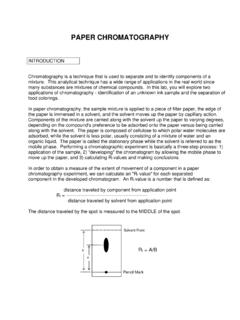
PAPER CHROMATOGRAPHY - Chem Lab
chemlab.truman.eduPAPER CHROMATOGRAPHY Chromatography is a technique that is used to separate and to identify components of a mixture. This analytical technique has a wide range of applications in the real world since many substances are mixtures of chemical compounds. In …

Experiment 6 — Thin-Layer Chromatography
www.amherst.eduThin-layer chromatography (TLC) is an extremely valuable analytical technique in the organic lab. It provides a rapid separation of compounds, and thereby gives an indication of the number and nature of the components of a mixture. TLC can also be used to identify compounds

Thin Layer Chromatography (TLC) - Boston College
www.bc.educhromatography paper on a piece of notebook paper, and draw a line in pencil, not pen, 1.5 cm above the bottom. Make small marks along the line using the dimensions given in Figure 1 on the Figs. 1, Expt. 4 page (you may bring the figure pages …