Example: tourism industry
PAPER CHROMATOGRAPHY - Chem Lab
PAPER CHROMATOGRAPHY Chromatography is a technique that is used to separate and to identify components of a mixture. This analytical technique has a wide range of applications in the real world since many substances are mixtures of chemical compounds. In …
Tags:
Information
Domain:
Source:
Link to this page:
Documents from same domain
PAPER CHROMATOGRAPHY - Truman State …
chemlab.truman.eduPAPER CHROMATOGRAPHY Chromatography is a technique that is used to separate and to identify components of a mixture. This analytical technique has a wide range of applications in the real world since
Gas Chromatography: Principles and Determination of ...
chemlab.truman.eduGas Chromatography: Principles and Determination of Percent Alcohol INTRODUCTION In this experiment you will apply gas chromatography to the separation of a water-ethanol mixture. This method is often used in the determination of alcohol (i.e. ethanol) in blood or urine.
List of Journal Abbreviations1 - Truman State …
chemlab.truman.eduJournal Name Journal Abbreviation Journal of Biological Chemistry J. Biol. Chem. Journal of Biomolecular Stereodynamics J. Biomol. Struct.
Cyanotypes - Truman State University
chemlab.truman.eduCyanotypes Materials: Item Amount per student Amount for 24 students Aqueous solution containing Potassium Ferricyanide and Ferric Ammonium Citrate ... • Ferric ammonium citrate is an irritant and the cyanotype solution is light sensitive (of course!). It will stain your skin. Wear gloves! Procedure: 1. Bring any small items you wish to print ...
Spectrophotometric Determination Of The Pka Of …
chemlab.truman.eduthe pH 1 and the pH 13 bromothymol blue solutions. Your instructor will show you how to use the instrument. From the recorded spectra choose one wavelength ( λ1) at which the pH 1 . 1--Spectrophotometric Determination Of The Pka Of Bromothymol Blue ...
Titration of the Weak Acid Potassium Hydrogen Phthalate …
chemlab.truman.edu(acid) (base) In this experiment you will determine the amount of acid present by titration with the strong base NaOH. Since it is hard to prepare a NaOH solution of accurately known concentration directly from the solid, you will need to standardize your NaOH solution against a precisely weighed amount of standard acid.
Determination of Mg by Titration with EDTA
chemlab.truman.eduThe endpoint of the titration is determined by the addition of Eriochrome Black T, which forms a colored chelate with Mg2+ and undergoes a color change when the Mg2+ is released to form a chelate with EDTA. While it is possible to achieve relatively good results by titration with
The Gravimetric Determination of Nickel
chemlab.truman.eduThe Gravimetric Determination of Nickel INTRODUCTION Nickel(II) forms a precipitate with the organic compound dimethylglyoxime, C4H6(NOH)2. The formation of the red chelate occurs quantitatively in a solution in which the pH is buffered in the range of 5 to 9. The chelation reaction that occurs is illustrated below.
Spectrophotometric Determination of Iron
chemlab.truman.eduPART A -- Determination of Spectral Response of a Single-Beam Spectrophotometer The purpose of this section is to familiarize you with the Spectronic 20 operation and to illustrate the inherent impact of the performance of the light source and detector on a measurement. The light source in the Spectronic 20 is a type S-4 (cesium-antimony ...
HYDRATES - Truman State University
chemlab.truman.edudesiccant and absorbs the moisture. Other chemicals, such as cobalt chloride, are used as humidity indicators, changing colors according to hydration. For instance, the copper sulfate used earlier in the semester was stated to be CuSO 4, but it actually had absorbed 5 moles of water for every 1 mole of CuSO 4 and should have been
Related documents
Paper Chromatography of Amino Acids
classes.kvcc.eduCHM250 Paper Chromatography Lab 5 | P a g e 7. After the hydrolysis is complete, cool the hydrolysate, stopper it and save the solution for the analysis by paper chromatography. Separation of Amino Acids by Paper Chromatography 1. Obtain a 24 x 15.5 cm rectangle of Whatman No. 1 filter paper. Handle this paper by the top edge only.

Answer Key for Chromatography Lab - Weebly
davidson-biochs.weebly.comHonors Biology: Chromatography Lab Answer Key Terms and Definitions (1 Point Each): 1. Chromatogram 2. Mobile Phase 3. Stationary Phase 4. Solute 5. Solvent 6. Heterogeneous Mixture 7. Homogenous Mixture 8. Endergonic Reaction 9. Exergonic Reaction 10. Heterotroph 11. Autotroph 12. Photosynthesis 13. Pigment 14. Adenosine Tri-phosphate 15 ...
Paper Chromatography of Amino Acids
faculty.buffalostate.eduPaper Chromatography Chromatography is an analytical tool for distinguishing different biomolecule based on their chemical properties. One of the oldest and most reliable forms of chromatograpy is paper chromatography. In this assay, a biomolecule (or mixture of biomolecules) is spotted on a piece of filter paper.
Lab 6: Paper Chromatography - Texas Christian University
geo1.tcu.eduLab 6: Paper Chromatography Pages145-154 Pre-lab page 151 No Post lab – Chromatogram must be turned in attached to lab report. Chromatography • Chromatography is an analytical technique used to separate the components of a mixture. • All forms of …
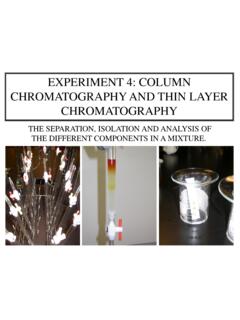
EXPERIMENT 4: COLUMN CHROMATOGRAPHY AND THIN …
academic.macewan.caperform column chromatography in the fume hood, tlc on the bench. to save time, run the tlc experiment while the column chromatography is underway. keep an eye on solvent labels and dispose of all waste in the appropriate containers. no lab report is required for experiment 4. there will be a quiz on experiments 3 & 4 next week.
Thin layer chromatography TLC
people.chem.umass.eduThin Layer Chromatography. Thin layer chromatography, or TLC, is a method for analyzing mixtures by separating the compounds in the mixture. TLC can be used to help determine the number of components in a mixture, the identity of compounds, and the purity of a compound. By observing the appearance of

Experiment 6 — Thin-Layer Chromatography
www.amherst.eduThin-layer chromatography (TLC) is an extremely valuable analytical technique in the organic lab. It provides a rapid separation of compounds, and thereby gives an indication of the number and nature of the components of a mixture. TLC can also be used to identify compounds

Thin Layer Chromatography (TLC) - Boston College
www.bc.educhromatography paper on a piece of notebook paper, and draw a line in pencil, not pen, 1.5 cm above the bottom. Make small marks along the line using the dimensions given in Figure 1 on the Figs. 1, Expt. 4 page (you may bring the figure pages …