Unit 10 - NCERT
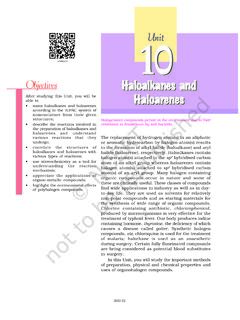
(i) From hydrocarbons by electrophilic substitution Aryl chlorides and bromides can be easily prepared by electrophilic substitution of arenes with chlorine and bromine respectively in the presence of Lewis acid catalysts like iron or iron(III) chloride. The ortho and para isomers can be easily separated due to large,
Download Unit 10 - NCERT

Information
Domain:
Source:
Link to this page:
Documents from same domain
ntse exam notification - National Council Of …
ncert.nic.inExamination: The tentative pattern of written examination will be as follows: Stage-I & Il : examination at the State/UT level will comprise of three papers i.e.
14 Effects Electric Current and Its - National …
ncert.nic.in76 EXEMPLAR PROBLEMS 3. Three bulbs A, B, C are connected in a circuit as shown in Figure 14.2. When the switch is ‘ON’ (a) bulb C will glow first. (b) bulb B and C will glow simulaneously and bulb A will
SEMICONDUCTOR AND SIMPLE CIRCUITSnot to be …
ncert.nic.in469 Semiconductor Electronics: Materials, Devices and Simple Circuits semiconductors. However , after 1990, a few semiconductor devices using organic semiconductors and semiconducting polymers have been
ENVIRONMENTAL CHEMISTRY - National Council …
ncert.nic.in400 CHEMISTRY (c) Hydrocarbons: Hydrocarbons are composed of hydrogen and carbon only and are formed by incomplete combustion of fuel …
LAWS OF MOTION
ncert.nic.inLAWS OF MOTION 91 In practice, the ball does come to a stop after moving a finite distance on the horizontal plane, because of the opposing force of friction which
DESIGN OF THE QUESTION PAPER Mathematics …
ncert.nic.inDESIGN OF THE QUESTION PAPER, SET-I 207 (A) 18 5 (B) 17 5 (C) 17 8 (D) 1 7. In the adjoining figure, PA and PB are tangents from a point P to a circle with centre O.
CHAPTER 10
ncert.nic.in(A) Main Concepts and Results Circle, radius, diameter , chord, segment, cyclic quadrilateral. • Equal chords of a circle (or of congruent circles) subtend equal angles at the
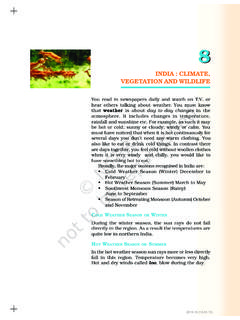
INDIA : CLIMATE, VEGETATION AND WILDLIFE
ncert.nic.inINDIA : CLIMATE, VEGETATION AND WILDLIFE 59 year. Therefore, they always appear gr een and are called evergreen forest as you may notice in Figure
Objectives Polymers - National Council of …
ncert.nic.in427 Polymers C:\Chemistry-12\Unit-15.pmd 28.02.07 Polymers can also be classified on the basis of mode of polymerisation into two sub groups.
TEXTBOOK IN GEOGRAPHY FOR CLASS IX
ncert.nic.inFOREWORD The National Curriculum Framework, (NCF) 2005, recommends that children’s life at school must be linked to their life outside the school. This principle
Related documents
Reactions of Aromatic Compounds - Rutgers University
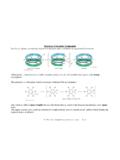
crab.rutgers.edutoward electrophilic aromatic substitution, and that the methyl group is an activating group). 2) Nitration of toluene generates a mixture of products. The major products are those with substitution at the ortho and para positions. (This preference for o/p substitution makes the methyl group an ortho/para director).
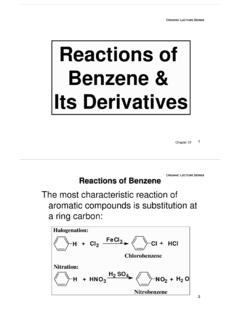
Reactions of Benzene & Its Derivatives
colapret.cm.utexas.eduThe electrophilic partner is a carbocation; it will arrange to the most stable ion: allylic>3o>2o>1o. Organic Lecture Series 17 Step 1: formation of an alkyl cation as an ion pair Step 2: attack of the alkyl cation on the aromatic ring Step 3: proton transfer regenerates the aromatic ring
Chapter 15: Benzene and Aromaticity
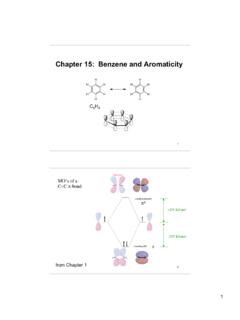
as.vanderbilt.eduBenzene undergoes electrophilic substitution reactions (chapter 16) rather than electrophilic addition +BrBr Br Br Br +HBr Fe catalyst electrophilic addition electrophilic substitution Stability of Benzene: Heats of Hydrogenations + H 2 + 2 H 2 + 3 H 2 + 118 KJ/mol + 230 KJ/mol calc'd value= 336 KJ/mol 6 KJ/mol added stability
7. Nitration of Methyl Benzoate - UMKC
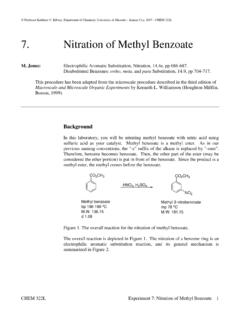
d.web.umkc.eduM. Jones: Electrophilic Aromatic Substitution, Nitration, 14.4e, pp 686-687. Disubstituted Benzenes: ortho, meta, and para Substitution, 14.9, pp 704-717. This procedure has been adapted from the microscale procedure described in the third edition of Macroscale and Microscale Organic Experiments by Kenneth L. Williamson (Houghton Mifflin ...
Cambridge International AS & A Level
gceguide.comThis document has 16 pages. Any blank pages are indicated. IB21 03_9701_12/3RP © UCLES 2021 [Turn over *9283990023 * Cambridge International AS & A Level

HHALAL ARENEARENESS …
ncert.nic.in44. Aryl chlorides and bromides can be easily prepared by electrophilic substitution of arenes with chlorine and bromine respectively in the presence of Lewis acid catalysts. But why does preparation of aryl iodides requires presence of an oxidising agent? 45. Out of o-and p-dibromobenzene which one has higher melting point and why? 46.
Genetics and Genomics Chapter 4 Questions & Answers ...
online.universita.zanichelli.itd) electrophilic alkylating agents e) automobile fumes i) intrastrand base cross-linking ii) interstrand base cross-linking iii) aromatic hydrocarbon DNA adducts iv) increased reactive oxygen species (ROS)- mediated damage Answer 4.3 a) iv) b) iii) c) i) d) ii) e) iii) Explanation 4.3
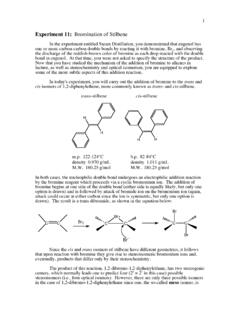
Experiment 11: Bromination of Stilbene
www.bc.eduIn both cases, the nucleophilic double bond undergoes an electrophilic addition reaction by the bromine reagent which proceeds via a cyclic bromonium ion. The addition of bromine begins at one side of the double bond (either side is equally likely, but only one option is drawn) and is followed by attack of bromide ion on the bromonium ion (again,
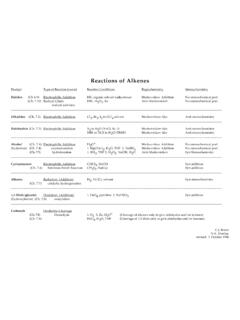
Reactions of Alkenes
www.vanderbilt.eduReactions of Alkenes Product Type of Reaction (name) Reaction Conditions Regiochemistry Stereochemistry Halides (Ch 6.9) Electrophilic Addition HX, organic solvent (anhydrous) Markovnikov Addition No stereochemical pref. (Ch. 7.10) Radical Chain HBr, H2O2, hν Anti-Markovnikov No stereochemical pref.