
Variable coefficients second order linear ODE (Sect. 2.1 ...
Existence and uniqueness of solutions. Remarks: I Every solution of the first order linear equation y0 + a(t) y = 0 is given by y(t) = c e−A(t), with A(t) = Z a(t) dt. I All solutions above are proportional to each other: y 1 (t) = c 1 e −A(t), y 2 (t) = c 2 e −A(t) ⇒ y 1 (t) = c 1 c 2 y 2 (t) Remark: The above statement is not true for solutions of second order, linear, homogeneous ...
Download Variable coefficients second order linear ODE (Sect. 2.1 ...

Information
Domain:
Source:
Link to this page:
Documents from same domain
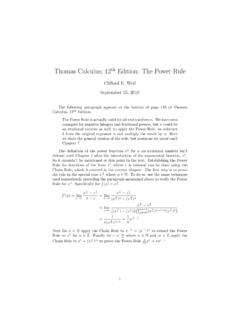
Thomas Calculus; 12th Edition: The Power Rule
users.math.msu.eduThomas Calculus; 12th Edition: The Power Rule Cli ord E. Weil September 15, 2010 The following paragraph appears at the bottom of page 116 of Thomas Calculus, 12th Edition. The Power Rule is actually valid for all real numbers n.
Convolution solutions (Sect. 6.6). - users.math.msu.edu
users.math.msu.eduConvolution solutions (Sect. 6.6). I Convolution of two functions. I Properties of convolutions. I Laplace Transform of a convolution. I Impulse response solution. I Solution decomposition theorem.
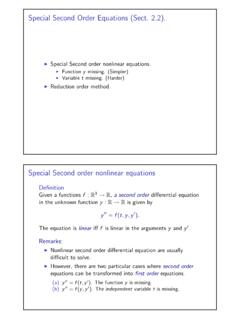
Special Second Order Equations (Sect. 2.2). Special Second ...
users.math.msu.eduSpecial Second Order Equations (Sect. 2.2). I Special Second order nonlinear equations. I Function y missing. (Simpler) I Variable t missing. (Harder) I Reduction order method. Special Second order nonlinear equations Definition Given a functions f : R3 → R, a second order differential equation in the unknown function y : R → R is given by
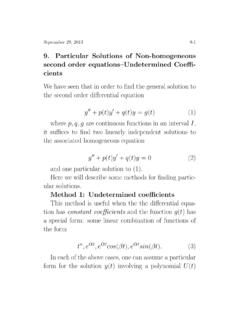
second order equations{Undetermined Coe - cients
users.math.msu.eduSeptember 29, 2013 9-1 9. Particular Solutions of Non-homogeneous second order equations{Undetermined Coe -cients We have seen that in order to nd the general solution to
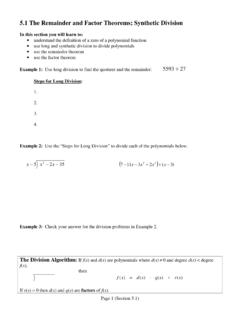
5.1 The Remainder and Factor Theorems.doc; Synthetic Division
users.math.msu.eduPage 2 (Section 5.1) Example 4: Perform the operation below. Write the remainder as a rational expression (remainder/divisor). 2 1 2 8 2 3 5 4 3 2 + − + + x x x x x Synthetic Division – Generally used for “short” division of polynomials when the divisor is in the form x – c. (Refer to page 506 in your textbook for more examples.)
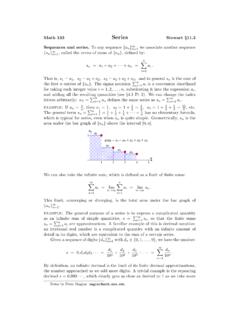
Math 133 Series Sequences and series. fa g
users.math.msu.eduGeometric sequences and series. A general geometric sequence starts with an initial value a 1 = c, and subsequent terms are multiplied by the ratio r, so that a n = ra n 1; explicitly, a n = crn 1. The same trick as above gives a formula for the corresponding geometric series. We have s …
The Laplace Transform (Sect. 6.1). - users.math.msu.edu
users.math.msu.eduThe Laplace Transform (Sect. 6.1). I The definition of the Laplace Transform. I Review: Improper integrals. I Examples of Laplace Transforms. I A table of Laplace Transforms. I Properties of the Laplace Transform. I Laplace Transform and differential equations.
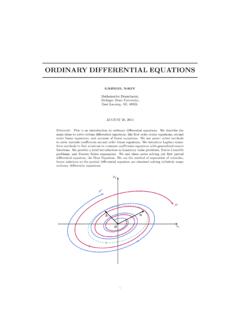
ORDINARY DIFFERENTIAL EQUATIONS
users.math.msu.eduThe equations in examples (c) and (d) are called partial di erential equations (PDE), since the unknown function depends on two or more independent variables, t, x, y, and zin these examples, and their partial derivatives appear in the equations.
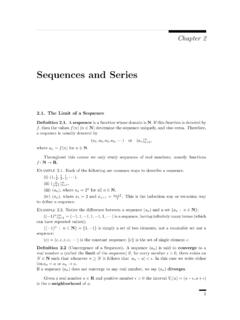
Sequences and Series - Michigan State University
users.math.msu.edu2 2. Sequences and Series A topological way to say lima n = ais the following: Given any -neighborhood V (a) of a, there exists a place in the sequence after which all of the terms are in V (a): Easy Fact: lim(c) = cfor all constant sequences (c): Quanti ers. The de nition of lima n = aquanti es the closeness of a n to aby an arbi-
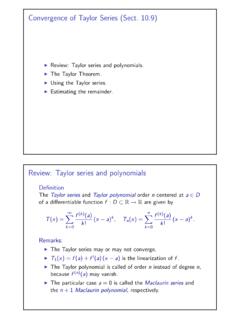
Convergence of Taylor Series (Sect. 10.9) Review: Taylor ...
users.math.msu.eduConvergence of Taylor Series (Sect. 10.9) I Review: Taylor series and polynomials. I The Taylor Theorem. I Using the Taylor series. I Estimating the remainder. The Taylor Theorem Remark: The Taylor polynomial and Taylor series are obtained from a generalization of the Mean Value Theorem: If f : [a,b] → R is differentiable, then there exits c ∈ (a,b) such that
Related documents
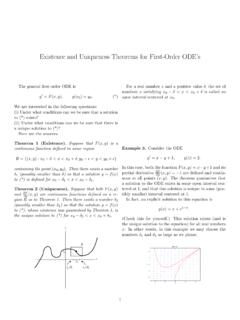
Existence and Uniqueness Theorems for First-Order ODE’s
faculty.math.illinois.eduTheorem 2 (Uniqueness). Suppose that both F(x;y) and @F @y (x;y) are continuous functions de ned on a re-gion R as in Theorem 1. Then there exists a number 2 (possibly smaller than 1) so that the solution y = f(x) to (*), whose existence was guaranteed by Theorem 1, is the unique solution to (*) for x0 2 < x < x0 + 2. x − 0 δ 2 x + 0 δ 2 0 ...
THE CHINESE REMAINDER THEOREM - University of …
kconrad.math.uconn.eduExistence of Solution. To show that the simultaneous congruences x a mod m; x b mod n have a common solution in Z, we give two proofs. First proof: Write the rst congruence as an equation in Z, say x = a + my for some y 2Z. Then the second congruence is the same as a+ my b mod n: Subtracting a from both sides, we need to solve for y in
18.03 LECTURE NOTES, SPRING 2014 - MIT Mathematics
math.mit.eduexistence and uniqueness theorem shows that there is a unique such function f(z) satisfying f0(z) = f(z); f(0) = 1: This function is called the complex exponential function ez. The number eis de ned as the value of ez at z= 1. But it is the function ez, not the number e, that is truly important. De ning ewithout de ning ez rst is a little ...

Galois Theory - University of Oregon
pages.uoregon.eduCONTENTS 2 5.3 Proof that Splitting Fields Are Unique. . . . . . . . . . . . . . . . . . . . .54 5.4 Uniqueness of Splitting Fields, and P(X) = X3 −2 ...
The Gauss-Jordan Elimination Algorithm
people.math.umass.eduDe nitions The Algorithm Solutions of Linear Systems Answering Existence and Uniqueness questions Echelon Forms Row Echelon Form De nition A matrix A is said to be in row echelon form if the following conditions hold 1 all of the rows containing nonzero entries sit above any rows whose entries are all zero,
Differential Equations I - University of Toronto ...
www.math.toronto.edu10.3 Existence and Uniqueness Theorem for Linear First Order ODE’s 155 10.4 Existence and Uniqueness Theorem for Linear Systems . . . . . . 156 11 Numerical Approximations 163

Math 2331 { Linear Algebra - UH
www.math.uh.eduExistence and Uniqueness Theorem Theorem (Existence and Uniqueness) 1 A linear system is consistent if and only if the rightmost column of the augmented matrix is not a pivot column, i.e., if and only if an echelon form of the augmented matrix has no row of the form 0 …

Chapter 3 Quadratic Programming
www.math.uh.eduLemma 3.2 Existence and uniqueness Assume that A 2 lRm£n has full row rank m • n and that the reduced Hessian ZTBZ is positive deflnite. Then, the KKT matrix K is nonsingular. Hence, the KKT system (3.3) has a unique solution (x⁄;‚⁄). Proof: The proof is left as an exercise. †