Example: tourism industry
Hybrid Molecular Orbitals
more electron density in particular regions. The bonding in a molecule predicted from this model corresponds well with the measurable physical and chemical properties. We could use the symmetry-based method to construct molecular orbital diagrams for larger molecules as well, but this can get complicated for larger structures.
Tags:
Information
Domain:
Source:
Link to this page:
Documents from same domain

Worksheet 15 - Molecular Shapes Lewis structures …
butane.chem.uiuc.eduWorksheet 15 - Molecular Shapes The shapes of molecules can be predicted from their Lewis structures by using the VSEPR (Valence Shell Electron Pair Repulsion) model, which states that electron pairs around a central …
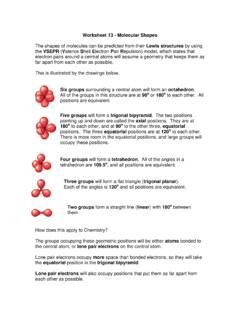
Worksheet 13 - Molecular Shapes Lewis structures by using ...
butane.chem.uiuc.eduWorksheet 13 - Molecular Shapes The shapes of molecules can be predicted from their Lewis structures by using the VSEPR (Valence Shell Electron Pair Repulsion) model, which states that electron pairs around a central atoms will assume a geometry that keeps them as far apart from each other as possible. This is illustrated by the drawings below.

Dissolved Oxygen and Carbon Dioxide
butane.chem.uiuc.eduDissociation of Carbon Dioxide Carbon dioxide reacts with water. The carbon atom of CO 2 is electron poor with an oxidation state of IV. The electron rich oxygen of water donates an electron pair to the carbon.
Dissolved Oxygen and Carbon Dioxide - University …
butane.chem.uiuc.eduDissolved Oxygen and Carbon Dioxide Every atmospheric gas is in equilibrium with that gas dissolved in ocean water. The concentrations of two of …

Oxidation Reactions of Sugars - University Of Illinois
butane.chem.uiuc.eduHalf Reactions for Chlorate + Glucose Chlorate anion is another oxidizing agent (see the gummy worm reaction on the index page) that can oxidize glucose and become reduced. The oxidation of glucose to carbon dioxide is the same as above.
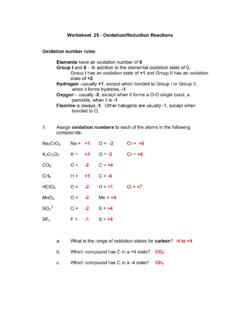
Worksheet 25 - Oxidation/Reduction Reactions 0 II +1 +2 …
butane.chem.uiuc.eduWorksheet 25 - Oxidation/Reduction Reactions Oxidation number rules: Elements have an oxidation number of 0 Group I and II – In addition to the elemental oxidation state of 0, Group I has an oxidation state of +1 and Group II has an oxidation state of +2. Hydrogen –usually +1, except when bonded to Group I or Group II, when it forms hydrides, -1. ...
Worksheet 25 - Oxidation/Reduction Reactions 0 II +1 +2 -2 -1
butane.chem.uiuc.eduWorksheet 25 - Oxidation/Reduction Reactions Oxidation number rules: Elements have an oxidation number of 0 Group I and II – In addition to the elemental oxidation state of 0, Group I has an oxidation state of +1 and Group II has an oxidation state of +2. Hydrogen –usually +1, except when bonded to Group I or Group II, when it forms hydrides, -1. ...
Reactions of Fats and Fatty Acids
butane.chem.uiuc.eduReactions of Fats and Fatty Acids Outline • Fats and Oils • Fatty Acid Biosynthesis • Biodiesel • Homework We hear quite a lot about the place of fats and oils in human nutrition. Foods high in fat are at the top of the food pyramid and these foods have about twice the …

Molecules of the Atmosphere - University of Illinois ...
butane.chem.uiuc.eduenthalpy change for the formation of any molecules from the elements in their standard states in called the enthalpy of formation. The reaction coordinate diagram for the reaction is below. The final product, NO, is at a higher energy than the reactants, 1/2 N 2 and 1/2 O 2.

Worksheet 7 - Ideal Gas Law I. Ideal Gas Law Ideal Gas Law ...
butane.chem.uiuc.eduP i V i = n i R T i and P f V f = n f R T f Since R is a constant, this can be re-written as: f f f f i i i i n T P V R n T PV = = , where i means initial state and f means final state. 2. When 1.10 g of magnesium reacts with 300.0 mL of 0.800 M HCl, the
Related documents

Regents Chemistry Topic Review Packet
www.ntschools.orgMar 09, 2003 · Draw separate diagrams for the liquid and the solid states. 7 ... surrounded by electrons moving in “electron cloud”. ... You can use Lewis structures to show the configuration of the valence electrons. 11. Atoms of the same element all contain the same number of protons.
Lewis Dot Structures and VSEPR - Surry County Public ...
www.surryschools.netmolecule and are represented by Lewis dot structures. • Draw Lewis dot diagrams to represent valence electrons in elements and draw Lewis dot structures to show covalent bonding. • Use valence shell electron pair repulsion (VSEPR) model to draw and name molecular shapes (bent, linear, trigonal planar, tetrahedral, and trigonal pyramidal).

Miessler-Fischer-Tarr5e SM Ch 05 CM
www.chem.uci.edua bond order of 1.5. The Lewis structures have an unpaired electron and an average bond order of 1.5. O2 has two unpaired electrons in its π* orbitals,and a bond order of 2. The simple Lewis structure has all electrons paired, which does not match the paramagnetism observed experimentally. Bond lengths are therefore in the order O2 2– > O 2

Chemistry of Matter - Science Spot
sciencespot.net14. Scientists use two types of diagrams to show the electron configuration for atoms. Follow your teacher’s directions to complete the diagrams. Sulfur Atomic # = 16 Atomic Mass = 32 Protons = 16 Neutrons = 16 Electron = 16 15. Calculate the missing information and then draw the Bohr Diagram and Lewis Structure for each element. Mg Atomic ...

Practice Problems H S SO CH Br HCN
web.gccaz.edu2. Draw the Lewis dot structures for each of the following molecules: a. H 2 S c. SO 3 b. CH 2 Br 2 d. HCN 3. Draw the Lewis dot structure for each of the following polyatomic ions: a. NH 4 + c. PO 4 –3 b. NO 3 – d. CO 3 2– 4. For the following molecules or ions (where the central atom is underlined): i. Draw the Electron dot structure. ii.
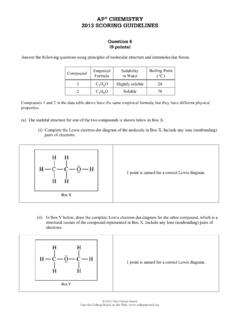
AP CHEMISTRY 2013 SCORING GUIDELINES
secure-media.collegeboard.orgto complete a Lewis electron-dot diagram, including any lone (non-bonding) pairs of electrons when given an array of atoms arranged to represent ethanol. Part (a)(ii) assessed knowledge of structural isomers by asking students to draw a complete Lewis electron-dot diagram for the isomer of the compound drawn in part (a)(i).
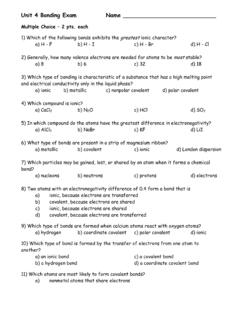
Unit 4 Bonding Exam Name
www.lmghs.orgDec 12, 2017 · e) In the box below, draw the Lewis electron-dot structure for the compound formed from magnesium and chlorine. [ Include any charges or partial charges.] (1 pt.) 32) Explain, in terms of electronegativity, why an H-F bond is expected to be more polar than an H-I bond. (2 pts.) BONUS Questions – 1 pt. each 33) Given the reaction: H2 + Cl 2 2HCl