Transcription of Re-conceptualizing “Scaffolding” and the Zone of Proximal ...
1 54 ABSTRACTThe linked concepts of scaffolding and the Zone of Proximal development (ZPD) were originally applied to the context of asymmetrical teaching and learning with a teacher or adult explicitly supporting a learner, usually a child, to achieve tasks beyond their ability when working alone. In this paper we investigate how these concepts need to be reconceptualized if they are to be applied to the different con text of symmetrical learning amongst groups of peers. We present two separate studies. In the first one we analyze the type of talk used by a group of children from Mexico solv ing the Raven s Standard Progressive Matrices (RSPM) test together both before and after an intervention program teaching exploratory talk . Our analysis demonstrates a ZPD created by the way in which they talk together.
2 In the second study we present the comparison of the talk of two groups of children, one from Mexico and the other from the UK, solv ing together a single matrix from the RSPM test. Our analy sis shows how the concept of scaffolding can be applied to understand how these groups of children use language to support shared thinking and learning. In both studies we found that applying ideas of scaffolding and the ZPD to symmetrical learning required the re-conceptualization of these concepts as characterizations of dynamic processes within dialogues. INTRODUCTIONThe linked concepts of scaffolding and the Zone of Proximal development are central to many recent accounts of teaching and learning. Bruner (l978) describes scaffold ing as cognitive support given by teachers to learners to help them solve tasks that they would not be able to solve work ing on their own.
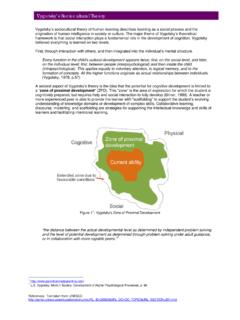
3 He goes on to describe this as a form of vicarious consciousness in which students are taken be yond themselves through participation in the consciousness of the teacher. This conception of scaffolding Re-conceptualizing Scaffolding and the Zone of Proximal development in the Context of Symmetrical Collaborative LearningManual Fern ndezRupert WegerifNeil MercerSylvia Rojas-DrummondJournal of Classroom Interaction, ISSN 0749-4025. 2015, Vol , pp. 54-72 Original Citation: Fern ndez, M., Wegerif, R., Mercer, N., & Rojas-Drummond, S. (2002). Re-conceptualizing scaffolding and the zone of Proximal development in the context of symmetrical col-laborative learning. Journal of Classroom Interaction, 36(2/1), is closely related to Vygotsky s concept of the Zone of Proximal De velopment (ZPD), which is described in Vygotsky s own words as:The distance between the actual developmental level as determined by independent problem-solving and the level of potential problem solving as determined through problem solving under adult guidance or in collaboration with more able peers.
4 (1978: 86)Although collaboration with peers is mentioned here by Vygotsky, it is noticeable that he refers only to more able peers, thereby implying that an intellectual asymme try must exist between participants in any joint activity. This is in keeping with Vygotsky s more general account of teach ing and learning in which this same asymmetry is assumed. However, as many researchers have noted (Littleton & Light, 1999; Cowie & van der Aalsvort, 2000) learning also occurs in collaboration between students who have similar levels of conceptual understanding. That is, learning and develop ment may also result from symmetrical interactions. Ex ploring the discourse of participants in this particular situa tion can help us to understand the process of learning more generally.
5 In this article we will use our analysis of the pro cess of problem solving and learning in small groups of chil dren to re-evaluate the concepts of scaffolding and the Zone of Proximal development . We begin by considering each concept in ZONE OF Proximal development (ZPD) In Vygotsky s original work ( 1978; 1987) the ZPD is offered as a dynamic alternative to the models of indi vidual ability used in conventional psychological testing. Instead of assessing what an individual child can do unaided, Vygotsky proposed assessing what an individual was capable of with the help of an adult or teacher. He hypothesised that children who might have reached similar levels of concep tual development might nevertheless differ in their potential or readiness to achieve higher levels of understanding, and such differences would be revealed by offering children struc tured help.
6 As with so many of Vygotsky s interesting ideas, however, it has been left mainly to others to explore the im plications and potential of the ZPD for psychological and educational and colleagues (Laboratory of Comparative Human Cognition, 1983, Rogoff, 1982b, Rogoff, Gauvain and Ellis, 1984; in Rogoff, 1990) have taken the ZPD to be a key element in the culturally based process of learning, whereby children appropriate knowledge and skills from more expert members of their society. This is a development of Vygotsky s claim that cognitive processes appear first at the social (intermental) level, and are then internalized and transformed as individual ways of thinking (the intramental level) (Vygotsky, 1987). In this formulation, the ZPD is pre cisely that dynamic region where the intermental folds in to become the intramental: a region in which the child devel ops through participating in the solution of problems with more experienced members of his or her cultural group.
7 Rogoff s thesis is that the development of the child towards more able ways of participation in society is carried out through a process of guided participation, which may or may not include explicit (1978, 1979, 1981, 1985 in Tharp and Gallimore, 1988) has applied the concept of the ZPD to an analysis of the language of interactions between teachers and learners. He describes how a teacher, parent or more capable peer offers directions or modelling to the child, which the child responds to in an imitative way. Similarly, researchers working in classroom contexts have described how a teacher can enable a learner to understand and complete a task using linguistic scaffolding tools such as questions, feedback, and explanations of the structure of the task (Maybin, Mercer, & Stierer, 1992; Mercer, I995).
8 Also drawing on school-based research, Newman, Griffin and Cole (1989) argue for a re formulation of the concept of the ZPD, suggesting that it Journal of Classroom Interaction 56needs to be expanded beyond the individual and asymmetri cal focus found in Vygotsky. They employ the concept in a more general sense to designate the space or construction zone where culture and cognition create each other. Through symmetrical interactions, they suggest, children can appro priate ways of understanding that are a result of their efforts to apply the tools of their culture. In this way, the culture is regenerated by the efforts of learners as they work together to use and adapt the tools provided by their ancestors. Interactions within the ZPD are considered by these authors as the generators of development and culture, in the sense that such interactions give to each child the opportunity to par ticipate in activities and goals that would be very difficult for them to achieve Wood, Bruner and Ross (1976), introduced the notion of scaffolding as a metaphor for the way an expert tutor (such as a parent) can support a young child s progress and achievement through a relatively difficult task.
9 They describe six functions of the tutor in scaffolding of the activity of the child (summarized here in paraphrase):1. To orientate the child s attention to the version of the task defined by the To reduce the number of steps that are required to solve a problem, thus simplifying the situation in a way that the learner can handle the components of the To maintain the activity of the child as she/he strives to achieve a specific goal, motivating her/him and directing her/his To highlight critical features of the task for the To control the frustration of the child and the risk of To provide the child with idealized models of required mentioned earlier, scaffolding was described by Bruner as a vicarious consciousness, a temporary intellec tual support which a teacher offers in order to draw the learner up towards a higher level of understanding.
10 This formula tion appears to assume a prior understanding of the solution of a problem, or a conception of the ideal outcome of a task, on the part of the person providing the scaffold . This is problematic if we wish to apply the concept to a more symmetrical kind of collaboration ( amongst peers) in which no participant knows the solution to a problem in advance, but they all work together in a group to discover the answer. This problem generates two questions which we aim to an swer in this paper: can the concept of scaffolding be made useful for understanding learning in symmetrical groups; and if so, what reconceptualization is required?THE INTERMENTAL development ZONE (IDZ)Drawing on both the concepts of scaffolding and the ZPD, Mercer (2000) has proposed that a new concept may be useful for understanding how that interpersonal commu nication can aid learning and conceptual development .