Transcription of Derivation of the Wave Equation
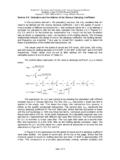
1 Derivation of the Wave EquationIn these notes we apply Newton s law to an elastic string, concluding that smallamplitude transverse vibrations of the string obey the waveequation. Consider a tiny elementof the (x, t) x uxT(x+ x, t)T(x, t) (x+ x, t) (x, t)The basic notation isu(x, t) = vertical displacement of the string from thexaxis at positionxand timet (x, t) = angle between the string and a horizontal line at positionxand timetT(x, t) = tension in the string at positionxand timet (x) = mass density of the string at positionxThe forces acting on the tiny element of string are(a) tension pulling to the right, which has magnitudeT(x+ x, t) and acts at an angle (x+ x, t) above horizontal(b)
2 Tension pulling to the left, which has magnitudeT(x, t) and acts at an angle (x, t)below horizontal and, possibly,(c) various external forces, like gravity. We shall assume that all of the external forcesact vertically and we shall denote byF(x, t) xthe net magnitude of the externalforce acting on the element of mass of the element of string is essentially (x) x2+ u2so the vertical componentof Newton s law says that (x) x2+ u2 2u t2(x, t) =T(x+ x, t) sin (x+ x, t) T(x, t) sin (x, t) +F(x, t) xDividing by xand taking the limit as x 0 gives (x) 1 +( u x)2 2u t2(x, t) = x[T(x, t) sin (x, t)]+F(x, t)= T x(x, t) sin (x, t) +T(x, t) cos (x, t) x(x, t) +F(x, t)(1)
3 We can dispose of all the s by observing from the figure thattan (x, t) = lim x 0 u x= u x(x, t)c Joel Feldman. 2000. All rights implies, using the figure on the right below, thatsin (x, t) = u x(x, t) 1 +( u x(x, t))2cos (x, t) =1 1 +( u x(x, t))2 tan 1 1 + tan2 (x, t) = tan 1 u x(x, t) x(x, t) = 2u x2(x, t)1 +( u x(x, t))2 Substituting these formulae into (1) give a horrendous mess. However, we can getconsiderable simplification by looking only at small vibrations. By a small vibration, we meanthat| (x, t)| 1 for allxandt. This implies that|tan (x, t)| 1, hence that u x(x, t) 1and hence that 1 +( u x)2 1sin (x, t) u x(x, t)cos (x, t) 1 x(x, t) 2u x2(x, t) (2)Substituting these into Equation (1) give (x) 2u t2(x, t) = T x(x, t) u x(x, t) +T(x, t) 2u x2(x, t) +F(x, t)(3)which is indeed relatively simple, but still exhibits a problem.
4 This is one Equation in thetwo there is a second Equation lurking in the background, that we haven tused. Namely, the horizontal component of Newton s law of motion. As a second simplifi-cation, we assume that there are only transverse vibrations. Our tiny string element movesonly vertically. Then the net horizontal force on it must be zero. That is,T(x+ x, t) cos (x+ x, t) T(x, t) cos (x, t) = 0 Dividing by xand taking the limit as xtends to zero gives x[T(x, t) cos (x, t)]= 0 For small amplitude vibrations, cos is very close to one and T x(x, t) is very close to other wordsTis a function oftonly, which is determined by how hard you are pulling onthe ends of the string at timet.
5 So for small, transverse vibrations, (3) simplifies further to (x) 2u t2(x, t) =T(t) 2u x2(x, t) +F(x, t)(4)In the event that the string density is a constant, independent ofx, the string tensionT(t)is a constant independent oft(in other words you are not continually playing with the tuningpegs) and there are no external forcesFwe end up with 2u t2(x, t) =c2 2u x2(x, t)wherec= T c Joel Feldman. 2000. All rights