Transcription of CPC Agar Base - HiMedia Labs
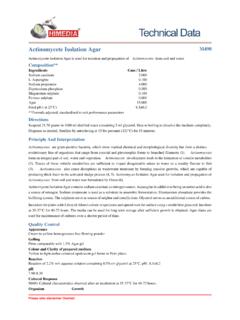
1 Please refer disclaimer agar BaseIngredientsGms / peptone B # pH ( at 25 C) **Formula adjusted, standardized to suit performance parameters# Equivalent to Beef extractDirectionsSuspend grams in 500 ml of purified / distilled water. Heat to boiling to dissolve the medium completely. Sterilize by autoclaving at 15 lbs pressure (121 C) for 15 minutes. Cool to 45-50 C and aseptically add the rehydrated contents of 1 vial of CPC Supplement (FD110). Mix well and pour into sterile Petri platesPrinciple And InterpretationVibrio species are natural inhabitants of brackish and salt water. Human disease is associated with ingestion of contaminated water or consumption of contaminated seafood.
2 Wound and systemic infections develop following contact with contaminated water (5). CPC (Cellobiose, Polymyxin and Colistin) agar base formulated as per APHA (7) is recommended for the cultivation and identification of Vibrio species from foods. CPC agar is a selective and differential agar medium, designed to differentiate Vibrio vulnificus from other Vibrios (7). Vibrio cholerae strains except V. cholerae 01-classical biotype grow on CPC agar while most Vibrio parahaemolyticus strains do not grow on CPC agar contains HM peptone B and peptone, which supply the essential nitrogenous, carbonaceous compounds, long chain amino peptides, vitamins and other growth nutrients to Vibrios.
3 Cellobiose is fermented by some Vibrios producing acid and is indicated by the pH indicator bromothymol blue, which turns yellow at acidic pH. Cresol red is the pH indicator of alkaline range, which turns red at alkaline pH. Alkaline pH of the medium enhances the recovery of approximately 25 grams of food sample with 225 ml Alkaline Peptone Water (M618). Transfer a loopful from the surface growth of either Alkaline Peptone Water (M618) or Gelatin Phosphate Salt Broth to the surface of the dried plates of CPC agar . Streak in a manner that will yield isolated colonies. Incubate CPC agar at 40 - 42 C for 18 to 24 colonies of V. cholerae on CPC agar are small, smooth, opaque and green to purple in colour as CPC agar contains two pH indicators viz.
4 Bromothymol blue and cresol red. A purple background will also develop in the CPC agar upon extended Use:Recommended for the cultivation and identification of Vibrio species from food **Type of specimen Food; Water food and dairy samples, follow appropriate techniques for sample collection and processing as per guidelines (1,6,8). For water samples, follow appropriate techniques for sample collection, processing as per guidelines and local standards.(2) After use, contaminated materials must be sterilized by autoclaving before discarding. Specimen Collection and Handling: HiMedia LaboratoriesTechnical DataReactionReaction of w/v aqueous solution at 25 C. pH : ResponseCultural characteristics observed after an incubation at 40 2 C for 18-24 (CFU)GrowthRecoveryColour ofcolonyVibrio cholerae ATCC1574850-100good - luxuriant>=50%green-purpleVibrio parahaemolyticus ATCC 17802 (00037*)>=104inhibited0%Vibrio vulnificus50-100good - luxuriant>=50%yellowQuality ControlAppearanceLight yellow to light brown homogeneous free flowing powderGellingFirm,comparable with agar gelColour and Clarity of prepared mediumOlive-green to light brown coloured, clear to slightly opalescent gel forms in Petri platesWarning and Precautions :Read the label before opening the container.
5 Wear protective gloves/protective clothing/eye protection/ face protection. Follow good microbiological lab practices while handling specimens and culture. Standard precautions as per established guidelines should be followed while handling specimens. Safety guidelines may be referred in individual safety data cholerae on CPC agar are small, smooth, opaque and green to purple in colour as CPC agar contains two pHindicators viz. bromothymol blue and cresol purple background will develop if incubation gets and EvaluationPerformance of the medium is expected when used as per the direction on the label within the expiry period when stored at recommended and Shelf LifeStore between 10-30 C in a tightly closed container and the prepared medium at 2-8 C.
6 Use before expiry date on the label. On opening, product should be properly stored dry, after tightly capping the bottle in order to prevent lump formation due to the hygroscopic nature of the product. Improper storage of the product may lead to lump formation. Store in dry ventilated area protected from extremes of temperature and sources of ignition Seal the container tightly after use. Product performance is best if used within stated expiry period. Please refer disclaimer : *Corresponding WDCM must ensure safe disposal by autoclaving and/or incineration of used or unusable preparations of this product. Follow established laboratory procedures in disposing of infectious materials and material that comes into contact with sample must be decontaminated and disposed of in accordance with current laboratory techniques (3,4).
7 DisposalHiMedia LaboratoriesTechnical DataDisclaimer :User must ensure suitability of the product(s) in their application prior to use. Products conform solely to the information contained inthis and other related HiMedia publications. The information contained in this publication is based on our research and developmentwork and is to the best of our knowledge true and accurate. HiMedia Laboratories Pvt Ltd reserves the right to make changes tospecifications and information related to the products at any time. Products are not intended for human or animal or therapeutic use butfor laboratory,diagnostic, research or further manufacturing use only, unless otherwise specified. Statements contained herein should notbe considered as a warranty of any kind, expressed or implied, and no liability is accepted for infringement of any P.
8 R., Baron J. H., Pfaller M. A., Jorgensen J. H. and Yolken R. H., (Ed.), 2003, Manual of Clinical Microbiology,8th Ed., American Society for Microbiology, Washington, Vanderzant C. and Splittstoesser D. F., (Eds), 1992, Compendium of Methods for the Microbiological Examination of Foods,3rd Ed., APHA, Washington : 03/ , Clinical Microbiology Procedures Handbook. 2nd , , Pfaller , , Carroll, , Funke, G., Landry, , Richter, and Warnock., (2015)Manual of Clinical Microbiology, 11th Edition. Vol. Y., and Tortorello , 2015, Compendium of Methods for the Microbiological Examination of Foods, 5thEd., American Public Health Association, Washington, Public Health Association, Standard Methods for the Examination of Dairy Products, 1978, 14th Ed.
9 , , Eaton , and Rice , (Eds.), 2015, Standard Methods for the Examination of Water andWastewater, 23rd ed., APHA, Washington, H. M. and Frank J. H., 2004, Standard Methods for the Microbiological Examination of Dairy Products, 17th Ed.,APHA Inc., Washington, Laboratories Pvt. Ltd. : 23, Vadhani , LBS Marg, Mumbai-400086, India. Customer care No.: 022-6116 9797 Corporate office : A-516,Swastik Disha Business Park,Via Vadhani Ind. Est., LBS Marg, Mumbai-400086, India. Customer care No.: 022-6147 1919 Email: Website.