Transcription of Unit 1 Atomic Structure and Nuclear Chemistry
1 Unit1 Atomic Structureand Nuclear ChemistryIntroduction to the atom Modern Atomic Theory Atoms cannot be subdivided, created, or destroyed in ordinary chemical reactions. However, these changes CAN occur in Nuclear reactions! Every atom has different properties from other atoms All matter is composed of atomsEx: grinding down a gold ringModern Atomic TheoryTheory -A set of tested hypotheses that gives an overall explanation of some natural : Cell theory & Evolutionary theoryWait, it s only a theory? Why are we learning it then? A theory is a powerful term in scienceWe can now see atoms.
2 Sort ofThe Kanji characters for "atom." This image was formed by using the tiny tip of an STM to pick up individual atoms of iron and place them on a copper (111) 1981 a STM (Scanning Tunneling Microscope) was created. -We can see them and manipulate them. Nanotechnology is comingAtoms can be moved and molded to make various devices such as molecular motors Structure of the AtomAccessing Prior on your previous science classes, draw a generic atom and label where you d find the nucleus, protons, neutrons, & electrons. a common beryllium atom, what is the:a) # protons?
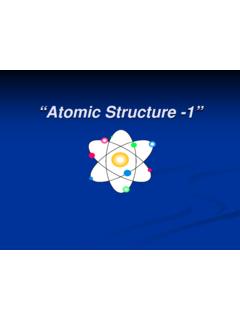
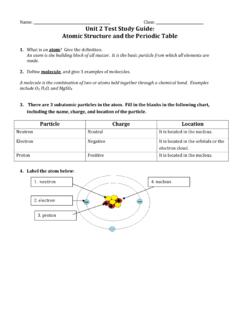
3 B) # neutrons?c) # electrons? Structure of an AtomParticleChargeMass #LocationPurposeElectron-10 Electron cloudBehavior of elementProton+11 NucleusIdentity of elementNeutron01 NucleusStability of nucleusNucleus(protons + neutrons)Electrons (in electron cloud)1/2000ththe mass of P+& NCharges in an AtomTheatomis generally neutralbecause:# of negative electrons = # of positive protonsThenucleus is positivelycharged because:Contains positive protons (and neutrons which don t have a charge).The Atomic most pictures are really inaccurate! nucleus (protons and neutrons) is small and dense and contains most of the massof the atom.
4 The electron cloud (where electrons are found) contain most of the volume(3-D space) of an drawn to scale (electrons would be really far away) & the nucleus penny has x 1022atoms. Atoms are mostly empty space. Atomic an nucleuswould be the size of a grain of you could make an atom as large as a football nucleus is really tiny compared to the total size of the atom, but it s never drawn that way. (electron cloud takes up most of the volume)Fun The particles that make up protons and the Periodic Table to determining # or protons, neutrons, and electronsReading the periodic tableAtomic #=# of protons& # electrons Proton # = Unique to every atom (serves as an atom s identity) (atoms are neutral and + and charges must balance out)Reading the periodic tableAtomic mass= the average mass of that atom -Round the Atomic mass (ex:12 ) -(electrons don t weigh much so aren t included in mass #)Mass #-= # protons + # neutronsEx.
5 Not all carbon atoms have the same mass so we have an average (see isotopes).PracticeAtomic # Atomic MassMass ## protons# electrons# that hold an Atom TogetherForces that hold atoms togetherElectromagnetic ForceNuclear ForceKeeps electrons near the nucleusKeeps nucleus from breaking apartElectromagnetic ForceProtons (in the nucleus) & Electrons are attracted to each other because of their opposite charges Idea is that opposite charges attract Nuclear Force The Nuclear force is a 100 X s stronger than the electromagnetic force and acts like a glue -the strong force (aka Nuclear forces)
6 Overcomes the electromagnetic forces as long as the protons are very close together-Electromagnetic forces should cause this nucleus to break apart because of all the protons repelling each other (same charge), but it doesn t ???? vs. Elements vs. Molecules/CompoundsElements, atoms, & moleculesatomABCmoleculeElementContains only one kind of atom (pure)DMolecule (bonded) & element (pure)2 or more atoms bonded togetherIsotopesIsotopes-atoms of the same element having different masses due to different # s of neutrons. (most have at least 2)Isotope(in hyphen notation)NucleusHydrogen 1(protium)Hydrogen-2(deuterium)Hydrogen- 3(tritium)The # indicates the mass numberof the isotope (version) you are referring to.
7 -They re all still Hydrogen because they have 1 proton3 Isotopes (versions) of CarbonIsotope= Almost all of the elements have at least 2 different isotopes. Some have 4, 5, or even 10. *They are all carbon because they have 6 protonsCalculating average Atomic massCan you guess which isotope is most common in nature? Carbon-12 because on the periodic table carbon has an average Atomic mass of Mass (amu)% Natural AbundanceC with Isotopes Atomic # Atomic MassMass ## protons# electrons# (estimate based on mass #)14668 One way to show isotopes in writing:Ex.
8 Carbon-14 Notations-another way to show isotopes23592 UElement symbolMass of Isotope(p++ no) Atomic #(# of p+)Hyphen NotationNuclear NotationUranium-235 Some Isotopes are Radioactive Some isotopes of elements are unstable (aka radioactive) Too many protons or neutrons in a nucleus (ratio important) Large elements (#84 & up) are radioactive Small ones can be radioactive too (see H isotopes )Isotopes of hydrogenH-3 is radioactiveIntro. to Radioactivity & the Band of Stability What determines if a nucleus will be radioactive? The neutron to proton ratio in the nucleus is an important part of stability.
9 Small, stable atoms= 1 neutron for every 1 proton Bigger, stable atoms = neutron/ 1 proton. Neutrons aid to increase the Nuclear force in larger atoms A nucleus with 84 protons or more will be radioactive regardless of how many neutrons it has (because of proton repulsion)Band of stability graph-isotopes located on edge are radioactiveHow to use the Band of Stability Graph Graph the number of protons (x-axis) vs. number of neutrons (y-axis) for the atom. If your point.. offthe band of stability = atom does not exist in nature (too unstable) at the edge of the band of stability = atom is unstable (radioactive).
10 On the band of stability = atom is stable(not radioactive).Types of Radioactive Decay(Alpha, Beta, & Gamma)& Balancing Nuclear EquationsRadioactive Decay (summary) An unstable nucleus will emit particles of alpha, beta, or gamma rays(aka radiation) to become a more stable element. Elements with Atomic # 84 or higher are radioactive no matter how many neutrons they have. ( Nuclear force only works when protons are close) Proton to Neutron Ratio determines stability (see band of stability graph) Ex: Uranium--> radioactive particles + Lead(unstable) (stable) This happens naturally & spontaneously3 Types of Radioactive Decay There are 3 types of particles that can be emitted from an unstable nucleus: Alpha ( ) particles Beta ( ) particles Gamma ( ) particlesAlpha Decay- Symbol: -Helium nucleus-2 protons & 2 neutrons Problem.