Transcription of The IB Diploma Programme: A guide for universities
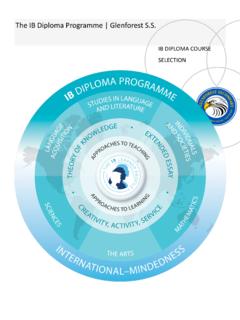
1 The IB Diploma programme : A guide for universitiesThe Diploma ProgrammeThe IB Diploma programme (DP) is an academically challenging and balanced programme of education for students aged 16 to 19. It is designed to address the intellectual, social, emotional and physical well-being of students. The DP aims to encourage students to be knowledgeable, inquiring, caring and compassionate, and to develop intercultural understanding, open-mindedness and the attitudes necessary to respect and evaluate a range of viewpoints. Students are prepared for effective participation in a rapidly evolving and increasingly global society as they: develop physically, intellectually, emotionally and ethically acquire breadth and depth of knowledge and understanding, studying courses from 6 subject groups (3 taken at higher level)
2 Develop the skills and a positive attitude toward learning that will prepare them for higher education study at least two languages and increase understanding of cultures, including their own make connections across traditional academic disciplines and explore the nature of knowledge through the programme s unique theory of knowledge course undertake in-depth research into an area of interest through the lens of one or more academic disciplines in the 4,000 word extended essay enhance their personal and interpersonal development through the creativity, action and service componentReach and growthIB DP students represent a broad range of nationalities from nearly 140 countries and reflect diverse experiences and perspectives, which they apply to their learning.
3 These experiences, in combination with the emphasis on international-mindedness and academic rigour, provide students with a unique set of skills, attitudes and perspectives for success in university and life in the 21st century. The total number of schools offering the DP increased by nearly 50% from September 2008 to September 2013, and over 127,000 students worldwide received results from the May 2013 examination session. By 2014, more than 1 million students will have participated in the DP since its inception in 1968. Such a distribution of schools and students is striking in its geographical, cultural and linguistic diversity, and allows universities to recruit a broad range of students from diverse backgrounds while remaining confident in the quality of their pre-university academic experience and credentials.
4 Curriculum developmentThe aim of DP curriculum development is to produce excellent, internationally minded, research-based materials that support schools in enabling students to develop the attributes of the learner profile and the IB mission thereby providing an excellent preparation for life in the 21st Curriculum review cycleAll DP subjects are reviewed on a seven-year teaching cycle to ensure that each is fit for purpose and incorporates the latest educational research and lessons learned from implementation of the existing 1. Growth of DP exam takers, 2008-2013 (May exams)Figure 2. Number of schools offering the DP worldwideFigure 3. Countries where the DP has the largest presence and growth1 Of countries which had more than 500 DP exam takers in 2012 Students also complete in-school assessment tasks, which are either sent directly to external examiners or marked by teachers and then moderated by the IB.
5 The marks awarded for each course range from 1 (lowest) to 7 (highest). Students can also be awarded up to three additional points for their combined results on theory of knowledge and the extended essay. The Diploma is awarded to students who gain at least 24 points, subject to certain minimum levels of performance across the whole assessment aims to:1. Support the curricular and philosophical goals of the programme through the encouragement of good classroom practice and pedagogy and constructive student involvement in their own Have a sufficiently high level of reliability and validity, appropriate to a high-stakes university entrance Reflect the international-mindedness of the programme , avoids cultural bias, and makes appropriate allowance for students working in their second language.
6 4. Pay appropriate attention to the higher-order cognitive skills (synthesis, reflection, evaluation, critical thinking) as well as the more fundamental cognitive skills (knowledge, understanding and application). As the rate of development and change in many societies increases, learning to learn becomes increasingly valuable. 5. Include a suitable range of tasks and instruments/components that ensure all objectives for each subject are Utilize the professional judgment of experienced senior examiners supported by statistical in the DP measures the extent to which students master basic and advanced academic skills, such as: critical-thinking, reflective, research and independent learning skills retaining knowledge understanding key concepts applying standard methods analysing and presenting information evaluating and constructing arguments solving problems creatively intercultural skills and understanding and an international outlookRepresentative and comprehensive feedback from DP teachers, students and universities about the course, an analysis of the effectiveness of the assessment instruments and a thorough review of subject-specific and broader pedagogical literature is incorporated into the evaluation of the existing curriculum.
7 In the development process a wide range of experts are consulted, teacher feedback is solicited and all new assessment instruments are trialed. Final guides and teacher support material are published in the 7th year of the cycle, and implementation of the new curriculum begins. Key tenets of DP curriculum review and development1. Curriculum development is research-based2. Curriculum development is a consultative and collaborative process3. Curriculum must support the IB mission and the international dimension of the programme4. Assessment plays a critical and ongoing role in curriculum development5. All stages of the curriculum development cycle are fully planned and documented using a project management approach6.
8 Curriculum documents and supporting material are of a very high standard and reflect current IB philosophy and policy7. Curriculum developments inform the provision of professional development opportunitiesAssessmentThe DP utilizes both internally and externally assessed criterion-related components to assess student performance. Written examinations at the end of the DP form the basis of the assessment for most courses. These include: essays, structured problems, short answers, data or text response questions, case studies, and limited use of multiple choice maximum possible Diploma points total, 45 (6 x 7, plus 3), is achieved by very few candidates (less than 1%), with about 5% of all full Diploma candidates gaining more than 40 points.
9 The average score for full Diploma candidates is around 30 points. The number of students taking DP exams has increased from less than 3,000 in 1980 to over 130,000 in 2013. Over the same period, pass rates have remained at around 80%, highlighting the consistency of Diploma programme assessment practices. ReliabilityTo ensure that student work is assessed fairly and consistently, nearly 8,500 trained examiners worldwide, many of whom are experienced DP teachers, are involved in the assessment process, including the development, marking and moderation of assessments. Each subject has a chief examiner, usually an academic from higher education with international authority in their field, and a rigorous process is applied to the development and marking of assessments.
10 Reliability of marking is ensured through: Appointing and retaining only appropriately qualified and experienced examiners who have demonstrated they can mark consistently and objectively according to set standards. Providing examiners with comprehensive instruction and training on how to mark. Checking the standard of examiner marking through seeding every examination session. Comparing DP curriculumOver the last ten years several qualifications bodies and research institutions have compared elements of DP course curriculum and assessments with others courses of study. Overall findings from the research have been favorable for the DP. However, as with all the studies cited here, to gain a more complete picture of how the DP compares to other curriculums and assessment in preparing students for success in university and life beyond, one should review the relevant research in Education Policy Improvement Center in the US undertook a four year project to create a set of academic-content standards in 8 DP subject areas, and determined the degree to which these standards aligned with accepted college-readiness standards: Knowledge and Skills for University Success (KSUS).