Transcription of Endothermic vs. Exothermic Lab - Jayne Heier
1 Endothermic vs. Exothermic Lab PRE-LAB DISCUSSION All chemical reactions release or absorb energy. In fact, all chemical reactions release and absorb energy when bonds between atoms are broken and bonds are made. PRE-LAB QUESTIONS 1. What is an Endothermic reaction? 2. What is an Exothermic reaction? 3. When an Endothermic reaction takes place what will happen to the temperature of a thermometer nearby the reaction? 4. When an Exothermic reaction takes place what will happen to the temperature of a thermometer nearby the reaction? PURPOSE After examining each reaction in the laboratory, you should be able to classify each reaction as Exothermic or Endothermic .
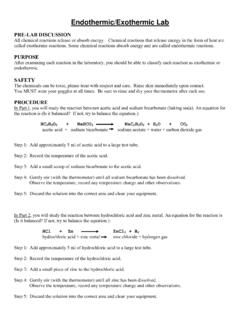
2 SAFETY The chemicals can be toxic, please treat with respect and care. Rinse skin immediately upon contact. You MUST wear your goggles and apron at all times. Be sure to rinse and dry your thermometer after each use. PROCEDURE In Part I, you will study the reaction between acetic acid and sodium bicarbonate (baking soda). An equation for the reaction is: HC2H3O2 + NaHCO3 NaC2H3O2 + H2O + CO2 acetic acid + sodium bicarbonate sodium acetate + water + carbon dioxide gas Step 1: Add approximately 5 ml of acetic acid to a large test tube. Step 2: Record the temperature of the acetic acid. Step 3: Add a small scoop of sodium bicarbonate to the acetic acid.
3 Quickly recover the container with the sodium bicarbonate. Step 4: Gently stir (with the thermometer) until all sodium bicarbonate has been dissolved. Observe the temperature, record any temperature change and other observations. Step 5: Discard the solution into the correct area and clean your equipment with soap and water. Dry it also. In Part 2, you will study the reaction between hydrochloric acid and zinc metal. An equation for the reaction is HCl + Zn ZnCl2 + H2 hydrochloric acid + zinc metal zinc chloride + hydrogen gas Step 1: Add approximately 5 ml of hydrochloric acid to a large test tube.
4 Step 2: Record the temperature of the hydrochloric acid. Step 3: Add a small piece of zinc to the hydrochloric acid. Step 4: Gently stir (with the thermometer) until all zinc has been dissolved. Observe the temperature, record any temperature change and other observations. Step 5: Discard the solution into the correct area and clean your equipment with soap and water. Dry it also. In Part 3, you will study the reaction between magnesium sulfate (Epsom salt) and water. An equation for the reaction is: MgSO4 + H2O MgSO4 + H2 + O2 magnesium sulfate + water hydrogen gas + oxygen gas Step 1: Add approximately 10 ml of water to a large test tube.
5 Step 2: Record the temperature of the water. Step 3: Add a small scoop of magnesium sulfate to the water. Quickly recover the container with the magnesium sulfate. Step 4: Gently stir (with the thermometer) until all magnesium sulfate has been dissolved. Observe the temperature, record any temperature change and other observations. Step 5: Discard the solution into the correct area and clean your equipment with soap and water. Dry it also. In Part 4, you will study the reaction between calcium chloride and water. An equation for the reaction is: CaCl2 + H2O CaCl2 + H2 + O2 calcium chloride + water calcium chloride + oxygen gas Step 1: Add approximately 10 ml of water to a large test tube.
6 Step 2: Record the temperature of the water Step 3: Add a small scoop of calcium chloride to the water. Quickly recover the container with the calcium chloride. Step 4: Gently stir (with the thermometer) until all calcium chloride has been dissolved. Observe the temperature, record any temperature change and other observations. Step 5: Discard the solution into the correct area and clean your equipment with soap and water. Dry it also. and OBSERVATIONS Example Data Table Reactants* Products* Initial Temperature Final Temperature Detailed Observations Part 1 Part 2 Part 3 Part 4 *Be sure to balance the equations first!
7 Part 1: HC2H3O2 + NaHCO3 NaC2H3O2 + H2O + CO2 Part 2: HCl + Zn ZnCl2 + H2 Part 3: MgSO4 + H2O MgSO4 + H2 + O2 Part 4: CaCl2 + H2O CaCl2 + H2 + O2 ANALYSIS 1. The reaction of sodium bicarbonate and acetic acid is Exothermic or Endothermic ? What evidence do you have? 2. The reaction of zinc metal and hydrochloric acid is Exothermic or Endothermic ? What evidence do you have? 3. The reaction of magnesium sulfate and water is Exothermic or Endothermic ? What evidence do you have? 4. The reaction of calcium chloride and water is Exothermic or Endothermic ? What evidence do you have? APPLICATION 5. Calcium chloride is as an ice-melting compound on sidewalks and city streets.
8 Explain what is happening (use one of the terms- Exothermic or Endothermic in your explanation). 6. Does the energy go from the surrounding to the chemicals or from the chemicals to the surroundings in an Exothermic reaction? 7. Classify each of the following as an Exothermic or Endothermic process. Melting ice cubes _____ Burning a candle _____ Evaporation of water_____ Baking Bread _____ Splitting a gas molecule apart _____ Formation of snow in clouds _____