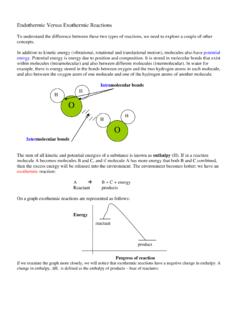
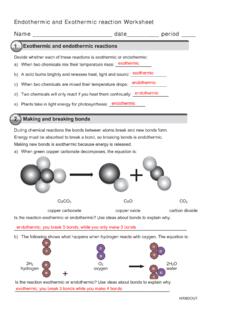
Transcription of Endothermic: A process or reaction that absorbs H.
1 Prentice Hall 2003 Chapter One3 EndothermicEndothermic: a process or reaction that absorbs : a process or reaction that absorbs heat and has a positive heat and has a positive H. H. ExothermicExothermic: : A process or reaction that releases A process or reaction that releases heat and has a negative heat and has a negative of conservation of energyLaw of conservation of energy: Energy can be : Energy can be neither created nor destroyed in any physical or neither created nor destroyed in any physical or chemical of reactionHeat of reaction : Represented by.
2 Represented by H, is the H, is the difference between the energy absorbed in difference between the energy absorbed in breaking bonds and that released in forming breaking bonds and that released in forming bonds. bonds. H is also known as enthalpy is also known as enthalpy Hall 2003 Chapter exothermic and endothermic exothermic and endothermic ReactionsReactionsWhen the total strength of the bonds formed in the When the total strength of the bonds formed in the products is greater than the total strength of the bonds products is greater than the total strength of the bonds broken in the reactants, energy is released and a broken in the reactants.
3 Energy is released and a reaction is reaction is exothermicexothermic. All combustion reactions are . All combustion reactions are exothermic . exothermic . Prentice Hall 2003 Chapter One5 When the total energy of the bonds formed in the When the total energy of the bonds formed in the products is less than the total energy of the bonds products is less than the total energy of the bonds broken in the reactants, energy is absorbed and the broken in the reactants, energy is absorbed and the reaction is is Hall 2003 Chapter Why Do Chemical reactions Why Do Chemical reactions Occur: Free EnergyOccur.
4 Free EnergySpontaneous processSpontaneous process : A process or reaction : A process or reaction that , once started, proceeds on its own without that , once started, proceeds on its own without any external external : A measure of the amount of molecular : A measure of the amount of molecular disorder in a system. Symbol disorder in a system. Symbol SSis used for is used for entropy and it has the unit of calories per mole entropy and it has the unit of calories per mole Kelvin. The greater the disorder or randomness Kelvin.
5 The greater the disorder or randomness of the particles in a substance or mixture, the of the particles in a substance or mixture, the larger the value of larger the value of Hall 2003 Chapter One7 To decide whether a process is To decide whether a process is spontaneous, both the enthalpy change and the spontaneous, both the enthalpy change and the entropy change must be taken into account. entropy change must be taken into account. When When H and H and S are both favorable, a S are both favorable, a process is process is spontaneousspontaneous; when both are ; when both are unfavorable, a process is unfavorable, a process is Free energy change (Free energy change ( G):G):Free energy Free energy change is used to describe spontaneity of a change is used to describe spontaneity of a process .
6 It takes both process . It takes both H and H and S into account. S into account. Prentice Hall 2003 Chapter One8 The value of the freeThe value of the free--energy change (energy change ( G) G) determines spontaneity. G is negative; free energy is released; process is G is negative; free energy is released; process is exothermic or exothermic or G is positive; free energy is added; process is G is positive; free energy is added; process is endothermic or endothermic or Hall 2003 Chapter How Do Chemical reactions How Do Chemical reactions Occur: reaction RatesOccur.
7 reaction RatesThe value of The value of G indicates whether a reaction G indicates whether a reaction will occur but it does not say anything about will occur but it does not say anything about how fast the reaction will occur or about the how fast the reaction will occur or about the details of the molecular changes that takes place details of the molecular changes that takes place during the the a chemical reaction to occur:For a chemical reaction to occur: Reactant particle must particle must collide.
8 Some chemical bonds have to chemical bonds have to Hall 2003 Chapter One10 Some chemical bonds have to chemical bonds have to form. Not all collision leads to product; only the Not all collision leads to product; only the colliding molecules approaching with right colliding molecules approaching with right orientation will form will form Hall 2003 Chapter One11 The energy change that occurs during the The energy change that occurs during the course of a chemical reaction can be visualized course of a chemical reaction can be visualized in an energy diagram as shown in the following in an energy diagram as shown in the following Fig.
9 Hall 2003 Chapter One12 Activation energy Activation energy (E(Eaa):):The amount of The amount of energy the colliding particles must have for energy the colliding particles must have for productive collisions to occur. The size of the productive collisions to occur. The size of the activation energy determines the reaction rate, activation energy determines the reaction rate, or how fast the reaction how fast the reaction occurs. The lower the activation energy, the greater the The lower the activation energy, the greater the number of productive collisions in a given number of productive collisions in a given amount of time, and faster the of time, and faster the reaction .
10 Higher the activation energy, the lower the Higher the activation energy, the lower the number of productive collisions , and slower the number of productive collisions , and slower the Hall 2003 Chapter One15 Prentice Hall 2003 Chapter Reversible reactions and Chemical Reversible reactions and Chemical EquilibriumEquilibriumReversible ReactionsReversible reactions ::A reaction that can go in either A reaction that can go in either direction, from products to reactants or reactants to direction, from products to reactants or reactants to products.