Transcription of vel 5-1: Endothermic vs. Exothermic - Reeths-Puffer
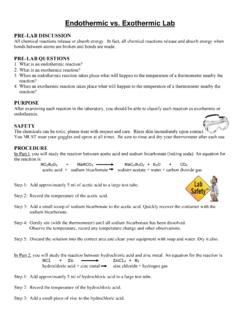
1 Endothermicvs. Exothermicvel5-1:Endothermicvs. ExothermicIn variouschemicalprocessessuchas reactionsand the dissolvingof salts,heatis eitherabsorbedorgivenoff. We call theseeventseitheran Endothermic (heatin) or Exothermic (heatout) is usualto detecttheseheateventsby measuringthe temperaturechangeassociatedwiththe thisproblem,you will dissolveseveralsaltsin water,measurethe resultingtemperaturecbange,and thenmakedeductionsaboutthe natureof the StartVirtualChemLaband selectEndothermicvs. Exothermicfromthe list of labwill openin the Therewill be a bottleof sodiumchloride(NaCI)on the lab weighpaperwill be on thebalancewithapproximately2 g ofNaCIon the The calorimeterwillbe on the lab benchand fiUedwith100 mL LabBookto stirreris On (youshouldbe able to see the shaftrotating).In the thermometerwindowclickSaveto obtaina baselinetemperatureofthe Dragthe weighpaperwiththe sampleto the calorimeteruntilit snapsinto placeand thenpourthesampleinto the changeintemperatureuntilit reachesa maximumand thenrecorddatafor an (Youcan clickon the clockon the walllabeledAccelerateto acceleratethe timein the laboratory.)
2 A bluedatalink will appearin the datalinkand recordthe temperaturebeforeaddingthe NaCland the highestor lowesttemperatureafteraddingthe NaClin the CLickthe red disposalbucketto clearthe the Stockroomto theclipboardand selectPresetExperiment#7 and repeatthe experimentwithNaN03 Recordthe initialand finaltemperaturesin the Clickthe red disposalbucketto clearthe the Stockroomto clipboardand selectPresetExperiment#8 and repeatthe experimentwithNaCH3 COO(NaAc).RecordtheinitiaJand finaltemperaturesin the (TrT.)NaCl(s) + H20(1)1J5,()6)!.4, '20- (s) + H20(I)1_t1 I} 0'L4,03-'11 NaCH3 COO+ H20(1)L ')( 00L')I~&+..1~Use yourexperimentaldatato answerthe Calculate!:iT(!:iT= T2- TI)for each mixtureand recordthemin the data An exothermicprocessgivesoff heat(warmsup).An endothermicprocessabsorbsheat(coolsoff). Whichsolutionsare endothermicand whichare Exothermic ?Whatis the signof the changeinenthalpyitsli)in eachcase?tva NOD\,vqsendo+hermi( (+ j H)b)o C +-13(Q (J \AIC(5ex oiheemj CC: -6 tI)9.
3 Whichsolution/s)had littleor no changein temperature? VerJ t,if(g~ {lJJe54 Enthalpyof Solutionvel5-2:Enthalpyof Solution:NH4N03 Haveyoueverusedone of those"instantcoldpacks"thatlookslikea plasticbag filledwithliquid?Ifyouhit the bag and shakeit up it getsextremelycold,but whydoesit do that?Theliquidinsidethe coldpackis water,andin the wateris anotherplasticbagor breaksthe tubeso that the watermixeswiththe a salt,suchas N~N03,in wateris caUeddissolution,and the heatassociatedwiththe dissolvingprocessis calledtheEnthalpyof this problem,youwilltakea sampleofNI-4N03,dissolveit in water,and aftermeasuringthe changein temperature,calculatethe enthalpyof solutionfor ~ selectEnthalpyof Solution:NH"NOJfromthe list of the Therewill be a bottleof ammoniumnitrate(N~N03)on the lab weighpaperwill be on thebalancewithapproximately2 g the massof the samplein the youcannotreadthe masson the balance,clickin the balanceareato ZoomIn. Returnto Labwhenyouhaverecordedthe 0 if Ilj3.}
4 Thecoffeecup calorimeterwillbe on the lab benchand filledwith100 mL Lab Bookto openit. Makecertainthe stirreris On (youshouldbe ableto see the shaftrotating).In thethermometerwindowclickSaveto obtaina baselinetemperatureof the Dragthe weighpaperwiththe sampleto the calorimeteruntilit snapsintoplaceand thenpourthesampleinto the changein temperatureuntilit reachesa maximumand thenrecorddatafor an (Youcan clickon the clockon the walllabeledAccelerateto acceleratethe timein the laboratory.)A bluedatalinkwillappearin the datalinkand recordthe temperaturebeforeaddingthe ~03and the highestorlowesttemperatureafteraddingthe N~OJin the CalculateIlT (IlT = 1initial-TfinaJfor the ~(_'-l3w:.&./_o_O. An exothermicprocessgivesoff heat(warmsup),and an endothermicprocessabsorbsheat(coolsoff). Wasthe additionof NH"N03to the wateran endothermicor exothermicprocess?Whatis the signofthe changein enthalpy(1lH)?e od a .+:bec m ~(C+ 11H)7. Determinethe molesof NH"N03in the ~N03is 80 I 041 Ljtvtl({ The heatabsorbedor lost by the watercan be calculatedusingq = m- Cwater I:lT.)))}
5 Assumethat thedensityof wateris 1 massoj the waterand substituteJar m. !1 Tis the changein the temperatureoj the waterand CWQleris the specificheat capacityJar water( ).Whatis the heat absorbedor lost, in J,by the water?g.:: ({o0'ji'-HZ~~ )( 1,31)$~ ,ot{Jou~ab56rhed9. The heattransferredfrom/tothe NI4N03can be dividedby the molesofNI4N03to obtainthe molarheatof solutionfor the molarheat of solution,in kl, oJNH4N03?54~,/Ot{J~/600= 154810 rs /Ol55/5Mo}; '1 8-/VIol10. If the acceptedvalue/orthe heata/solution/orsugaris ,calculatethe acceptedanswerl% Error=x 100acceptedanswer%Error=Ie2.(. L.[ ~ .-. 25,(oq)/ x. 10025,CtJqThisexperimentdoesnot considerthat all of the conditionsare standardstateconditions;therefore,youare calculatingLVfsolnot LVfOsol'error56 SpecificHeatof AIvel5-3:SpecificHeatof AIOn a sunnyday,the waterin a swimmingpoolmaywarmup a degreeor twowhilethe concretearoundthe poolmaybecometoo hot to walkon waterandconcreteare beingheatedby the takesmoreheattoraisethe temperatureof somesubstancesthanothers,whichis heatrequiredto raisethe temperatureof 1 g of a substanceby 1 degreeis calledthe specificheatcapacityor ,for instance,has a specificheatof highin comparisonwiththe specificheatsfor othermaterials,suchas concreteor this experiment,youwiUuse asimplecalorimeterand yourknowledgeof the specificheatof waterto measurethe specificheatofaluminum(AI).)]}}
6 1. StartVirtualChemLaband selectThe SpecificHeatof Al fromthe list of willopenin the Clickon the Lab Bookto openit Recordthe massof AI on the it is too smallto readclickon the Balanceareato zoomin, recordthe massof Al in the datatablebelow,and returnto thelaboratory.'7, "?J'5L{ ~ 93. Pickup the Al samplefromthe balancepan and placethe samplein the set to heatto 200 Thecalorimeterhas beenfilledwith100 mL waterat 25 Cis densityof the waterto determinethe massof waterfromthe volumeand recordthe volumeandmassin the stirreris On (youshouldbe ableto see the shaftrotating).Clickthe thermometerwindowto bringit to the frontand clickSaveto obtaina baselinetemperatureof the observethe temperaturein the calorimeteras a functionof timeusingthe Clickon the Ovento openit. Dragthe hot AI samplefromthe ovenuntilit snapsintoplaceabovethecalorimeterand dropit in. Clickthe thermometerand graphwindowsto bringthemto the frontagainand observethe changein temperaturein the graphwindowuntilit reachesa constantvalueand thenwaitan the temperaturewindow.}
7 (Youcan clickon the clockon the walllabeledAccelerateto acceleratethe timein the laboratory.)A bluedatalink willappearin the lab bluedatalinkand recordthe temperaturebeforeaddingthe Al and thehighesttemperatureafteraddingthe AI in the datatable.(Rememberthatthe waterwillbeginto cooldownafterreachingthe equilibriumtemperature.)DataTableAImasso f metal(g)[."b54~C}volumeof water(roL) water(g)qq. ~ qinitialtemperatureof water(0C) "'.000initialtemperatureof metal(0C)200 Clmaxtempof water+ metalC C)"-','38 'DOvnL)( Calculatethe changein temperatureof the water( )'(~7I "80_25)7. Calculatethe heat(q), in J, gainedby the waterusingthe followingequation:qwaler= mWalerx CWBler,givenCwaler= (K g)g ~ (qq \l?% ) ( :I, Ik'4 ~ o(_ 'lGI ~ d' c )-<1q3 I &> JO'JW8. Calculatethe changesin temperatureof the Al ( Ca () b - 27 I ? a()) (02 9. Rememberingthatthe heatgainedby the wateris equalto the heatlost by the metal,calculatethespecificheat0/ aluminumin J/K -qmelaJ- mAlx anAI=-----=-=='---(mmelal)(!))]
8 10. Calculatethe percenterrorin the specificheatvaluethat Al is Error=x 100acceptedansweri 90:358 SpecificHeatof Pbvel5-4:SpecificHeatof PbOn a sunnyday,the waterin a swimmingpoolmaywarmup a degreeor two whilethe concretearoundthe poolmaybecometoo hot to walkon waterandconcreteare beingheatedby the samesource-thesun. Thisevidencesuggeststhat it takesmoreheattoraisethe temperatureof somesubstancesthanotbers,whichis amountof heatrequiredto raisethe temperatureof 1 g of a substanceby 1 degreeis calledthe specificheatcapacityor specificheatofthat ,for instance,has a specificheatof highin comparisonwiththe specificheatsfor othermaterials,suchas concreteor this experiment,you will use asimplecalorimeterand yourknowledgeof the specificheatof waterto measurethe specificheatof lead(Pb).1. StartVirtualChemLaband selectThe SpecificHeatof Pb fromthe list of lab willopenin the Clickon the LabBookto openit. Recordthe massof Pb on the it is too smallto readclickon the Balanceareato zoomin, recordthe massofPbin the datatablebelow,and returnto thelaboratory.
9 "3j I '2z,<iJ3. Pickup the Pb samplefromthe balancepan and placethe samplein the ovenis set to heatto 200 The calorimeterbas beenfilledwith100 mL densityof waterat 25 Cis densityof the waterto determinethe massof waterfromthe volumeand recordthe volumeandmassin the stirreris On (youshouldbe ableto see the shaftrotating).Clickthe thermometerwindowto bringit to the frontand clickSaveto obtaina baselinetemperatureof the can observethe temperaturein the calorimeteras a functionof timeusingthe Clickon the Ovento openit. Dragthe hot Pb samplefromthe ovenuntilit snapsinto placeabovethecalorimeterand dropit in. Clickthe thermometerand graphwindowsto bringthemto the frontagainand observethe changein temperaturein the graphwindowuntilit reachesa constantvalueand thenwaitan the temperaturewindow.(Youcan clickon the clockon the walllabeledAccelerateto acceleratethe timein the laboratory.)A bluedatalink will appearin the lab bluedatalink and recordthe temperaturebeforeaddingthe Pb and thehighesttemperatureafteraddingthe Pb in the datatable.
10 (Rememberthat the waterwill beginto cooldownafterreachingthe equilibriumtemperature.)DataTablePbmasso f metal(g)33, 122-<;cvolumeof water(mL) water(g)qq I l? qinitialtemperatureof water(0e)25,O()'l$initialtemperatureof metal(0e)' water+ metal(0e)2.(0,5(00:::59 Chapter56. Calculatethe changesin temperatureof the water(I1 TwQter)'(2615&0 -l5I 000)CJ7. Calculatethe heat(q), in J, gainedby the waterusingthefollowingequation:~ :: (qq, g9 Y 4. 184 :,%'cc )( (ao)g '"&, d'JOV~8. Calculatethe changesin temperatureof the Ph (ATp!).(J,OOc, - 2tQ ,.5(g0 )173,'itt DC9. Rememberingthat the heatgainedby the wateris equalto the heatlost by the metal,calculatethespecificheatof leadin 11K -q metal= mPbX ATpbX CPbandCpbqmdal(m,DCtal)(LlTmetal)J-___., :0~ ::::..I_7~8:__::-- ~_:::___:oG-",-~3~ :..;;; :..:..q_, )( )~{..:..J__:_1~3 ~ )~C~=-~.~II'3 t10. Calculatethe percenterrorin the specificheatvaluethat you Ph is acceptedanswerl% Error=x 100acceptedanswerX/DOe '3060 Heatof Formation:Ethanolvel5-8:Heatof Formation:EthanolTheheatof formationis the heatof reactionfor the formationof a compoundfromits be determinedby measuringthe beatof combustionfor the compoundand thenusingHess'slaw to convertthe heatof combustionto a heatof beatof combustioncan be performedat constantvolumeusinga devicecalleda a bombcalorimetera sampleis burnedin a constant-volumechamberin the presenceofoxygenat releasedwarmsthe watersurroundingthe temperatureincreaseof the water,it is possibleto calculatethe quantityof beatreleasedduringthe this assignmentyouwill first measurethe heatof combustionofethanol(ethylalcohol,C2H50H) and thenconvertthe beatof combustionto a beatof StartVirtualChemLaband selectHeatof Formation.))}