Example: bachelor of science
MODULAR ARITHMETIC
By the de nition of a \remainder," we can write a = im + r 1, where r 1 is the remainder under division by m and satis es 0 r 1 m 1. Similarly, b = jm + r 2 with 0 r 2 m 1. Then if m divides a b, this means that m divides im + r 1 jm r 2 = m(i j) + r 1 r 2. Since m clearly divides m(i j), we get that m divides r 1 r 2. We know that r 1 and r
Tags:
Information
Domain:
Source:
Link to this page:
Documents from same domain
1 Origins of Language - University College Dublin
www.ucd.ieOrigins of Language1 1 Origins of Language ANDREW CARSTAIRS-MCCARTHY 1 Introduction Among the inhabitants of some African forests about eight million years ago
Taxonomy of Anderson et al (2001) and Bloom (1956).
www.ucd.ieKrathwohl’s Taxonomy of the Affective Domain was developed from Bloom’s original and is the best known of the affective domains, it includes concepts such as Receiving ideas; Responding to ideas, phenomena; Valuing ideas,

Ethical Considerations EC Research Proposals
www.ucd.ieUniversity of Dublin Trinity College Ethical Considerations in EC Research Proposals Mary Sharp

Analytical Driver Red Blue - University College Dublin
www.ucd.ie2 Study based on the researchs of Merrill & Roger, “Personal Styles and Effective Performance - 1981” & Bolton&Bolton’s “Social Style and Management - 1984”

ZActive Learning with Technology - University …
www.ucd.ie3 Introduction to Programme Modules Level 9 Modules This Level 9 module can be undertaken as a stand-alone module for the award of Certificate in Continuing
The Ladder of Inference - University College Dublin
www.ucd.iePage 2 Unfortunately, assumptions and conclusions are particularly difficult to test. For instance, suppose I wanted to find out if Larry real ly thought I was incompetent.

Activation and active labour market policies in …
www.ucd.ieUCD GEARY INSTITUTE DISCUSSION PAPER SERIES Activation and active labour market policies in OECD countries: stylized facts and evidence on their effectiveness

Leadership - University College Dublin
www.ucd.ieLeadership is about working with people to do new things in a world which is increasingly complex and fast changing. We need organisations that are flexible and sustainable, and organisations are made up of individuals.

Leadership Styles & Team Roles - University College …
www.ucd.ie© 2010 Deloitte Touche Tohmatsu Leadership Styles & Team Roles Behaving „As One‟
Mark Aronoff and Kirsten Fudeman - University …
www.ucd.ie2 MORPHOLOGY AND MORPHOLOGICAL ANALYSIS of linguistics that deals with words, their internal structure, and how they are formed. n 1.2 Morphemes A major way in which morphologists investigate words, their internal
Related documents

Math 127: Chinese Remainder Theorem - CMU
www.math.cmu.eduMath 127: Chinese Remainder Theorem Mary Radcli e 1 Chinese Remainder Theorem Using the techniques of the previous section, we have the necessary tools to solve congruences of the form ax b (modn). The Chinese Remainder Theorem gives us a tool to consider multiple such congruences simultaneously.

The Chinese Remainder Theorem - luc.edu
gauss.math.luc.eduBy solving this by the Chinese remainder theorem, we also solve the original system. (The solution is x 20 (mod 56).) Of course, the formula in the proof of the Chinese remainder theorem is not the only way to solve such problems; the technique presented at the beginning of this lecture is actually more general, and it requires no mem-orization.

The Chinese Remainder Theorem - homepages.math.uic.edu
homepages.math.uic.eduChinese Remainder Theorem tells us that there is a unique solution modulo m, where m = 11 ⋅ 16 ⋅ 21 ⋅ 25 = 92400. We apply the technique of the Chinese Remainder Theorem with k = 4, m 1 = 11, m 2 = 16, m 3 = 21, m 4 = 25, a 1 = 6, a 2 = 13, a 3 = 9, a 4 = 19, to obtain the solution. We compute z 1 = m / m 1 = m 2 m 3 m 4 = 16 ⋅ 21 ...

Section 4.3 - The Chinese Remainder Theorem
zimmer.csufresno.eduSolution: Since 8 and 9 are relatively prime, we can use the Chinese remainder theorem to solve the congruences x ≡ 1 (mod 8) x ≡ 3 (mod 9) One comes up with x ≡ 57 (mod 72). Thus since 12 divides 72, we must also have x ≡ 57 (mod 12). But 57 6≡2 (mod 12)
Math 110 Homework 3 Solutions
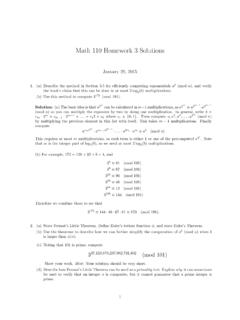
www.math.lsa.umich.eduBy the Chinese Remainder Theorem, we already knew that the map (Z=mnZ) ! (Z=mZ) (Z=nZ) c(mod nm) 7! c(mod m) ;c(mod n) is one-to-one and onto. Now we know that it maps every unit c(mod mn) to a pair of units c(mod m) ;c(mod n) , and conversely that every pair of units is in the image of a unit c(mod mn). We conclude that the map re-
Chapter 4.4: Systems of Congruences
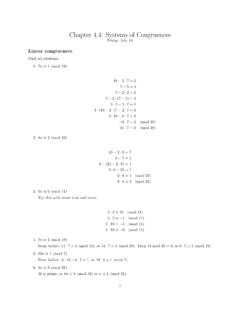
math.berkeley.eduChinese Remainder Theorem Decide whether the system has a solution. If it does, nd it. 1. x 3 (mod 8), x 1 (mod 7) Try x = 8a+7b. mod 8, we get 3 x 7b (mod 8), and solving gives b = 5. mod 7, we get 1 x 8a (mod 7), so a 1 (mod 7). Therefore one …

Problems on Discrete Mathematics1 LTEX at January 11, 2007
www.itk.ilstu.eduThen we exam each case to see if the theorem is valid. If the theorem holds in every case, then the theorem is correct in the entire domain. Note that we must use the idea of universal generalization2 in the proof of each case. 2See the logic chapter for more details. °c Chung-Chih Li, Kishan Mehrotra