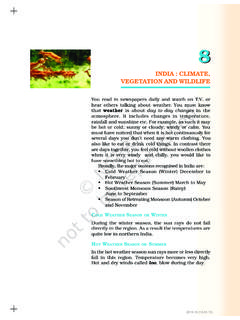
Transcription of Fig. 8.1: People from various parts of the world
1 Renuka was excited. Shrikant Uncle was home after agap of nearly four months. He was a wildlife photographerand travelled widely. Renuka s interest in wildlife andforests began at an early age, when her uncle introducedher to books on nature. Pictures of distant lands andpeople, who lived there, always fascinated : People from various parts of the world In these pictures Renuka, you can see People fromdifferent parts of the world some from dry deserts, somefrom frozen lands and some from hot wet rainforests. They look so different from me , observed Renuka. Theymay look different, but they share the same basic needsof life food, clothing and shelter , explained Shrikant Uncle.
2 Their children do the same things as you probably do,play games, quarrel sometimes and then make-up, sing,dance and help the families with various things that needto be done. They live closer to nature and very early intheir lives have learnt to care for nature. They learn howto catch fish and how to collect material from the forests. 2021-2256 OUR ENVIRONMENTG lossaryIn Chapters 8, 9 and 10, you will learn about the lifeof People in the different natural regions of the IN THE AMAZON BASINB efore learning about the Amazon basin, let us look at themap (Fig. ). Notice that the tropical region lies veryclose to the equator; between 10 N and 10 S. So, it is referredto as the equatorial region.
3 The river Amazon flows throughthis region. Notice how it flows from the mountains to thewest and reaches the Atlantic Ocean to the place where a river flows into another body ofwater is called the river s mouth. Numerous tributariesjoin the Amazon River to form the Amazon basin. Theriver basin drains portions of Brazil, parts of Peru, Bolivia,Ecuador, Columbia and a small part of the countries of the basin through which theequator : Theseare small rivers thatjoin the main main river alongwith all its tributariesthat drain an areaforms a river basin orthe catchment Amazon Basin isthe largest river basinin the : The Amazon Basin in South AmericaDo you know?
4 When Spanishexplorers discoveredthe Amazon river,they were attacked bya group of local tribeswearing headgearsand grass peoplereminded them of thefierce tribes of womenwarriors known inancient RomanEmpire as theAmazons. Hence thename ENVIRONMENT INTERACTIONS: THE TROPICAL AND THE SUBTROPICAL REGION57 CLIMATEAs you now know, the Amazon Basin stretches directlyon the equator and is characterized by hot and wet climatethroughout the year. Both day and nights are almostequally hot and humid. The skin feels sticky. It rainsalmost everyday, that too without much warning. Theday temperatures are high with very high humidity. Atnight the temperature goes down but the humidityremains it rains heavily in this region, thick forestsgrow (Fig.)
5 The forests are in fact so thickthat the dense roof created by leaves andbranches does not allow the sunlight to reachthe ground. The ground remains dark and shade tolerant vegetation may grow , bromeliads grow as plant rainforest is rich infauna. Birds such as toucans (Fig. ),humming birds, macaw with theirbrilliantly coloured plumage, oversizedbills for eating make them differentfrom birds we commonly see in birds also make loud sounds inthe forests. Animals like monkeys,sloth and ant-eating tapirs are foundhere (Fig. ). various species of reptiles and snakesalso thrive in these jungles. Crocodiles, snakes, pythonsabound. Anaconda and boa constrictor are some of thespecies.
6 Besides, the basin is home to thousands ofspecies of insects. Severalspecies of fishes including theflesh-eating Piranha fish isalso found in the river. Thisbasin is thus extraordinarilyrich in the variety of life OF THE RAINFORESTSP eople grow most of their food in small areas after clearingsome trees in the forest. While men hunt and fish alongthe rivers, women take care of the crops. They mainly growDo you know?Bromeliads arespecial plants thatstore water in theirleaves. Animals likefrogs use thesepockets of water forlaying their s doSome TV channelsbroadcastdocumentaries on thewildlife of the to watch some ofthe films and shareyour experience withthe : The Amazon ForestFig.
7 : ToucansFig. : Tapir2021-2258 OUR ENVIRONMENTFig. : Gradual Destruction of ForestsDo you know?Slash and Burn is away of cultivating landwhere farmers clear apiece of land byslashing or cuttingdown trees and are then burnt,which releases thenutrients into the crops are grown inthis cleared field for afew repeatedlyusing the patch ofland, the soil loosesits nutrients. So it isabandoned. Then theyclear another plot ofland to plant. In themean time youngtrees grow in the oldfield. In this way soilfertility is can thenreturn to it and startcultivating it , pineapple and sweet potato. As hunting and fishingare uncertain it is the women who keep their families aliveby feeding them the vegetables they grow.
8 They practice slash and burn agriculture . The staple food is manioc,also known as cassava that grows under the ground likethe potato. They also eat queen ants and egg sacs. Cashcrops like coffee, maize and cocoa are also rainforests provide a lot of wood for the families live in thatched houses shaped likebeehives. There are other large apartment-like housescalled Maloca with a steeply slanting of the People of the Amazon basin is slowlychanging. In the older days the heart of the forest, couldbe reached only by navigating the river. In 1970 the TransAmazon highway made all parts of the rainforestaccessible. Aircrafts and helicopters are also used forreaching various places.
9 The indigenous population waspushed out from the area and forced to settle in newareas where they continued to practice their distinctiveway of developmental activities are leading to the gradualdestruction of the biologically diverse rainforests. It isestimated that a large area of therainforest has been disappearingannually in the Amazon can see that thisdestruction of forests hasa much wider implication(Fig. ). The topsoil iswashed away as therains fall and thelush forestturns intoa ENVIRONMENT INTERACTIONS: THE TROPICAL AND THE SUBTROPICAL REGION59 LIFE IN THE GANGA-BRAHMAPUTRA BASINThe tributaries of rivers Ganga andBrahmaputra together form theGanga-Brahmaputra basin in theIndian subcontinent (Fig.)
10 Thebasin lies in the sub-tropical regionthat is situated between 10 N to 30 Nlatitudes. The tributaries of the RiverGanga like the Ghaghra, the Son, theChambal, the Gandak, the Kosi andthe tributaries of Brahmaputra drainit. Look at the atlas and find namesof some tributaries of the plains of the Ganga and theBrahmaputra, the mountains and the foothills of theFig. : Ganga-Brahmputra BasinFig. Brahmaputra river2021-2260 OUR ENVIRONMENTG lossaryHimalayas and the Sundarbans delta are the mainfeatures of this basin. Ox-bow lakes dot the plain area is dominated by monsoon climate. Themonsoon brings rains from mid-June to summers are hot and the winters at the map of India (Fig.)