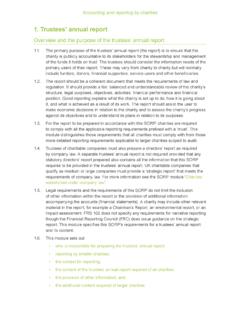
Transcription of 10. Balance sheet - Charities SORP
1 Accounting and reporting by Charities EX POSU RE D RAF T CONSULT AT ION DR AF T 82 10. Balance sheet Introduction All Charities preparing accruals accounts must prepare a Balance sheet at the end of each reporting period which gives a true and fair view of their financial position. The Balance sheet provides a snapshot statement of a charity s assets and liabilities and how these are represented by the different classes of funds held by a charity. The objective of the Balance sheet is to show the resources available to the charity and whether these are available for all purposes of the charity or have to be used for specific purposes because of legal restrictions placed on their use. This module applies to all Charities , whether reporting under the FRSSE or FRS 102, and sets out: the structure of the Balance sheet ; fixed assets headings, classification and disclosures; current assets headings, classification and disclosures; liabilities headings, classification and disclosures; and funds classification and disclosures.
2 Each section explains what items are included in each heading of the Balance sheet ; the recognition principles and the measurement methods used for Balance sheet items; and the information that must be, or should be, provided in the notes if not shown on the face of the Balance sheet . For information on the recognition and measurement of financial assets and liabilities Charities must refer to the SORP module Accounting for financial assets and liabilities . Structure of the Balance sheet Table 5 sets out the format of a charity s Balance sheet and the headings used to present its assets, liabilities and funds. A charity s Balance sheet must: adopt the same format in subsequent reporting periods unless there are special reasons for a change that are explained in the notes; and provide corresponding amounts for the previous reporting period for each heading disclosed in the Balance sheet .
3 Accounting and reporting by Charities EX POSU RE D RAF T CONSULT AT ION DR AF T 83 Table 5: Balance sheet Note ref. Total funds Prior year funds Further details Fixed assets: A Intangible assets A1 Tangible assets A2 Heritage assets A3 Investments A4 Total fixed assets Current assets: B Stocks B1 Debtors B2 Investments B3 Cash at bank and in hand B4 Total current assets Liabilities: C Creditors: Amounts falling due within one year C1 Net current assets or liabilities Total assets less current liabilities Creditors: Amounts falling due after more than one year C2 Provisions for liabilities and charges. C3 Net asset or liabilities excluding pension asset or liability Defined benefit pension scheme asset or liability C4 Total net assets or liabilities The funds of the charity: D Endowment funds D1 Restricted income funds D2 Unrestricted funds D3 Revaluation reserve D4 Pension reserve D5 Total unrestricted funds Total charity funds Accounting and reporting by Charities EX POSU RE D RAF T CONSULT AT ION DR AF T 84 If there is a nil amount for a particular Balance sheet heading in the current reporting period, a corresponding amount for the reporting period must still be disclosed unless that amount is also nil.
4 If the amount for both the current and previous reporting periods is nil, then the heading should be omitted from the Balance sheet . The Balance sheet must be signed by one or more trustees, each of whom has been authorised to do so by the trustee body, and must specify the date the accounts, including the Balance sheet , were approved by the trustee body. Where necessary to give a true and fair view, additional information must be provided in an additional heading or sub-heading in the Balance sheet or given in a note to the accounts. Charities may choose to analyse the items included in any Balance sheet heading in greater detail either on the face of the Balance sheet or in a related note. The Balance sheet may also be presented in a columnar format that analyses Balance sheet items by class of fund: unrestricted, restricted income and endowment.
5 Where the corresponding amount for the previous reporting period is not comparable due to a change in accounting policy, it must be adjusted if material to the Balance sheet and the reason for the adjustment explained in the notes to the accounts. The sections that follow are cross-referenced to the analysis headings shown in Table 5. A: Fixed assets headings, classification and disclosures Fixed assets provide an economic benefit to the charity on an on-going basis ( for more than one reporting period) through their ability to: generate income and/or gains; and/or contribute to furthering the charity s objectives. Charities that hold or have received donated fixed assets in the reporting period must refer to the SORP module Donated goods, facilities and services, including volunteers.
6 Fixed assets are recognised when: a resource is controlled by the charity as a result of a past event or transaction, for example a past gift or purchase; it is probable that the expected future economic benefits associated with the asset will flow to the charity; and the historical cost or fair value of the asset can be measured reliably. Accounting and reporting by Charities EX POSU RE D RAF T CONSULT AT ION DR AF T 85 Disclosure in the notes applying to all classes of fixed assets For each class of fixed assets, the following analysis of their cost or valuation must be provided in the notes to the accounts: cost or valuation at the beginning of the reporting period; acquisitions during the reporting period; revaluations during the reporting period; disposals during the reporting period; transfers to or from that class of item during the reporting period; and cost or valuation at the end of the reporting period.
7 The following analysis must also be provided for each class of fixed assets that is subject to depreciation or impairment provisions: the cumulative amount of depreciation or impairment provided at the beginning of the reporting period; amount adjusted on disposal; amount of depreciation or amortisation provided in the reporting period; amount of any impairment provision in the reporting period; amount of any impairment reversals in the reporting period; amount of any transfer or other adjustment in the reporting period; and the cumulative amount of depreciation, amortisation or impairment provided at the end of the reporting period. The carrying amount for each class of fixed assets must also be provided at the beginning and end of the reporting period. A1: Intangible fixed assets Intangible fixed assets are non-financial fixed assets that do not have physical substance but are identifiable and are controlled by the charity through custody or legal rights.
8 Intangible fixed assets include goodwill purchased on the acquisition of a business and/or purchased intangible assets such as concessions, patents, licences, trademarks and similar rights. Although such assets lack physical substance they provide an on-going economic benefit to the charity. The cost of internally generated goodwill or intangible assets such as brands and logos must not be capitalised and are written off as expenditure as incurred. Expenditure on research must always be written off, but the costs incurred in the development phase of an internal project may in certain circumstances be recognised as an intangible asset. The criteria for the recognition of development costs as an intangible asset are rigorous and involve a demonstration of technical and financial feasibility of the development asset.
9 For more information, refer to section 6 of the FRSSE or section 18 of FRS 102 as applicable. Intangible fixed assets must be measured at their historical cost. The residual value of intangible fixed assets is nil when calculating the charge for amortisation unless Accounting and reporting by Charities EX POSU RE D RAF T CONSULT AT ION DR AF T 86 reliable evidence exists to the contrary. Amortisation (see Appendix 1, Glossary of terms ) on intangible fixed assets must be charged as an expense to the relevant statement of financial activities (SoFA) category reflecting the use of the asset. Charities preparing accounts using FRS 102 may opt, after initial recognition at cost, to use the revaluation model; for more information, refer to section 18 of FRS 102. Capitalised goodwill and intangible assets must be amortised on a straight-line basis over their useful economic lives, which must be reviewed at each reporting date.
10 Whether preparing the accounts under the FRSSE or FRS 102, if the useful life cannot be estimated reliably it is presumed to be five years. Disclosures The notes to the accounts for all Charities must: explain the accounting policies adopted for intangible assets, including the measurement basis adopted, the amortisation rates and methods used and, where relevant, the policies for the recognition of any capitalised development expenditure; and provide an analysis reconciling the opening and closing carrying amounts of each class of intangible asset held. Where applicable when the accounts are prepared under FRS 102, the following additional disclosures must be made: for intangible assets acquired by way of grant, their value on initial recognition and their carrying amount; the carrying amounts of any intangible assets to which the charity has restricted title or that are pledged as security for liabilities; the amount of contractual commitments for the acquisition of intangible assets; the amount of research and development expenditure recognised as expenditure in the year; the heading(s) in the SoFA in which a charge of amortisation of intangible assets is included.