Transcription of 4.3Reaction Stoichiometry
1 Reaction StoichiometryBy the end of this section, you will be able to: Explain the concept of Stoichiometry as it pertains to chemical reactions Use balanced chemical equations to derive stoichiometric factors relating amounts of reactants andproducts Perform stoichiometric calculations involving mass, moles, and solution molarityA balanced chemical equation provides a great deal of information in a very succinct format. Chemical formulasprovide the identities of the reactants and products involved in the chemical change, allowing classification of thereaction. Coefficients provide the relative numbers of these chemical species, allowing a quantitative assessmentof the relationships between the amounts of substances consumed and produced by the reaction. These quantitativerelationships are known as the reaction sstoichiometry, a term derived from the Greek wordsstoicheion(meaning element ) andmetron(meaning measure ).
2 In this module, the use of balanced chemical equations for variousstoichiometric applications is general approach to using stoichiometric relationships is similar in concept to the way people go about manycommon activities. Food preparation, for example, offers an appropriate comparison. A recipe for making eightpancakes calls for 1 cup pancake mix,34cup milk, and one egg. The equation representing the preparation ofpancakes per this recipe is1 cup mix +34cup milk + 1 egg 8 pancakesIftwodozenpancakesareneededforab igfamilybreakfast,theingredientamountsmu stbeincreasedproportionallyaccording to the amounts given in the recipe. For example, the number of eggs required to make 24 pancakes is24 pancakes 1 egg8 pancakes= 3 eggsBalancedchemicalequationsareusedinmu chthesamefashiontodeterminetheamountofon ereactantrequiredtoreactwithagivenamount ofanotherreactant,ortoyieldagivenamounto fproduct, balanced equation are used to derivestoichiometric factorsthat permit computation of the desired quantity.
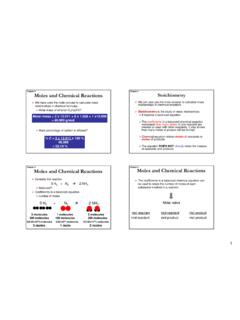
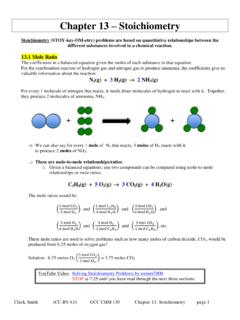
3 Toillustrate this idea, consider the production of ammonia by reaction of hydrogen and nitrogen:N2(g) + 3H2(g) 2NH3(g)This equation shows ammonia molecules are produced from hydrogen molecules in a 2:3 ratio, and stoichiometricfactors may be derived using any amount (number) unit:2 NH3molecules3 H2moleculesor2 doz NH3molecules3 doz H2moleculesor2 mol NH3molecules3 mol H2moleculesThese stoichiometric factors can be used to compute the number of ammonia molecules produced from a givennumber of hydrogen molecules, or the number of hydrogen molecules required to produce a given number ofammonia molecules. Similar factors may be derived for any pair of substances in any chemical of Reactant Required in a ReactionHowmany moles ofI2are required toreact with ofAlaccording tothe following equation (seeFigure )?196 Chapter 4 Stoichiometry of Chemical ReactionsThis content is available for free at + 3I2 2 AlI3 Figure and iodine react to produce aluminum iodide.
4 The heat of the reaction vaporizessome of the solid iodine as a purple vapor. (credit: modification of work by Mark Ott)SolutionReferringtothebalancedchemic alequation,thestoichiometricfactorrelati ngthetwosubstancesofinterestis3 mol I22 mol this factor:mol I2= mol Al 3 mol I22 mol Al= mol I2 Check Your LearningHowmanymolesofCa(OH) (PO4)2accordingto the equation3Ca(OH)2+ 2H3PO4 Ca3(PO4)2+6H2O? molExample of Product Molecules Generated by a ReactionHow many carbon dioxide molecules are produced when mol of propane is combusted according tothis equation?C3H8+ 5O2 3CO2+ 4H2 OSolutionTheapproachhereisthesameasforEx ample ,thoughtheabsolutenumberofmoleculesisreq uested,not the number of moles of molecules. This will simply require use of the moles-to-numbers conversionfactor, Avogadro s balanced equation shows that carbon dioxide is produced from propane in a 3:1 ratio:3 mol CO21 mol C3H8 Using this stoichiometric factor, the provided molar amount of propane, and Avogadro s number,Chapter 4 Stoichiometry of Chemical mol C3H8 3 mol CO21 mol C3H8 1023CO2moleculesmol CO2= 1024CO2moleculesCheck Your (OH)2accordingtothefollowingequation.
5 (NH4)2SO4+ Ca(OH)2 2NH3+ CaSO4+ 2H2 1024NH3moleculesThese examples illustrate the ease with which the amounts of substances involved in a chemical reaction of ,however,notaneasytask,andthe practical application of Stoichiometry requires that we use the more readily measured property of Masses of Reactants and ProductsWhatmassofsodiumhydroxide,NaOH,w ouldberequiredtoproduce16goftheantacidmi lkofmagnesia[magnesium hydroxide, Mg(OH)2] by the following reaction?MgCl2(aq) + 2 NaOH(aq) Mg(OH)2(s)+ 2 NaCl(aq)SolutionThe approach used previously inExample likewise used here; that is, we mustderive an appropriate stoichiometric factor from the balanced chemical equation and use it to relate theamounts of the two substances of interest. In this case, however, masses (not molar amounts) are providedand requested, so additional steps of the sort learned in the previous chapter are required. The calculationsrequired are outlined in this flowchart:16 g Mg(OH)2 1 mol Mg(OH) g Mg(OH)2 2 mol NaOH1 mol Mg(OH)2 g NaOHmol NaOH= 22 g NaOHCheck Your Learning198 Chapter 4 Stoichiometry of Chemical ReactionsThis content is available for free at mass of gallium oxide, Ga2O3, can be prepared from g of gallium metal?
6 The equation for thereaction is4Ga + 3O2 gExample Masses of ReactantsWhat mass of oxygen gas, O2, from the air is consumed in the combustion of 702 g of octane, C8H18, oneof the principal components of gasoline?2C8H18+ 25O2 16CO2+ 18H2 OSolutionThe approach required here is the same as for theExample , differing only in that the provided andrequested masses are both for reactant g C8H18 1 mol g C8H18 25 mol O22 mol C8H18 g O2mol O2= 103g O2 Check Your LearningWhat mass of CO is required to react with g of Fe2O3according to the equationFe2O3+ 3CO 2Fe + 3CO2? gThese examples illustrate just a few instances of reaction Stoichiometry calculations. Numerous variations on thebeginning and ending computational steps are possible depending upon what particular quantities are provided andsought (volumes, solution concentrations, and so forth). Regardless of the details, all these calculations share acommon essential component: the use of stoichiometric factors derived from balanced chemical a general outline of the various computational steps associated with many reaction 4 Stoichiometry of Chemical Reactions199 Figure flowchart depicts the various computational steps involved in most reaction (Figure ) are a safety feature provided in most automobiles since the 1990s.
7 The effectiveoperation of an airbag requires that it be rapidly inflated with an appropriate amount (volume) of gas when thevehicle is involved in a collision. This requirement is satisfied in many automotive airbag systems through useof explosive chemical reactions, one common choice being the decomposition of sodium azide, NaN3. Whensensors in the vehicle detect a collision, an electrical current is passed through a carefully measured amountof NaN3to initiate its decomposition:2 NaN3(s) 3N2(g)+2Na(s)This reaction is very rapid, generating gaseous nitrogen that can deploy and fully inflate a typical airbag ina fraction of a second (~ s). Among many engineering considerations, the amount of sodium azideused must be appropriate for generating enough nitrogen gas to fully inflate the air bag and ensure its properfunction. For example, a small mass (~100 g) of NaN3will generate approximately 50 L of in Everyday Life200 Chapter 4 Stoichiometry of Chemical ReactionsThis content is available for free at Reaction the balanced equation, then outline the steps necessary to determine the information requested in each ofthe following:(a) The number of moles and the mass of chlorine, Cl2, required to react with g of sodium metal, Na, toproduce sodium chloride, NaCl.
8 (b) The number of moles and the mass of oxygen formed by the decomposition of g of mercury(II) oxide.(c) The number of moles and the mass of sodium nitrate, NaNO3, required to produce 128 g of oxygen. (NaNO2isthe other product.)(d) The number of moles and the mass of carbon dioxide formed by the combustion of kg of carbon in anexcess of oxygen.(e) The number of moles and the mass of copper(II) carbonate needed to produce kg of copper(II) oxide. (CO2is the other product.)Chapter 4 Stoichiometry of Chemical Reactions223 Figure deploy upon impact to minimize serious injuries to passengers. (credit: Jon Seidman)(f) the number of moles and the mass requested for each reaction inExercise the balanced equation, then outline the steps necessary to determine the information requested in each ofthe following:(a) The number of moles and the mass of Mg required to react with g of HCl and produce MgCl2and H2.
9 (b) The number of moles and the mass of oxygen formed by the decomposition of g of silver(I) oxide.(c) The number of moles and the mass of magnesium carbonate, MgCO3, required to produce 283 g of carbondioxide. (MgO is the other product.)(d) The number of moles and the mass of water formed by the combustion of kg of acetylene, C2H2, in anexcess of oxygen.(e) The number of moles and the mass of barium peroxide, BaO2, needed to produce kg of barium oxide, BaO(O2is the other product.)(f) the number of moles and the mass requested for each reaction inExercise produced by the reaction of mL of a solution of H3PO4according to the followingequation:2Cr + 2H3PO4 3H2+ 2 CrPO4.(a) Outline the steps necessary to determine the number of moles and mass of H2.(b) Perform the calculations chloride is formed by the reaction of L of a M solution of HCl according to the followingequation:2Ga + 6 HCl 2 GaCl3+ 3H2.
10 (a) Outline the steps necessary to determine the number of moles and mass of gallium chloride.(b) Perform the calculations produced by the reaction of mol of CuCl2according to the following equation:2 CuCl2+4KI 2 CuI + 4 KCl + I2.(a) How many molecules of I2are produced?(b) What mass of I2is produced? is often extracted from ores as K[Ag(CN)2] and then recovered by the reaction2K Ag(CN)2 (aq) + Zn(s) 2Ag(s) + Zn(CN)2(aq) + 2 KCN(aq)224 Chapter 4 Stoichiometry of Chemical ReactionsThis content is available for free at (a) How many molecules of Zn(CN)2are produced by the reaction of g of K[Ag(CN)2]?(b) What mass of Zn(CN)2is produced? mass of silver oxide, Ag2O, is required to produce g of silver sulfadiazine, AgC10H9N4SO2, fromthe reaction of silver oxide and sulfadiazine?2C10H10N4SO2+ Ag2O 2 AgC10H9N4SO2+ is silicon carbide, SiC, a very hard material used as an abrasive on sandpaper and in otherapplications.