Example: dental hygienist
Chapter 13 Stoichiometry
13.3 Mass-Volume Stoichiometry OR Molar Mass gas @ STP Recall: Avogadro’s Molar Volume is 22.4 L/mol for a gas only at STP Steps: 1) If given grams, use MM as your conversion factor to get to moles of the given -If given volume, use molar volume to get to moles of the given
Tags:
Information
Domain:
Source:
Link to this page:
Documents from same domain
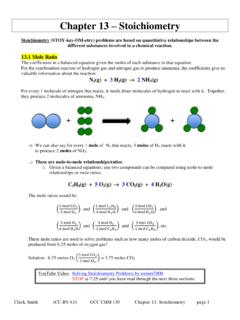
Chapter 13 Stoichiometry - Glendale Community College
web.gccaz.eduChapter 13 – Stoichiometry Stoichiometry (STOY-key-OM-etry) problems are based on quantitative relationships between the different substances involved in a chemical reaction.

Chapter 14. CHEMICAL EQUILIBRIUM
web.gccaz.eduChapter 14. CHEMICAL EQUILIBRIUM 14.1 THE CONCEPT OF EQUILIBRIUM AND THE EQUILIBRIUM CONSTANT Many chemical reactions do not go to completion but instead attain a ...
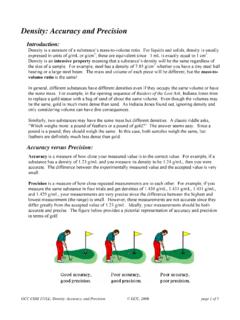
Density: Accuracy and Precision
web.gccaz.eduGCC CHM 151LL: Density: Accuracy, and Precision © GCC, 2008 page 4 of 5 glassware. ... 1. Obtain a set of 4 brass slugs and 1 aluminum slug. 2.
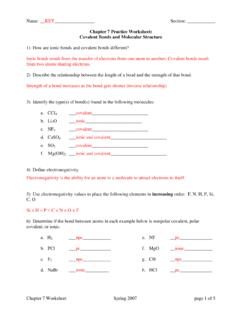
Chapter 7 Practice Worksheet: Covalent Bonds and Molecular ...
web.gccaz.eduChapter 7 Worksheet Spring 2007 page 1 of 5 Chapter 7 Practice Worksheet: Covalent Bonds and Molecular Structure 1) How are ionic bonds and covalent bonds different? ... f. Mg(OH) 2 ___ ionic and covalent _____ 4) Define electronegativity. Electronegativity is the ability for an atom in a molecule to attract electrons to itself. ...

Balancing Equations Worksheet KEY
web.gccaz.eduBalancing Equations Worksheet KEY 1. Zn (s) + 2 AgNO 3 (aq) ⇒ Zn(NO 3) 2 (aq) + 2 Ag (s) 2. N 2 (g) + 3 H 2 (g) ⇒ 2 NH 3 (g) 3. NaCl (aq) + AgC 2H 3O 2 (aq) ⇒ NaC 2H 3O 2 (aq) + AgCl (s) 4. 3 Mg(OH) 2 (aq) + 2 H 3PO 4 (aq) ⇒ 6 H 2O (l) + Mg 3(PO 4 ) 2 (aq) 5. 2 HNO 3 (aq) + Ni (s) ⇒ Ni(NO 3) 2 (aq) + H 2 (g) 6. Ba(HCO 3) 2 (s) ⇒ BaCO 3 (s) + H 2O (g) + CO

Intermolecular and Ionic Forces - web.gccaz.edu
web.gccaz.eduIntermolecular and Ionic Forces ... general, intermolecular forces are much weaker than the ionic and covalent bonds that hold together the atoms and ions in a compound. ... compared in this lab. The alkane used in this activity is pentane, CH 3 CH 2 CH 2 CH 2 CH 3. Alcohols are

Marine Biology: Study Guide - web.gccaz.edu
web.gccaz.eduBIO145: Marine Biology 3 Study Guide Chapter 10 An Introduction to Ecology Ecology is the scientific study of the interactions between organisms and their environment that determine the distribution and abundance of organisms.

CHM 130LL: Electrolytes - Welcome to web.gccaz.edu
web.gccaz.edumainly in body fluids outside the cells. Human body fluids have almost the ... CHM 130LL: Electrolytes Lab . GCC CHM 130LL Spring 2016 page 2 of 7 Understanding ... This makes it possible to identify which substance is in which well (ex: A3 or C2). In your data table (on the next page), ...
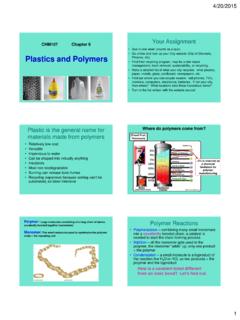
Polymers and Plastics - web.gccaz.edu
web.gccaz.edua chemical feedstock for polymer manufacturing Polymer: ... • Now back to polymers and plastics Given these monomers predict the structure of the polymer Ethylene Vinyl chloride ... recycle numbers are these plastics? • Plastic comes from oil – so less recycling means

CHM 130 Predicting Products Worksheet
web.gccaz.eduCHM 130 Predicting Products Worksheet Circle the appropriate reaction type for each, complete the reaction with products (remember to check charges for ionic compounds), include states, and finally balance each reaction.
Related documents

Practice Problems (Chapter 5): Stoichiometry
www.cabrillo.edu3 CO 2 + 4 H 2 O Part II: Stoichiometry problems 5. If 54.7 grams of propane (C 3 H 8) and 89.6 grams of oxygen (O 2) are available in the balanced combustion reaction to the right: a) Determine which reactant is the limiting reactant. b) Calculate the theoretical yield of CO 2 in grams.

4.3Reaction Stoichiometry
web.ung.edu4.3Reaction Stoichiometry By the end of this section, you will be able to: • Explain the concept of stoichiometry as it pertains to chemical reactions • Use balanced chemical equations to derive stoichiometric factors relating amounts of reactants and products • Perform stoichiometric calculations involving mass, moles, and solution molarity
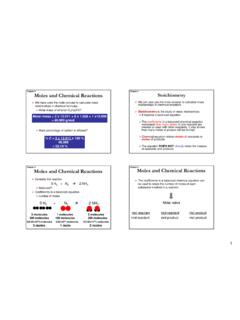
Chapter 4 Moles and Chemical Reactions Stoichiometry
people.uwec.eduStoichiometry Chapter 4 x 4 Fe + 3 O 2 2 Fe 2O3. 6 Stoichiometry The steel industry relies on the reaction between iron(III) oxide and carbon to produce iron and CO 2.

CHM 130 Stoichiometry Worksheet
web.gccaz.eduCHM 130 Stoichiometry Worksheet The following flow chart may help you work stoichiometry problems. Remember to pay careful attention to what you are given, and what you are trying to find. 1. Fermentation is a complex chemical process …
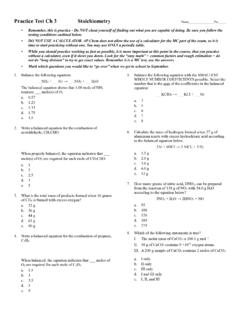
Practice Test Ch 3 Stoichiometry Name Per
www.alvinisd.netPractice Test Ch3 Stoichiometry (page 3 of 3) 1. d It might be easiest to balance the equation with mostly whole numbers: 2 NH 3 + ⁷⁄₂O 2 → 2NO 2 + 3H 2O. The question asks about the amount of oxygen reacting with ONE mole of ammonia, thus cut the ⁷⁄₂ (3.5) of oxygen in half to 1.75 2. c …

Chapter 3 Stoichiometry - Home - Chemistry
www2.chemistry.msu.eduStoichiometry Limiting reagent, example: Soda fizz comes from sodium bicarbonate and citric acid (H 3C 6H 5O 7) reacting to make carbon dioxide, sodium citrate (Na 3C 6H 5O 7) and water. If 1.0 g of sodium bicarbonate and 1.0g citric acid are reacted, which is limiting? How much carbon dioxide is produced? 3NaHCO 3(aq) + H 3C 6H 5O 7(aq ...
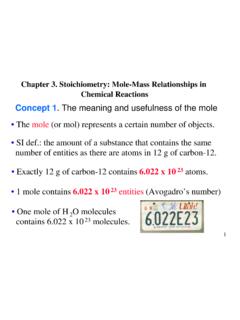
Chapter 3. Stoichiometry: Mole-Mass Relationships in ...
www.uh.eduChapter 3. Stoichiometry: Mole-Mass Relationships in Chemical Reactions 1 • The mole (or mol) represents a certain number of objects. • SI def.: the amount of a substance that contains the same number of entities as there are atoms in 12 g of carbon-12. • Exactly 12 g of carbon-12 contains 6.022 x 10 23 atoms. • One mole of H 2 O molecules

Stoichiometry Practice Worksheet
www.socialcircleschools.comSolve the following stoichiometry grams-grams problems: 1) Using the following equation: 2 NaOH + H 2SO 4 2 H 2O + Na 2SO 4 How many grams of sodium sulfate will be formed if you start with 200.0 grams of sodium hydroxide and you have an excess of sulfuric acid? 2) Using the following equation: Pb(SO 4)2 + 4 LiNO 3 Pb(NO 3)4 + 2 Li 2SO 4

Stoichiometry: Baking Soda and Vinegar Reactions
labsci.stanford.edu3 (aq) + CH 3 COOH (aq) ----> CO 2 (g) + H 2 O (l) + CH 3 COONa (aq) Stoichiometry can be used to predict the amount of carbon dioxide released in this process. Conservation of mass requires that all atoms that enter a reaction as reactants must exit the reaction in the products. Consider the example of decomposing water into Hydrogen and ...

STOICHIOMETRY OF COMBUSTION
fluid.wme.pwr.wroc.plstoichiometry of oxygen/fuel reaction. Stoichiometric air means the minimum air in stoichiometric mixture. The stoichiometric air/fuel ratio (AFR) can be calculated from the reaction equation (g/g). For gas AFR is usually determined in m3/m 3. The actual combustion air …