Example: bachelor of science
Chapter 3 Stoichiometry - Home - Chemistry
Stoichiometry Limiting reagent, example: Soda fizz comes from sodium bicarbonate and citric acid (H 3C 6H 5O 7) reacting to make carbon dioxide, sodium citrate (Na 3C 6H 5O 7) and water. If 1.0 g of sodium bicarbonate and 1.0g citric acid are reacted, which is limiting? How much carbon dioxide is produced? 3NaHCO 3(aq) + H 3C 6H 5O 7(aq ...
Tags:
Information
Domain:
Source:
Link to this page:
Documents from same domain

Standard Operating Procedure: Pumps
www2.chemistry.msu.eduStandard Operating Procedure: Pumps Last Updated: ... operation of ports and evacuation procedures are covered in the glove box SOP document. As a general
Radiation Detection & Measurement Dept. of …
www2.chemistry.msu.eduRadiation Detection & Measurement Dept. of Chemistry --- Michigan State Univ. National Superconducting Cyclotron Lab DJMorrissey Spring/2oo9

Chemistry 151 - Michigan State University
www2.chemistry.msu.eduChemistry 151 • Professor James H. Geiger • Office: Chemistry Building, Room 9 ... Chemistry, the Central Science, 10th edition, Prentice-Hall, 2005. ISBN: 0-13-109686-9. ... Registering for Mastering Chemistry, What You Need: A valid email address

Bond Dissociation Energies of Organic Molecules
www2.chemistry.msu.eduBond Dissociation Energies of Organic Molecules STEPHEN J. BLANKSBY*,† AND G. BARNEY ELLISON*,‡ Department of Chemistry, University of Wollongong, NSW, 2522, Australia, and Department of Chemistry &

Chapter 1 Structure and Bonding - Chemistry
www2.chemistry.msu.eduThe atomic mass (atomic weight) of an element is weighted average mass in atomic mass units (amu) of an element’s naturally occurring isotopes. Carbon: Atomic Number and Atomic Mass 12C 6 AC Z 13C 6 (98.9 12.000) (1.1 13.000) 12.011 100 × +× =

Chapter 9: Atomic Absorption Spectrometry
www2.chemistry.msu.eduChapter 9: Atomic Absorption Spectrometry. Read: pp. 230 – 249 Problems: 9-1,3,5,6,8. Figure 9-13a. A(λ)= ε(λ)bC = log P. o /P

Chapter 24 Chemistry of Coordination Compounds
www2.chemistry.msu.edu6 3+ • Co3+ electron configuration: • 4s23d4----" 4s03d6 • Need six orbitals for six ligands so: !Hybridize 1 4s, 3 4p and 2 3d to give: !Sp3d2 orbitals. The 6 …
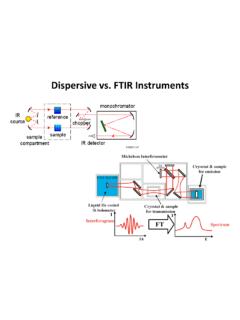
Dispersive vs. FTIR Instruments - Chemistry
www2.chemistry.msu.eduA spectroscopic technique used to observe vibrational, rotational, and other low-frequency [modes in a system. 1] It relies on inelastic scattering, or Raman scattering, of monochromatic light, usually from a laser in the visible, near infrared, or near ultraviolet range.

Principles of FTIR Spectroscopy - Chemistry
www2.chemistry.msu.eduPrinciples of Diffuse Reflectance Method K is the absorption coefficient, and S is the scattering coefficient. In practice, the comparative reflectance r∞ with respect to a standard powder such as KBr or KCl, of which K is near zero (0) in the actual measurement range Spectrum of solid caffeine Measurement of chemicals adhering to a surface ...

Chapter 5 Signals and Noise - Michigan State University
www2.chemistry.msu.eduNoise pick-up and possible amplification by the instrument circuit can be minimized. Difference Amplifiers →Analyte signal and reference signals are fed into the inputs of an operational amplifier is a scaler-type configuration. Common mode noise rejection. V o = R. k. R. i (V. 2 - V. 1)
Related documents

Practice Problems (Chapter 5): Stoichiometry
www.cabrillo.edu3 CO 2 + 4 H 2 O Part II: Stoichiometry problems 5. If 54.7 grams of propane (C 3 H 8) and 89.6 grams of oxygen (O 2) are available in the balanced combustion reaction to the right: a) Determine which reactant is the limiting reactant. b) Calculate the theoretical yield of CO 2 in grams.

4.3Reaction Stoichiometry
web.ung.edu4.3Reaction Stoichiometry By the end of this section, you will be able to: • Explain the concept of stoichiometry as it pertains to chemical reactions • Use balanced chemical equations to derive stoichiometric factors relating amounts of reactants and products • Perform stoichiometric calculations involving mass, moles, and solution molarity
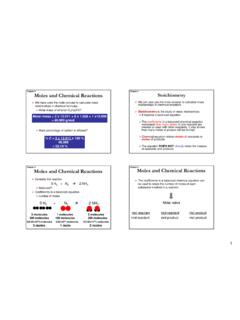
Chapter 4 Moles and Chemical Reactions Stoichiometry
people.uwec.eduStoichiometry Chapter 4 x 4 Fe + 3 O 2 2 Fe 2O3. 6 Stoichiometry The steel industry relies on the reaction between iron(III) oxide and carbon to produce iron and CO 2.

CHM 130 Stoichiometry Worksheet
web.gccaz.eduCHM 130 Stoichiometry Worksheet The following flow chart may help you work stoichiometry problems. Remember to pay careful attention to what you are given, and what you are trying to find. 1. Fermentation is a complex chemical process …
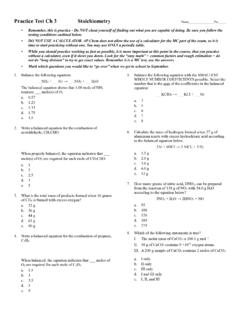
Practice Test Ch 3 Stoichiometry Name Per
www.alvinisd.netPractice Test Ch3 Stoichiometry (page 3 of 3) 1. d It might be easiest to balance the equation with mostly whole numbers: 2 NH 3 + ⁷⁄₂O 2 → 2NO 2 + 3H 2O. The question asks about the amount of oxygen reacting with ONE mole of ammonia, thus cut the ⁷⁄₂ (3.5) of oxygen in half to 1.75 2. c …
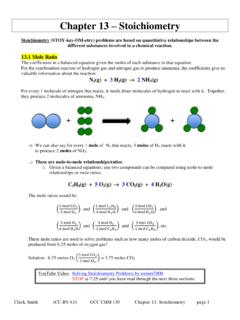
Chapter 13 Stoichiometry
web.gccaz.edu13.3 Mass-Volume Stoichiometry OR Molar Mass gas @ STP Recall: Avogadro’s Molar Volume is 22.4 L/mol for a gas only at STP Steps: 1) If given grams, use MM as your conversion factor to get to moles of the given -If given volume, use molar volume to get to moles of the given
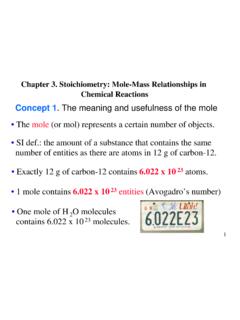
Chapter 3. Stoichiometry: Mole-Mass Relationships in ...
www.uh.eduChapter 3. Stoichiometry: Mole-Mass Relationships in Chemical Reactions 1 • The mole (or mol) represents a certain number of objects. • SI def.: the amount of a substance that contains the same number of entities as there are atoms in 12 g of carbon-12. • Exactly 12 g of carbon-12 contains 6.022 x 10 23 atoms. • One mole of H 2 O molecules

Stoichiometry Practice Worksheet
www.socialcircleschools.comSolve the following stoichiometry grams-grams problems: 1) Using the following equation: 2 NaOH + H 2SO 4 2 H 2O + Na 2SO 4 How many grams of sodium sulfate will be formed if you start with 200.0 grams of sodium hydroxide and you have an excess of sulfuric acid? 2) Using the following equation: Pb(SO 4)2 + 4 LiNO 3 Pb(NO 3)4 + 2 Li 2SO 4

Stoichiometry: Baking Soda and Vinegar Reactions
labsci.stanford.edu3 (aq) + CH 3 COOH (aq) ----> CO 2 (g) + H 2 O (l) + CH 3 COONa (aq) Stoichiometry can be used to predict the amount of carbon dioxide released in this process. Conservation of mass requires that all atoms that enter a reaction as reactants must exit the reaction in the products. Consider the example of decomposing water into Hydrogen and ...

STOICHIOMETRY OF COMBUSTION
fluid.wme.pwr.wroc.plstoichiometry of oxygen/fuel reaction. Stoichiometric air means the minimum air in stoichiometric mixture. The stoichiometric air/fuel ratio (AFR) can be calculated from the reaction equation (g/g). For gas AFR is usually determined in m3/m 3. The actual combustion air …