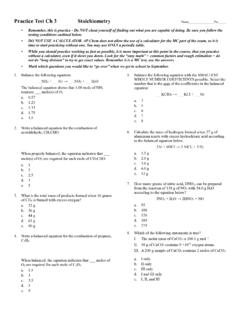
Transcription of Practice Problems (Chapter 5): Stoichiometry
1 Practice Problems (Chapter 5): Stoichiometry CHEM 30A Part I: Using the conversion factors in your tool box 1. How many moles CH3OH are in g CH3OH? 2. What is the mass in grams of x 1016 atoms S? 3. How many molecules of CO2 are in g CO2? 4. What is the mass in grams of 1 atom of Au? KEY Tool Box: To convert between Use From g A mol A molar mass periodic table mol A particles A Avogadro s # memory mol A mol B molar ratio coeff. in bal. eqn. 1 mol S x 1023 atoms S x 1016 atoms S g S 1 mol S = x 10 7 g S 1 mol CH3OH g CH3OH g CH3OH = mol CH3OH CH3OH = 1( g/mol) + 4( g/mol) +1( g/mol) = g/mol CO2 = 1( g/mol) + 2( g/mol) = g/mol x 1023 molecules CO2 1 mol CO2 g CO2 1 mol CO2 g CO2 = x 1023 molecules CO2 1 mol Au x 1023 atoms Au 1 atom Au g Au 1 mol Au = x 10 22 g Au C3H8 + 5 O2 3 CO2 + 4 H2O Part II: Stoichiometry Problems 5.
2 If grams of propane (C3H8) and grams of oxygen (O2) are available in the balanced combustion reaction to the right: a) Determine which reactant is the limiting reactant. b) Calculate the theoretical yield of CO2 in grams. Limiting Reactant: _____ Theoretical Yield: _____ 6. A reaction has a theoretical yield of g SF6, but only g SF6 are obtained in the lab, what is the percent yield of SF6 for this reaction? Answer: _____ g g O2 g CO2 actual yield SF6 theoretical yield SF6 % yield SF6 = (100%) = g SF6 g SF6 (100%) = % yield SF6 % yield SF6 1 mol C3H8 g C3H8 g C3H8 5 mol O2 1 mol C3H8 = g O2 g O2 1 mol O2 1 mol O2 g O2 g O2 3 mol CO2 5 mol O2 = g CO2 g CO2 1 mol CO2 theoretical yield CO2 (actually have) Way #2.
3 Needed only have g O2 1 mol C3H8 g C3H8 g C3H8 3 mol CO2 1 mol C3H8 = g CO2 g CO2 1 mol CO2 1 mol O2 g O2 g O2 3 mol CO2 5 mol O2 = g CO2 g CO2 1 mol CO2 theoretical yield CO2 Way #1: forms less product 7. If grams of butane (C4H10) and grams of oxygen (O2) are available in the following reaction: ____ C4H10 + ____ O2 ____ CO2 + ____ H2O a) Balance the equation for the reaction. b) Determine which reactant is the limiting reactant. c) Calculate the theoretical yield of CO2 in grams.
4 Limiting Reactant: _____ Theoretical Yield: _____ d) If the actual yield of CO2 is g CO2, what is the percent yield? Answer: _____ g g 8 10 2 13 Check: C 8 H 20 O 26 charge 0 C4H10 g CO2 actual yield CO2 theoretical yield CO2 % yield CO2 = (100%) = g CO2 g CO2 (100%) = yield CO2 % yield CO2 1 mol C4H10 g C4H10 g C4H10 8 mol CO2 2 mol C4H10 = g CO2 g CO2 1 mol CO2 1 mol O2 g O2 g O2 8 mol CO2 13 mol O2 = g CO2 g CO2 1 mol CO2 theoretical yield CO2 Way #1.
5 Forms less product 1 mol C4H10 g C4H10 g C4H10 13 mol O2 2 mol C4H10 = g O2 g O2 1 mol O2 theoretical yield CO2 Way #2: only need have g O2 1 mol C4H10 g C4H10 g C4H10 8 mol CO2 2 mol C4H10 = g CO2 g CO2 1 mol CO2 (actually have)