Transcription of 7 BASIC QC TOOLS & 7 NEW MANAGEMENT & PLANNING …
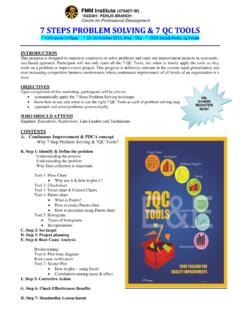
1 7 BASIC QC TOOLS & 7 NEW MANAGEMENT & PLANNING TOOLS FMM Institute, Sg Petani 19-20 Apr 2017 (Wed - Thur) F M M I N S T I T U T E , K e d a h / P e r l i s B r a n c h Page 1 Introduction One of the standard clauses in latest ISO 9001: 2008 Edition Quality MANAGEMENT System standard is Continual Improvement . Arising from this, organizations are required to demonstrate continual improvement activities are conducted consistently in a proper and systematic manner. 7 QC TOOLS and PDCA is one of the common approach that being employed by many organizations in realizing this requirements.
2 Furthermore in today competitive market place, MANAGEMENT has to empower employees to be more proactive in dealing with quality and process issues for continual improvement. Therefore, they should be trained to master 7QC TOOLS that can be applied for process and quality improvement in a cost competitive environment. Through this application and implementation, organization able to achieves quality and productivity improvement in various section and division which finally bring benefits and values to both the organization and their employees. The 7 QC TOOLS are focused more on quantitative methodology for problem solving where else 7 New QC TOOLS are more towards qualitative approach.
3 How often have we corrected a problem and yet the problem keeps happening again? If your answer is YES, then you need a proven method to problem solving. You need NEW QC TOOLS . New QC TOOLS has 7 scientifically proven methods to help you analyse, solve, evaluate and improve your results every time. They are so powerful such that you can practically improve, prevent and correct thorough and difficult issues and problems. OBJECTIVE ---------------------------------------- ---------------------------------------- ----------------------- Upon return to workplace, participants will be able to : Use effective problem-solving TOOLS for quality and productivity improvement ; Understand simple statistic and common sense techniques ; Able to use 7 QC TOOLS to identify problem causes, analyse data, do evaluation and rectify problem.
4 Learn the Plan-Do-Check-Action (PDCA) 12 steps in problem and project improvements Easy step-by-steps practical analysis and evaluation of all issues/problems using 7 New QC TOOLS ; Enhances team cooperation and action through 7 New QC TOOLS application; Excellent for cross functional team intervention WHO SHOULD ATTEND _____ Production, Operation, Quality and Supporting Department executives and supervisors who are involved in quality and productivity improvement projects execution and implementation COURSE CONTENT Introduction to Plan-Do-Check-Action (PDCA) Methodology Why improvements? Introduction to PDCA Deming Improvement Cycle Brief overview of various 7 QC TOOLS Differences between 7 QC TOOLS and 7 MP TOOLS Data Collection / Checksheets Data collection introduction Why are data collected ?
5 What kinds of data are collected ? Common mistakes and errors made in data collection Recording Checksheets, Checklist Checksheets and Location Checksheets Pareto Diagram Pareto principle, Prioritization using 80/20 rules Why are Pareto Diagrams used ? When and How to use Pareto Diagrams ? Video Showing Cause and Effect Diagram Brainstorming techniques Importance of Cause and Effect Diagram When and How to use Cause and Effect Diagram ? How to develop and prepare Cause and effect Diagram Critical Factors to consider Histogram How to draw Histogram ? What information we can get / extract from Histogram ? Data characteristics - Central tendency, Dispersion and Spreadness and Shape / Pattern analysis Video Showing IN HOUSE AVAILABLE SBL Claimable 7 BASIC QC TOOLS & 7 NEW MANAGEMENT & PLANNING TOOLS FMM Institute, Sg Petani 19-20 Apr 2017 (Wed - Thur) F M M I N S T I T U T E , K e d a h / P e r l i s B r a n c h Page 2 Scatter Diagram What is Scatter Diagram ?
6 Relationship of data When and How to use Scatter Diagram ? Mutual correlation analysis using Simple Linear Regression and Coefficient Correlation Video Showing Charting / Graphs / Control Charts Common Graph and Charting Trend and pattern analysis Flow Charting Stratification What is Stratification ? Stratification principle When and How to use Stratification ? 12 Steps in PDCA Cycle (Video Showing) Introduction to 7 New QC TOOLS and Description Why improvements? Introduction to PDCA Deming Improvement Cycle How do 7 New QC TOOLS Works Together in Actual Workplace Application 7 MP TOOLS work flows Integration Affinity Diagram (KJ Method) Concepts & Application Card Game Workshop Interrelationship Digraph (ID Graph) Concepts & Application The Essential Skills Needed for Managers workshop Tree Diagram Concepts & Application Prioritization Matrices Full Analytical Criteria Method Consensus Criteria Method Combination ID/Matrix Method Matrix Diagram L Matrix / T Matrix X Matrix / C Matrix / Y Matrix Process Decision Program Chart (PDPC)
7 Concepts & Application Activity Network Diagram (AND) Concepts & Application TRAINER PROFILE: MR KUANG KOK HO Mr. Kuang Kok Hoo graduated from the University of Science Malaysia. He majors in Applied Statistics and Operational Research and Minors in MANAGEMENT . He is a Senior Member of the American Society for Quality (ASQ) and ASQ Certified Quality Engineer (CQE) and Manager of Quality/Organizational Excellence (CMQ/OE). He is also the Lead Auditor from International Register of Certificated Auditor (IRCA), United Kingdom specializing in iso9000 QMS, ISO 14001 EMS, ISO22000 Food Industry QMS, ISO/TS16949 Automotive QMS, and Six Sigma Champion / Leader.
8 He has been exposed to various kind of trainings such as ISO 9000 / ISO22000/ ISO/TS16949 Quality MANAGEMENT System, ISO14001 Environmental MANAGEMENT System, Train the Trainer, Competency Based Training (CBT) from DETAFE, Adelaide Australia and Statistical Quality Control Courses such as Statistical Process Control (SPC), Advance SPC, 6 Sigma Program, Failure Mode Effects Analysis (FMEA), Acceptance Sampling Plans, Gage Repeatability & Reproducibility (GR&R), Design of Experiment (DOE), Product Reliability & Liability, 7 QC TOOLS , 7 Advance Quality MANAGEMENT & PLANNING TOOLS , 5S Housekeeping, Quality Control Circles (QCC), Productivity & Quality Improvement and more than 15 over years of working experience directly in the Quality discipline, he has served QC/QA, TQM, Quality System and Training position in the electronic components, semiconductors, computer peripherals and automotive manufacturing industries.
9 Besides that, he also invited to conduct training for various manufacturing industries like steel and metal, motor and motorcycle, foods, furniture, oil processing and rubber & plastic products, semiconductor & electronics components, pharmaceutical, computer peripherals and telecommunication. His major accomplishment were in the setting up the ISO 9000 / ISO14000 / ISO22000 / ISO/ TS16949 Quality MANAGEMENT System, introduced Total Quality Culture and Function, Six Sigma Black Belt and Green Belt Programmes, Lean Manufacturing System, Total Productive Maintenance (TPM) and Just-In-Time (JIT), Kaizen Improvement Programmes activities in such organizations.
10 Mr. Kuang also is an invited judge and speaker for some of the manufacturing industries and government bodies such as Tenaga Nasional Berhad (TNB), Telekom Malaysia Berhad, Inland Revenue Board, TLDM, TUDM, Local Town Council, Lion Group of Companies and Hong Leong Group of Companies, Agilent Malaysia, Siemens Semiconductor (M) Sdn. Bhd., Osram Opto Semiconductor Sdn. Bhd., Toshiba Electronic Malaysia (TEM), Motorola Malaysia, Unisem Berhad, Carsem Semiconductor (M) Sdn. Bhd, Flextronics (M) Sdn. Bhd., TEAC Electronics (M) Sdn. Bhd., Mabuchi Motor (M) Sdn. Bhd., Hitachi Semiconductor, IDS Electronics, Yamaha Electronic (M) Sdn.