Example: marketing
ACETIC ACID 1603
reanalyze and apply the appropriate dilution factor in calculations. 12. Measure peak area. Divide the peak area of analyte by the peak area of internal standard on the same chromatogram. CALCULATIONS: 13. Determine the mass, mg (corrected for DE) of acetic acid found in the sample front (W f) and back (W
Tags:
Information
Domain:
Source:
Link to this page:
Documents from same domain
School Chemistry Laboratory Safety Guide
www.cdc.govSchool Chemistry Laboratory Safety Guide. October 2006. U.S. Consumer Safety Product Commission DEPARTMENT OF HEALTH AND HUMAN SERVICES. Centers for Disease Control and Prevention
Biosafety in Microbiological and Biomedical …
www.cdc.goviii. Foreword. Biosafety in Microbiological and Biomedical Laboratories (BMBL) quickly became the cornerstone of biosafety practice and policy in the United States upon first
Sobering Facts: Drunk Driving in Georgia
www.cdc.govSobering Facts: Drunk Driving in GEORGIA Keep Georgia safe. Keep drunk drivers off the road. This fact sheet provides a snapshot of alcohol-involved deaths and drunk driving
ALCOHOLS III 1402
www.cdc.govALCOHOLS III: METHOD 1402, Issue 2, dated 15 August 1994 - Page 3 of 4 a. Remove and discard back sorbent section of a media blank sampler. b. Inject a known amount of analyte or DE stock solution directly onto front sorbent section
Fast Facts
www.cdc.govAny person working outdoors is at risk of exposure to poisonous plants, such as poison ivy, poison oak, and poison sumac. When in contact with skin, the sap oil (urushiol) of

Trans Fat: The Facts
www.cdc.gov• Read the Nutrition Facts label and ingredient list to compare foods. » Choose products with 0 grams trans fat. » Check the Ingredient List to see if there is any partially hydrogenated oil in the product.

ANTIBIOTIC RESISTANCE THREATS
www.cdc.govApr 23, 2013 · 6. ANTIBIOTIC RESISTANCE THREATS IN THE UNITED STATES, 2013. Executive Summary. Antibiotic Resistance Threats in the United States, 2013. is a snapshot of the complex problem
Chlorine Residual Testing
www.cdc.govChlorine Residual Testing Fact Sheet, CDC SWS Project 4 Methods to Test Free Chlorine in the Field in Developing Countries There are three main methods to test free chlorine residual in drinking water in the field
2018 Combined Recommended Immunization …
www.cdc.govRecommended Immunization Schedule for Children and Adolescents Aged 18 Years or Younger, UNITED STATES, 2018 Approved by the Advisory Committee on …

Traveling? Make Sure You Protect Yourself from …
www.cdc.govCS26201 Malaria transmission occurs throughout Malaria transmission occurs in some parts Malaria transmission is not known to occur Center for Global Health
Related documents
Using Bleach as a Disinfectant - Northeastern University
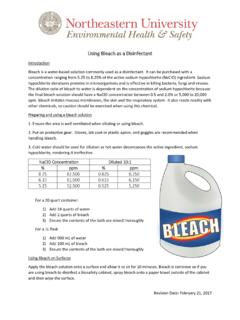
www.northeastern.eduFeb 21, 2017 · The dilution ratio of bleach to water is dependent on the concentration of sodium hypochlorite because the final bleach solution should have a NaClO concentration between 0.5 and 2.0% or 5,000 to 20,000 ppm. Bleach irritates mucous membranes, the skin and the respiratory system. It also reacts readily with

DILUTION CHART - picdfw.com
picdfw.comDILUTION CHART Some numbers are rounded up or down to make measuring easier PIC’s dilution ratios are written as parts. Therefore, when PIC’s label suggest a dilution ratio of 1-to-4 (1:4) that means 1 part product and 4 parts water. Some people calculate dilution by dividing by 4 (in this example), which is an incorrect answer.

Chapter 3 Molar Mass Calculation of Molar Masses
people.uwec.edubefore dilution after dilution Although the number of moles of solute does not change, the volume of solution does change. ... called the molar ratio . Molar ratio = moles element A mole of substance Molar ratio = moles element A moles element B or Molar Ratios Chapter 3 H2O: – Molar Ratio = 2 moles of H
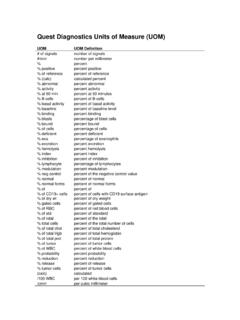
Quest Diagnostics Units of Measure (UOM)
www.questdiagnostics.comdilution factor : dilution factor . dilution titer : dilution titer . dose(s) dose(s) DPM : degradations per minute . EIA titer : enzyme immunoassay titer . ... normalized ratio . international ISR : status ratio . immune IU : unit . international IU/24 h : international units per 24 hours . IU/dL : international units per deciliter .

Spectrophotometry Page 1 10 Lab #4 SPECTROPHOTOMETRY
gervind.faculty.mjc.eduThe transmittance is defined as the ratio of the light ... A dilution series is a succession of step dilutions, each with the same dilution factor, where the diluted material of the previous step is used to make the subsequent dilution. EXAMPLES . Spectrophotometry Page 7 of 10
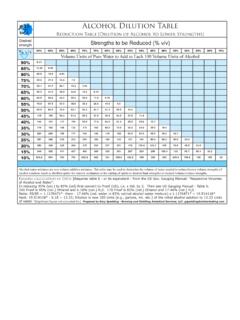
Alcohol Dilution Table
apilink.roRatio: 95/85 = 1.1176471*--then-- 17.46% (vol. water in 85% vol/vol alcohol water mixture) x 1.1176471* = 19.514118* Next: 19.514118* - 6.18 = 13.33; Dilution is now 100 Units [e.g., gallons, mL. etc.] of the initial alcohol solution to 13.33 Units of water. *[Significant figures not accounted for.] Prepared by Gary Spedding - Brewing and ...

3.1 Stationary Gas Turbines
www3.epa.govThe cycle thermal efficiency is defined as the ratio of useful shaft energy to fuel energy input. Simple cycle gas turbines are typically used for shaft horsepower applications without ... most of the dilution takes place downstream of the primary flame, which does not minimize peak temperature in the flame and suppress thermal NOX formation.
Dilution and Concentration
downloads.lww.comRatio strength = = = X X 11 400:,answer 1000 50 5 1000 120 50 025 mL mL mL mL == = % %.% XX X ==== 1 400 1 400 1 400:, :,answer X answer CHAPTER 10 • Dilution and Concentration 211 Critical Thinking 10.1 Dilution of a solid or liquid does not entail adding more drug. Therefore, the amount of drug in the diluted product is the same; only the ...
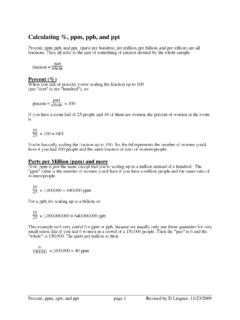
Calculating %, ppm, ppb, and ppt - Lingner Chem
lingnerchem.comabove and it always involves the part/whole ratio: 0.00006 g 150 g 100 = 0.0.000040% 0.00006 g 150 g 1,000,000 = 0.40 ppm 0.00006 g 150 g 1,000,000,000 = 400 ppb The "units" for the "part" and the "whole" always need to be the same, so you might need to do a conversion first, …