Transcription of Affordable Care Act
1 Affordable Care Act3-1 IntroductionThis lesson covers some of the tax provisions of the Affordable Care Act (ACA). You will learn how to deter-mine if taxpayers are eligible to receive the premium tax credit. A list of terms you may need to know is included at the end of the the 2019 tax year, the individual Shared Responsibility Payment (SRP) is reduced to zero. Taxpayers who do not have health insurance coverage during 2019 or later do not require an exemption to avoid the the end of this course, using your resource materials, you will be able to: Determine eligibility for the premium tax credit (PTC) Calculate the premium tax credit, if applicable Report taxpayers premium tax credit on the tax returnAffordable Care ActWhat do I need?
2 Form 13614-C Publication 4012 Publication 17 Publication 974 Form 1095-A & Instructions Form 8962 & InstructionsOptional Publication 5120 Publication 5121 Publication 5156 Publication 5172 Form 1095-B & Instructions Form 1095-C & InstructionsWhat is the Affordable Care Act?Under the Affordable Care Act (ACA), the federal government, state governments, insurers, employers, and individuals share responsibility for improving the quality and availability of health insurance coverage in the United States. The ACA reforms the existing health insurance market by prohibiting insurers from denying coverage or charging higher premiums because of an individual s preexisting conditions.
3 The ACA also creates the Health Insurance Marketplace. For more information about the Marketplace, see Some states have established their own health insurance marketplaces. We will refer to them all simply as the Marketplace is where taxpayers find information about health insurance options, purchase health insur-ance, and, if eligible, obtain help paying premiums and out-of-pocket costs. The Marketplace estimates the amount of the premium tax credit (PTC) that eligible taxpayers may be able to claim on their federal income tax returns. Based on that estimate, eligible taxpayers can decide if they want to have all, some or none of their estimated credit paid in advance to their insurance company to help pay for taxpayer receive Form 1095-A?
4 While conducting an interview with taxpayers using Form 13614-C, Intake/Interview & Quality Review Sheet, you will determine whether taxpayers received Form 1095-A, Health Insurance Statement from a Health Insurance Marketplace. The Marketplace sends this form to individuals who enrolled themselves or family members in coverage through the Marketplace. The form includes information about the coverage, who was covered, and when. The deadline for the Marketplaces to provide Form 1095-A to taxpayers is January 31. Taxpayers expecting to receive a Form 1095-A should wait to file their income tax return until they receive that form.
5 Affordable Care Act3-2 Who is allowed a premium tax credit (PTC)?The premium tax credit (PTC) helps eligible taxpayers pay for health insurance purchased through a Health Insurance Marketplace. When enrolling in qualified health coverage through the Marketplace, the Marketplace estimates the amount of the PTC that eligible taxpayers may claim on their federal tax return. Based on that estimate, eligible taxpayers choose to have advance payments of the premium tax credit (APTC) made on their behalf to their insurance company, or to forego APTC and get all of the benefit of the PTC when they claim the credit on their federal tax return.
6 Those who choose to get the benefit of APTC must file a federal tax return for the year the payments are made even if they have gross income for the year that is below the income tax filing general, taxpayers are allowed a PTC if they meet all of the following: The taxpayer, spouse (if filing a joint return), or dependents were enrolled in a qualified health plan offered through the Marketplace for one or more months in which the enrolled individual was not eligible for Minimum Essential Coverage (MEC), other than coverage in the individual market.
7 The premiums for the plan or plans in which the taxpayer and his or her family members enroll are paid by the due date of the taxpayer s return (not including extensions). The taxpayer is an applicable taxpayer. A taxpayer is an applicable taxpayer if he or she meets the following three requirements: The taxpayer s income is at least 100 percent but not more than 400 percent of the federal poverty line for the taxpayer s family size. The following exceptions allow a taxpayer with household income below 100 percent of the federal poverty line to be an applicable taxpayer, provided the taxpayer meets the other applicable taxpayer requirements: -The taxpayer, the taxpayer s spouse, or a dependent who enrolled in a qualified health plan is not a citizen, but is lawfully present in the and not eligible for Medicaid because of immigra-tion status.
8 -The taxpayer was determined eligible for APTC by the Marketplace and received the benefit of APTC for one or more months of coverage of a family member. If married, the taxpayer files a joint return with his or her spouse (unless the taxpayer is considered unmarried for Head of Household filing status, or meets the criteria which allows certain victims of domestic abuse or spousal abandonment to claim the PTC using the Married Filing Separately filing status). See the instructions for Form 8962, Premium Tax Credit, for more details about these exceptions.
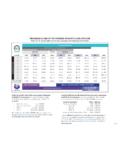
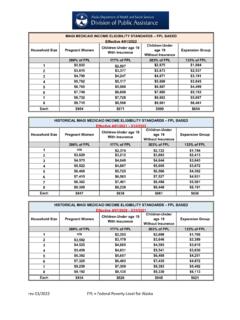
9 The taxpayer cannot be claimed as a dependent by another poverty Line (FPL)The federal poverty line (FPL) is an income amount adjusted for family size that is considered poverty level for the year. The Department of Health and Human Services (HHS) determines the FPL amounts annually and publishes a table reflecting these amounts at the beginning of each calendar year. You can also find this information on the HHS website at HHS provides three sets of federal poverty guidelines: one for residents of the 48 contiguous states and , one for Alaska residents, and one for Hawaii residents.
10 Affordable Care Act3-3If the taxpayer moved at all during the tax year and lived in Alaska and/or Hawaii, or is filing jointly and his or her spouse lived in a different state, use the table with the higher dollar amounts for the family size. For purposes of the PTC, eligibility for a certain year is based on the most recently published set of federal poverty guidelines as of the first day of the annual open enrollment period. As a result, the PTC for the current tax year is based on the prior year guidelines (for example, the guidelines used for 2019 APTC and PTC are the guidelines published in January 2018, which are the most recently published guidelines at the time of the open season for 2019 enrollments).