Example: barber
Algorithms for Non-negative Matrix Factorization
At each iteration of our algorithms, the new value of W or H is found by multiplying the ... of the objective function: We will show that by defining the appropriate auxiliary functions G(h, ht) for both IIV - W HII and D(V, W H), the update rules in Theorems 1 and 2 easily follow from Eq. (11).
Tags:
Information
Domain:
Source:
Link to this page:
Documents from same domain
Generative Adversarial Imitation Learning
proceedings.neurips.ccnetworks [8], a technique from the deep learning community that has led to recent successes in modeling distributions of natural images: our algorithm harnesses generative adversarial training to fit distributions of states and actions defining expert behavior. We test our algorithm in Section 6, where
Prototypical Networks for Few-shot Learning
proceedings.neurips.cc˚: RD!RMwith learnable parameters ˚. Each prototype is the mean vector of the embedded support points belonging to its class: c k= 1 jS kj X (x i;y i)2S k f ˚(x i) (1) Given a distance function d: R M R 
Inductive Representation Learning on Large Graphs
proceedings.neurips.ccnode classification, clustering, and link prediction [11, 28, 35]. ... (e.g., citation data with text attributes, biological data with functional/molecular markers), our approach can also make use of structural features that are present in all graphs (e.g., node degrees). ... through theoretical analysis, that GraphSAGE is capable of learning ...
Bootstrap Your Own Latent A New Approach to Self ...
proceedings.neurips.ccmining strategies [14, 15] to retrieve the nega-tive pairs. In addition, their performance criti-cally depends on the choice of image augmenta- ... to prevent collapsing while preserving high performance. To prevent collapse, a straightforward solution …
Spatial Transformer Networks - NeurIPS
proceedings.neurips.ccConvolutional Neural Networks define an exceptionally powerful class of models, ... localisation, semantic segmentation, and action recognition tasks, amongst others. ... can take any form, such as a fully-connected network or a convolutional network, but should include a final regression layer to produce the transformation ...
Semi-supervised Learning with Deep Generative Models
proceedings.neurips.ccapproximately invariant to local perturbations along the manifold. The idea of manifold learning ... We show for the first time how variational inference can be brought to bear upon the prob- ... probabilities are formed by a non-linear transformation, with parameters , of a set of latent vari-ables z. This non-linear transformation is ...
Unsupervised Learning of Visual Features by Contrasting ...
proceedings.neurips.ccpseudo-labels to learn visual representations. This method scales to large uncurated dataset and can be used for pre-training of supervised networks [7]. However, their formulation is not principled and recently, Asano et al. [2] show how to cast the pseudo-label assignment problem as an instance of the optimal transport problem.
PyTorch: An Imperative Style, High-Performance Deep ...
proceedings.neurips.ccFacebook AI Research benoitsteiner@fb.com Lu Fang Facebook lufang@fb.com Junjie Bai Facebook jbai@fb.com Soumith Chintala Facebook AI Research soumith@gmail.com Abstract Deep learning frameworks have often focused on either usability or speed, but not both. PyTorch is a machine learning library that shows that these two goals
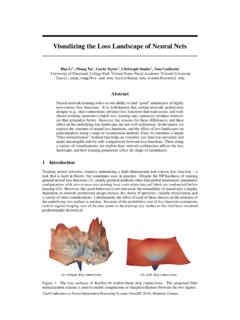
Visualizing the Loss Landscape of Neural Nets
proceedings.neurips.cctask that is hard in theory, but sometimes easy in practice. Despite the NP-hardness of training general neural loss functions [3], simple gradient methods often find global minimizers (parameter configurations with zero or near-zero training loss), even when data and labels are randomized before training [43].
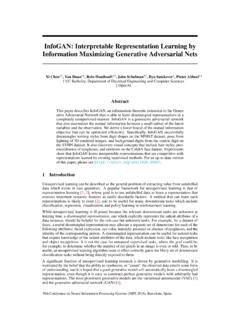
InfoGAN: Interpretable Representation Learning by ...
proceedings.neurips.ccof the digit (0-9), and chose to have two additional continuous variables that represent the digit’s angle and thickness of the digit’s stroke. It would be useful if we could recover these concepts without any supervision, by simply specifying that an MNIST digit is generated by an 1-of-10 variable and two continuous variables.
Related documents

Design and Analysis of Algorithms Tutorial
www.tutorialspoint.comAlgorithms are often quite different from one another, though the objective of these algorithms are the same. For example, we know that a set of numbers can be sorted using different algorithms. Number of comparisons performed by one algorithm may vary with others for the same input. Hence, time complexity of those algorithms may differ.
The Running Time of Programs - Stanford University
infolab.stanford.educlever algorithms, then left the company, only to have their algorithms ripped out and replaced by something slower but more understandable by subsequent main- ... On the other hand, program efficiency is an objective matter: a program takes what time it takes, and there is no room for dispute. Unfortunately, we cannot run

Nonlinear Programming: Concepts, Algorithms and …
cepac.cheme.cmu.edu• Algorithms • Newton Methods • Quasi-Newton Methods Constrained Optimization • Karush Kuhn-Tucker Conditions ... Objective Function: indicator of "goodness" of solution, e.g., cost, yield, profit, etc. Decision Variables: variables that influence process behavior and
COMPUTER NETWORKS LAB SYLLABUS III Year B.Tech. CSE - I ...
api.mlritm.ac.inOBJECTIVE: To understand the functionalities of various layers of OSI model To understand the operating System ... Different algorithms in Network layer 6. Analyze the presentation layer, application layer 7. They can understand how the data transferred from source to destination 8. They can come to know that how the routing algorithms worked ...

Estimating Parameters of Van Genuchten Model for Soil ...
www.naturalspublishing.comcited in the literature [12,13]. Thus, the objective of this study was: (1) Improve the method of particle swarm optimization (IPSO) to avoid falling into local optimal solution and appearing the premature phenomenon; (2) Compare the performance of three intelligent algorithms, i.e. IPSO, GA and SA, on estimating the VG equation parameters for ...

OCR GCSE (9-1) Computer Science J276/02 Computational ...
www.ocr.org.ukJ276/02 Computational thinking, algorithms and programming . Sample Question Paper . Date – Morning/Afternoon. Time allowed: 1 hour 30 minutes . You may not use: a calculator * 0 0 0 0 0 0 * First name. Last name. Centre number . Candidate number. INSTRUCTIONS • Use black ink. • Complete the boxes above with your name, centre number and ...
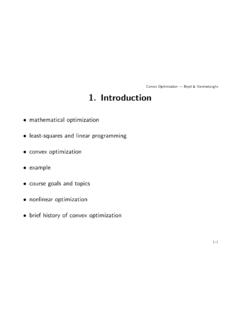
Convex Optimization — Boyd & Vandenberghe 1. Introduction
web.stanford.edu• reliable and efficient algorithms and software • computation time proportional to n2k(A∈ Rk×n); less if structured • a mature technology using least-squares • least-squares problems are easy to recognize • a few standard techniques increase flexibility (e.g., including weights, adding regularization terms) Introduction 1–5