Transcription of App Note - Solar Irradiance Measurements using …
1 Irradiance is the amount of energy at each wavelength emitted from a radiant sample. Absolute Irradiance is the measure of light in absolute terms. Relative Irradiance is a comparison of the fraction of energy the sample emits and the energy the sampling system collects from a lamp with a blackbody energy of absolute Solar Irradiance is relevant in a number of applications: monitoring the sunlight itself, perhaps in the context of its relationship to greenhouse gases such as atmospheric ozone; investigating the effects of Solar radiation on ecological systems and crops; and evaluating the effects of UV sunlight on our skin and eyes.
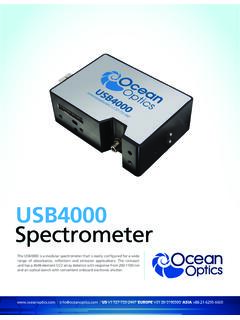
2 In one recent application, researchers launched an Ocean Optics USB2000+UV-VIS spectrometer (200-850 nm) from a weather balloon to measure Solar radiation in relation to ozone levels at different altitudes as the balloon ascended into the atmosphere (Figure 1).In an earlier experiment focusing on the measurement a series of strong absorption lines in the Solar spectrum, we configured an Ocean Optics Jaz spectrometer with a grating optimized to 200-850 nm, a detector collection lens to increase light collection, a 50 m slit and a battery module for portable operation. The Jaz is a self-contained spectrometer that operates via a microprocessor and low-power OLED display.
3 Modules including battery and Ethernet functionality can be added to the spectrometers are especially suited for Solar Irradiance Measurements , where portability and flexibility make the researcher s job easier. Determination of absolute and relative Solar Irradiance is possible, as well as related applications such as measurement of upwelling and downwelling radiation and evaluation of ozone Irradiance Portable spectroscopy Atmospheric gasesTechniques Solar Irradiance Absolute irradianceApplications Ozone monitoring Upwelling/downwellingSolar Irradiance Measurementsusing miniature SpectroscopyWritten by Ocean Optics StaffApplication NotesExperiment ConditionsBackgroundFor absolute Irradiance Measurements , we used a radiometrically calibrated light source and cosine corrector.
4 The cosine corrector collects sunlight from 180 and attaches directly to an SMA 905 connector on the Jaz (Figure 2). Also, accessory options such as a fixture for mounting Jaz in various positions and a shoulder holster for carrying Jaz are time for this measurement was 4 milliseconds, with spectral averaging set at 10 and boxcar smoothing at 2. The resulting spectrum shows a number of strong absorption lines US +1 727-733-2447 EUROPE +31 26-3190500 ASIA +86 21-6295-6600 ResultsBecause of their compact size, low power require-ments and simple operation, miniature spectrometers are convenient analytical tools for Solar Irradiance Measurements of all types.
5 The spectrometers are easily portable and extremely robust as well, having been used aboard manned and unmanned airborne vehicles and transported to the top of Mt. Everest and other demanding locations to measure the interaction of Solar radiation and atmospheric gases including 2: The Jaz spectrometer can be mounted to a tripod and positioned to collect Solar radiation from 180 field of view using a cosine corrector attached to the 1: A spectrometer launched from a weather balloon measures Solar radiation at different 3: Atmospheric elements can be identified in a Solar spectrum captured with a miniature elements in the range from 300-850 nm, including hydrogen, helium and sodium (Figure 3).
6 Similar results can be achieved using different spectrometer models with comparable optical bench configurations, including a USB2000+ spectrometer that has our extended-range (200-1050 nm) grating and our USB2000+RAD, an application-ready setup with all the components needed for absolute Solar Irradiance Measurements . Contact us today for more informationon setting up your spectroscopysystem from Ocean Optics.