Transcription of August 2018 TPP - NSW Treasury
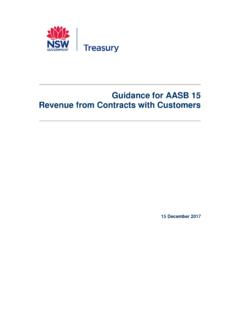
1 August 2018 TPP 18-06 Policy and Guidelines Paper NSW Government Business Case Guidelines NSW Treasury TPP18-06 TPP18-06 NSW Government Business Case Guidelines i Preface The NSW Government Business Case Guidelines have been developed to assist agencies and government entities with the preparation of business cases in line with best practice. The NSW Government is committed to the ongoing improvement of public services by ensuring resource allocation decisions are made and public funds are spent in the most efficient way and are directed to services that provide the best outcomes and benefits for New South Wales. Business cases are a key tool to inform evidence-based investment decisions by government. These decisions include policy and program interventions utilising scarce community resources to deliver outcomes for the people of NSW. Treasury has a central role in providing guidance to public sector entities. It aims to ensures resource allocation decisions are well timed, offer value for money, consider and mitigate risks and are consistent with Government priorities and objectives.
2 The NSW Government Business Case Guidelines (the Guidelines) establish a best practice, clear and consistent approach to preparing business cases. Business cases which are prepared according to these guidelines provide a robust evidence base for government policy and investment proposals and inform effective and efficient resource allocation decisions for capital, recurrent and ICT investment and regulatory proposals. In addition, the Guidelines are designed to assist in reducing the time and cost of developing business cases, while meeting best practice. The Guidelines are supported by a suite of templates and tools. The Guidelines will support the sector s capacity and capability to deliver investment and policy proposals that are robust, transparent and appropriate to the size, complexity and cost of the intervention. They will strengthen confidence in the government to make sound investment decisions. This version of the NSW Government Business Case Guidelines supersedes the previous department of Premier and Cabinet Business Case Guidelines 2000, the Treasury policy papers Guidelines for Capital Business Cases (TPP08-05) and the Commercial Policy Framework: Guidelines for Financial Appraisal (TPP07-04).
3 Michael Pratt AM Secretary NSW Treasury August 2018 Treasury reference: TPP18-06 Note General inquiries concerning this document should be initially directed to: Financial Management and Accounting Policy team of NSW Treasury NSW Treasury TPP18-06 TPP18-06 NSW Government Business Case Guidelines ii Contents i Contents .. ii Executive Summary .. 1 2 1. About the Business Case Guidelines .. 3 Purpose of the Business Case Guidelines .. 3 How to use these Guidelines? .. 4 2. Purpose of a Business Case .. 5 What is a Business Case? .. 5 What are the characteristics of a pgood business case? .. 5 When should a business case be prepared?.. 6 How much time should be spent in developing a business case and who should prepare it? .. 6 3. Overview of key components and stages of a business 8 Key components of a business case .. 8 Business case stages .. 9 4. Stage 0-Problem Definition .. 11 Purpose of the Problem Definition Stage.
4 11 Relevant steps .. 11 Step 1: Define the business need / challenge or opportunity Reason for government intervention .. 13 Step 2: Define the objective of planned intervention .. 14 Step 3: Define strategic context/ intention and explain how this business case will contribute to relevant government priorities and outcomes (qualitatively and quantitatively) .. 16 Step 4: Understand benefits and risks from the intervention (change) and how these link to Programs and contribute to Program KPIs .. 16 Step 5: Identify relevant 18 Step 6: Investigate potential strategic responses and interventions to address the problem .. 18 Step 7: Provide high level cost estimates for the intervention (strategic responses) identified .. 20 Next steps .. 20 5. Stage 1 - Strategic Business Case .. 21 Purpose of the Strategic Business Case Stage .. 21 Relevant steps .. 21 The Case for Change .. 22 Step 8: Review the Case for Change Problem Definition .. 22 NSW Treasury TPP18-06 TPP18-06 NSW Government Business Case Guidelines iii Cost Benefit 23 Step 9: Creating your options Develop and refine the long list of options.
5 23 Step 10: Assessing and narrowing down your options (conduct a CBA for Stage 1) .. 27 Stage 1 CBA applied to a Long List of 29 Financial Analysis .. 31 Step 11: Assessing and narrowing down your options (prepare a Financial Appraisal) .. 31 Step 12: Assessing and narrowing down your options (prepare a Financial Impact Statement) .. 34 Rationale for the short list of options: .. 35 Next steps .. 35 6. Stage 2-Detailed Business Case .. 36 Purpose of the Detailed Business Case Stage .. 36 Relevant steps .. 36 The Case for Change .. 38 Step 13: Revisit the Strategic Business Case and confirm the case for change .. 38 Cost Benefit Analysis .. 39 Step 14: Revisit the Strategic Business Case CBA to confirm the short list of options .. 39 Step 15: Select preferred option Conduct Stage 2 / Full CBA on short list of 40 Financial Analysis .. 40 Step 16: Revisit the Strategic Business Case FAP and FIS to confirm the short list of options.
6 40 Step 17: Select the preferred option Conduct Stage 2/ Full Financial Appraisal .. 41 Step 18: Prepare a Financial Impact Statement on Short List of options .. 42 Selecting the preferred option: .. 42 Commercial Analysis .. 42 Step 19: Develop a procurement strategy .. 42 Step 20: Specify technical requirements .. 44 Step 21: Identify contractual issues .. 44 Management Analysis .. 45 Step 22: Establish clear governance arrangements .. 45 Step 23: Establish a project management strategy, framework and plan .. 45 Step 24: Establish a change management strategy and plan .. 46 Step 25: Develop a benefits plan and register .. 47 Step 26: Establish a risk management strategy, framework and plan .. 48 Step 27: Establish a post implementation evaluation plan .. 49 7. Next steps and updates to the business case 50 NSW Treasury TPP18-06 TPP18-06 NSW Government Business Case Guidelines iv Appendix 1: Overview of the business case process and 51 Appendix 2: Financial Appraisal.
7 52 Typical Cash Flows in a Financial Appraisal (FAP) .. 52 Differences between CBA and FAP .. 52 Estimating cash flows for financial appraisals .. 53 Differences between a Financial Appraisal and a Financial Impact Statement .. 55 Appendix 3: Business Cases under Outcome Budgeting .. 56 Appendix 4: Style tips for writing a business case .. 57 Appendix 5: Example of defining benefits .. 58 Appendix 6: Stakeholder 59 Appendix 7: Option generation tools .. 60 Appendix 8: Differences of a Stage 2 CBA compared to Stage 1 .. 61 Appendix 9: Common governance arrangements .. 62 Appendix 10: Risk 63 Appendix 11: Project evaluation plan 64 Glossary .. 65 NSW Treasury TPP18-06 TPP18-06 NSW Government Business Case Guidelines 1 Executive Summary The NSW Government is committed to delivering efficient and effective services and developing regulations that maximise the benefit for the people of NSW. NSW is facing many challenges, including growing demands for services, an ageing population and budget constraints.
8 As a result, there is an increased need for Government to focus on delivering the right services that are customer centric and best meet the needs of our community now and into the future, while providing value for money and the right regulatory settings. Fundamental to this focus is standardising and improving the requirements and criteria of resource allocation and policy impact. The NSW Government Business Case Guidelines (the Guidelines) are designed to facilitate evidence-based resource allocation and regulatory impact decisions. The Guidelines provide a best practice guide on developing business cases. The Guidelines also provide a performance-informed resource management and regulatory framework consistent with the move to Outcome Budgeting and outcome focused regulation. A business case captures the reasoning for initiating a project or program and is the primary document for describing how the case for change, economic and financial analysis, along with sound commercial and management analysis inform the decisions and actions for any investment proposal.
9 It should also be a well-written and well-structured document. Applying the Guidelines will facilitate preparing a business case based on robust logic that links the proposed investment and policy intervention with immediate and long-term outcomes and benefits, including strategic Government priorities, State Outcomes. Critical parameters such as cost, time, limitations, quality, social and environmental benefits should be documented, along with an assessment of the agency s capability for timely delivery of the project or program. The Guidelines have been developed to be adaptable to business cases for projects of all types and sizes. They should be scaled to the size, complexity, level of risk and estimated cost on a case-by-case basis. The scope of the Guidelines extends from the initial stages in the investment process where analysis is used to support a funding decision, through to retrospective analysis of the benefits of an investment after its completion.
10 While the Guidelines have been developed to support better investment decision making, they can also be applied to regulatory and policy interventions that involve costs and benefits for government and the wider community. The wider application caters for the need to understand the impact of government action by considering the costs and benefits of a range of options, including non-build and non-regulatory options. There has been a move to develop different types of business cases including integrated program, vision led, place-based, spatial and corridor projects and agile business cases. The Guidelines may need to be adapted for these types of interventions. Treasury will work with other agencies through a Community of Practice to co-design, where necessary, additional guidance to address these types of business cases over the next three to eighteen months. The principles of preparing a business case in these guidelines nevertheless remain the same. If you are currently preparing business cases for these types of projects, please contact your Treasury analyst.