Transcription of Bacillus Cereus Agar Base - HiMedia Labs
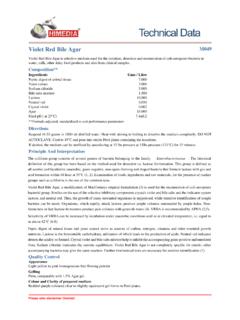
1 Please refer disclaimer Cereus agar BaseIntended useM833 Bacillus Cereus agar base with added supplements is used as a selective medium for the isolation and enumeration of Bacillus Cereus from food **IngredientsGms / thymol pH ( at 25 C) **Formula adjusted, standardized to suit performance parametersDirectionsSuspend grams in 475 ml distilled water. Heat to boiling to dissolve the medium completely. Sterilize by autoclaving at 15 lbs pressure (121 C) for 15 minutes. Cool to 45-50 C and aseptically add rehydrated contents of 1 vial of Polymyxin B Selective Supplement (FD003) and 25 ml of sterile Egg Yolk Emulsion (FD045). Mix well and pour into sterile Petri And InterpretationBacillus Cereus causes food poisoning due to the consumption of contaminated rice (4, 6), eye infections (5) and a wide range of other clinical conditions like abscess formation, meningitis, septicemia and wound infection.
2 Bacillus Cereus is a known cause of disease mastitis, especially in ewes and heifers among the veterinarians (7). Holbrook and Anderson (1) developed Bacillus Cereus agar , which is a highly specific and selective medium for the isolation and enumeration of Bacillus Cereus from foods. It supports the growth of even a small number of Bacillus Cereus cells and spores in the presence of large number of other food contaminants. The typical colonies of Bacillus Cereus are crenate, about 5 mm in diameter and have a distinctive turquoise to peacock blue colour surrounded by a good egg yolk precipitate of the same colour. The bacteria do not ferment mannitol and thus there is no change in colour of the indicator dye around the of polymyxin-B sulphate (2, 3) at a final concentration of 100 units per ml of medium is sufficient to make the medium selective for the isolation of Bacillus Cereus .
3 It suppresses the growth of accompanying bacterial flora. If moulds are suspected in the inoculum, 40 mcg per ml filter-sterilized cycloheximide may be incorporated to suppress the mould contamination. Some strains of Bacillus Cereus have very weak egg yolk reaction. Moreover, on this medium Bacillus Cereus is indistinguishable from Bacillus provides and sodium pyruvate improve egg yolk precipitation and enhance sporulation. Bromothymol blue acts as pH indicator to detect mannitol fermentation. For the isolation and enumeration of Bacillus Cereus in foodstuffs the following method is recommended. Distribute of the homogenized specimen diluted in Peptone Water (M028) onto the surface of the medium. Incubate at 37 C under aerobic conditions for 24-48 hours.
4 Possible growth of contaminants is greatly reduced by incubation for 24 hours. Report the results as the number of Bacillus Cereus colonies per gram weight of the food sample. Confirmatory tests should be carried out before of specimen Food and dairy samples For food and dairy samples, follow appropriate techniques for sample collection and processing as per guidelines (7,8,12). After use, contaminated materials must be sterilized by autoclaving before discarding. Specimen Collection and Handling: HiMedia LaboratoriesTechnical DataGellingFirm,comparable with agar gelColour and Clarity of prepared mediumBasal medium :Green coloured clear to slightly opalescent gel. After addition of egg yolk emulsion : Yellowish greencoloured opaque gel forms in Petri platesReactionReaction of w/v aqueous solution (basal medium) at 25 C.
5 PH : ResponseCultural characteristics observed with added Polymyxin B Selective Supplement (FD003) and Egg Yolk Emulsion (FD045)after an incubation at 35-37 C for 24-48 ResponseOrganismInoculum(CFU)GrowthRecov eryColour ofcolonyEgg YolkReactionCultural ResponseBacillus Cereus ATCC 1087650-100good-luxuriant>=50%bluepositi ve,precipitationEscherichia coli ATCC25922 (00013*)>=10 inhibited0%Proteus vulgaris ATCC1331550-100good-luxuriant>=50%greenn egativeSerratia marcescens ATCC810050-100good-luxuriant>=50%yellow- lightpink(pigmentproduction isenhanced byincubation at25-30 C)negativeStaphylococcus aureus ATCC 25923 (00034*)50-100good-luxuriant>=50%yellowp ositive,clearingQuality ControlAppearanceCream to greenish yellow homogeneous free flowing powderWarning and Precautions :Read the label before opening the container.
6 Wear protective gloves/protective clothing/eye protection/ face protection. Follow good microbiological lab practices while handling specimens and culture. Standard precautions as per established guidleines should be followed while handling specimens. Saftey guidelines may be referred in individual safety data sheetsLimitations : Bacillus Cereus and Bacillus thuringiensis shows identical characteristics and hence difficult to of Bacillus Cereus is done by colony characteristics and reaction, however further biochemical characteristics should be shouls be carried out for strains of Bacillus Cereus may show poor growth due to nutritional and EvaluationPerformance of the medium is expected when used as per the direction on the label within the expiry period when stored atrecommended and Shelf LifeStore between 10-30 C in a tightly closed container and the prepared medium at 2-8 C.
7 Use before expiry date on the label. On opening, product should be properly stored dry, after tightly capping the bottle inorder to prevent lump formation due to the hygroscopic nature of the product. Improper storage of the product may lead to lump formation. Store in dry ventilated area protected from extremes of temperature and sources of ignition Seal the container tightly after use. Use before expiry date on the performance is best if used within stated expiry period. Key : *Corresponding WDCM refer disclaimer :User must ensure suitability of the product(s) in their application prior to use. Products conform solely to the information contained inthis and other related HiMedia publications. The information contained in this publication is based on our research and developmentwork and is to the best of our knowledge true and accurate.
8 HiMedia Laboratories Pvt Ltd reserves the right to make changes tospecifications and information related to the products at any time. Products are not intended for human or animal or therapeutic use butfor laboratory,diagnostic, research or further manufacturing use only, unless otherwise specified. Statements contained herein should notbe considered as a warranty of any kind, expressed or implied, and no liability is accepted for infringement of any Holbrook R. and Anderson J., 1980, Can. J. Microbiol. 26(7):753-7592. Donovan , 1958, J. Appl. Bacteriol, 21(1): Mossel , Koopman J. and Jongerius E., 1967, J. Appl. Microbiol. 15(3) Mortimer and McCann G., 1974, Lancet, Bouza E., Grant S., Jordan C. et al, 1979, Arch. Ophthalmol. 97:4986. Wohlgemuth K.
9 , Kirkbride, , Bicknell, E. J. and Ellis, , 1972 , J. Am. Vet. Med. Ass. 161 Kirnbull , J. Clin. Pathol. 32:289 ReferenceUser must ensure safe disposal by autoclaving and/or incineration of used or unusable preparations of this product. Follow established laboratory procedures in disposing of infectious materials and material that comes into contact with clinical sample must be decontaminated and disposed of in accordance with current laboratory techniques (10,11). F. P. and Ito K., (Ed.), 2001, Compendium of Methods for the Microbiological Examination of Foods, 4th Ed.,American Public Health Association, Washington, Public Health Association, Standard Methods for the Examination of Dairy Products, 1978, 14th Ed., , Clinical Microbiology Procedures Handb0ook.
10 2nd , , Pfaller , , Carroll, , Funke, G., Landry, , Richter, and Warnock., (2015)Manual of Clinical Microbiology, 11th Edition. Vol. H. M. and Frank J. H., 2004, Standard Methods for the Microbiological Examination of Dairy Products, 17th Ed.,APHA Inc., Washington, : 01/ 2017 HiMedia LaboratoriesTechnical DataHiMedia Laboratories Pvt. Ltd. : 23, Vadhani , LBS Marg, Mumbai-400086, India. Customer care No.: 022-6116 9797 Corporate office : A-516,Swastik Disha Business Park,Via Vadhani Ind. Est., LBS Marg, Mumbai-400086, India. Customer care No.: 022-6147 1919 Email: Website.