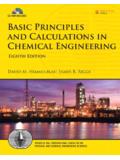
Transcription of Basic Principles and Calculations in Chemical Engineering
1 University of Tikrit Chemical Engineering Department Basic Principles and Calculations in Chemical Engineering First Year By Assist. Prof. Dr. Ahmed Daham Basic Principles First Year Asst. Prof. Dr. Ahmed Daham 2 Part 2 material Balances Chapter Page 6 Introduction to material balance 133 7 General Strategy for Solving material balance Problems 166 8 Solving material balance Problems for Single Units Without Reaction 196 9 The Chemical Reaction Equation and Stoichiometry 225 10 material Balances for Processes Involving Reaction 260 11 material balance Problems Involving Multiple Units
2 305 12 Recycle, Bypass, and Purge and the Industrial Application of material Balances 341 Chapter 6 Introduction to material balance : material balance involves Calculations the quantities of all materials that enter and leave any system or process which are based on the principle of the "law of conversation of mass". This law states that matter is neither created nor destroyed in the process and the total mass remains unchanged. The general principle of material balance Calculations is to put and solve a number of independent equations involve number of unknowns of compositions and mass flow rates of streams enter and leave the system or process.
3 The process can be defined as one or a series of operations in which physical and Chemical treatments are carried out and a desired product is result in the end such as distillation, drying, absorption, Chemical manufacture, .. etc. The system can be defined as any arbitrary portion of a process that you want to consider for analysis such as a reactor. The system boundary must be fixed in each problem by drawing an imaginary boundary around it as shown in the following figure: Basic Principles First Year Asst.
4 Prof. Dr. Ahmed Daham 3 There are two important classes of systems: 1. Closed system: The material neither enters nor leaves the vessel (system), as shown below: Figure 1: Closed system 2. Open system (flow system): The material cross the system boundary, as shown below: Figure 1: Open system (Flow system) The Chemical processes can be classified as batch, continuous and semi-batch: 1. Batch process: The feed materials are placed into the system (reactor, mixer, filter.)
5 Etc) at the beginning of the process. These materials are held for a period of time known as "residence time" or " retention period" during which the required physical and/or Chemical changes are occurred. The products are removed all at once after this time. No masses crossed the system boundary during this time. Batch process fall into the category of closed systems. The basis used in such processes is usually "one batch", and the material balance for physical batch processes in which there is no Chemical reaction can be written as: Input = Output (Initial quantity) (Final quantity) Basic Principles First Year Asst.
6 Prof. Dr. Ahmed Daham 4 This equation can be applied for every substance (component balance ) or for total materials (total material balance ). 2. Semi-batch process: A semi-batch reactor of stirred type tank as shown in the Figure 4, often used for its own particular characteristics. In this type, all quantity of one reactant is initially put in the reactor, and then other reactants are continuously fed. Only flows enter the systems, and no leave, hence the system is an unsteady state.
7 This arrangement is useful when the heat of reaction is large. The heat evolved can be controlled by regulating the rate of addition of one of the reactants. Figure 2: The initial state of a batch mixing process Figure 3: The final state of a batch mixing process Figure 4: Semi-batch reactor (Stirred type reactor) Basic Principles First Year Asst. Prof. Dr. Ahmed Daham 5 3. Continuous process (Flow process): The input and output materials are continuously transferred across the system boundary; the feed continuously enters the system and the product continuously leaves the system.
8 The physical and/or Chemical changes take place during the flow of materials through the effective parts of equipments (packing, sieve plate, filter cloth,..etc). A convenient period of time such as minute, hour, or day must chosen as a basis over which material balance Calculations be made. This type of processes can be classified as "steady state" and "unsteady state" processes. a- Steady state process: The steady state process can be defined as that process in which all the operating conditions (temperature, pressures, compositions, flow rate.)
9 Etc.) remains constant with time. In such process there is no accumulation in the system, and the equation of material balance can be written as: Figure 5: Steady state system b- Unsteady state process: For an unsteady state process, not all of the operating conditions in the process ( , temperature, pressure, compositions, flow rate,.. etc.) remain constant with time, and/or the flows in and out of the system can vary with time, hence the accumulation of materials within can be written as follows: Input = Output Input - Output = Accumulation Basic Principles First Year Asst.
10 Prof. Dr. Ahmed Daham 6 Remarks: 1. By their nature, batch and semi-batch processes are unsteady state operations since the concentration within the closed system is continuously changed with time. 2. Continuous processes are usually runs as close as possible to the steady state by using suitable control units. However, unsteady state (transient) conditions exist during the start up of a process. All material balance and design Calculations are done for steady state conditions.